

US Dollar Outlook: weakness driven by positioning, but the macro story isn’t broken
The US dollar faces downside pressure as positioning shifts post-FOMC meeting, but the structural drivers remain unchanged.
The recent slide in the US dollar has raised questions about whether a deeper, more structural downturn is re-emerging. Yet the bulk of the currency’s weakness appears rooted not in deteriorating fundamentals, but in shifts in market positioning and a dovish reading of the latest Federal Reserve meeting. In the near term, the dollar may continue to soften, but its trajectory in the coming weeks will depend squarely on whether investors stay confident that the Fed still has ample room to ease.
A pullback fuelled by expectations, not fundamentals
Markets have traded the post-meeting narrative as if the Fed had opened the door to a more aggressive easing cycle. But this interpretation arguably stretches beyond what policymakers actually communicated. US economic performance remains comparatively resilient, and the macro backdrop has not meaningfully deteriorated.
As long as investors believe the Fed can continue cutting without risking inflation stability, dollar softness can extend. However, if inflation proves stickier, particularly through core services or via tariff-related price pressures, the Fed will quickly become more cautious. In that scenario, rate-cut expectations would retrace, US yields would rebound, and the dollar would likely strengthen.
In other words: the dollar’s latest weakness is fragile and highly contingent on the market maintaining a “soft-landing” mindset.
Powell’s ‘near neutral’ remark: a pause, not an end
Chair Jerome Powell’s comment that rates are now “very near neutral” has been widely interpreted as a signal that the cutting cycle is nearly done. But the message is more nuanced. Rather than declaring the end of policy easing, Powell indicated that the Fed sees less urgency for rapid additional cuts unless growth weakens materially.
Further rate reductions are still likely in 2026, though the path may be slower and shallower than markets had assumed. This recalibration in expectations could give the dollar room to recover from its recent slump. Still, a definitive bottom has not been confirmed. The currency’s medium-term outlook will hinge on:
- Relative US economic performance (so far still stronger than many peers)
- Yield differentials, as other central banks approach the end of their own easing cycles—or consider tightening
A Dollar in holding pattern
For the moment, the Fed’s message is best read as a “pause” rather than a clear directional signal. This leaves the dollar in a range-bound phase: neither convincingly bullish nor decisively bearish.
What could break this holding pattern? Bullish catalysts for the dollar would be upside surprises in core PCE or services inflation, sticky wage growth, a tariff-driven price shock, or a growth wobble in Europe or China, which would push risk-off sentiment towards the dollar. Meanwhile, bearish catalysts could be further evidence of U.S. labour-market softening, disinflation continuing at a rapid pace, the Fed signalling a deeper rate-cut path for 2026, or stronger macroeconomic performance abroad.
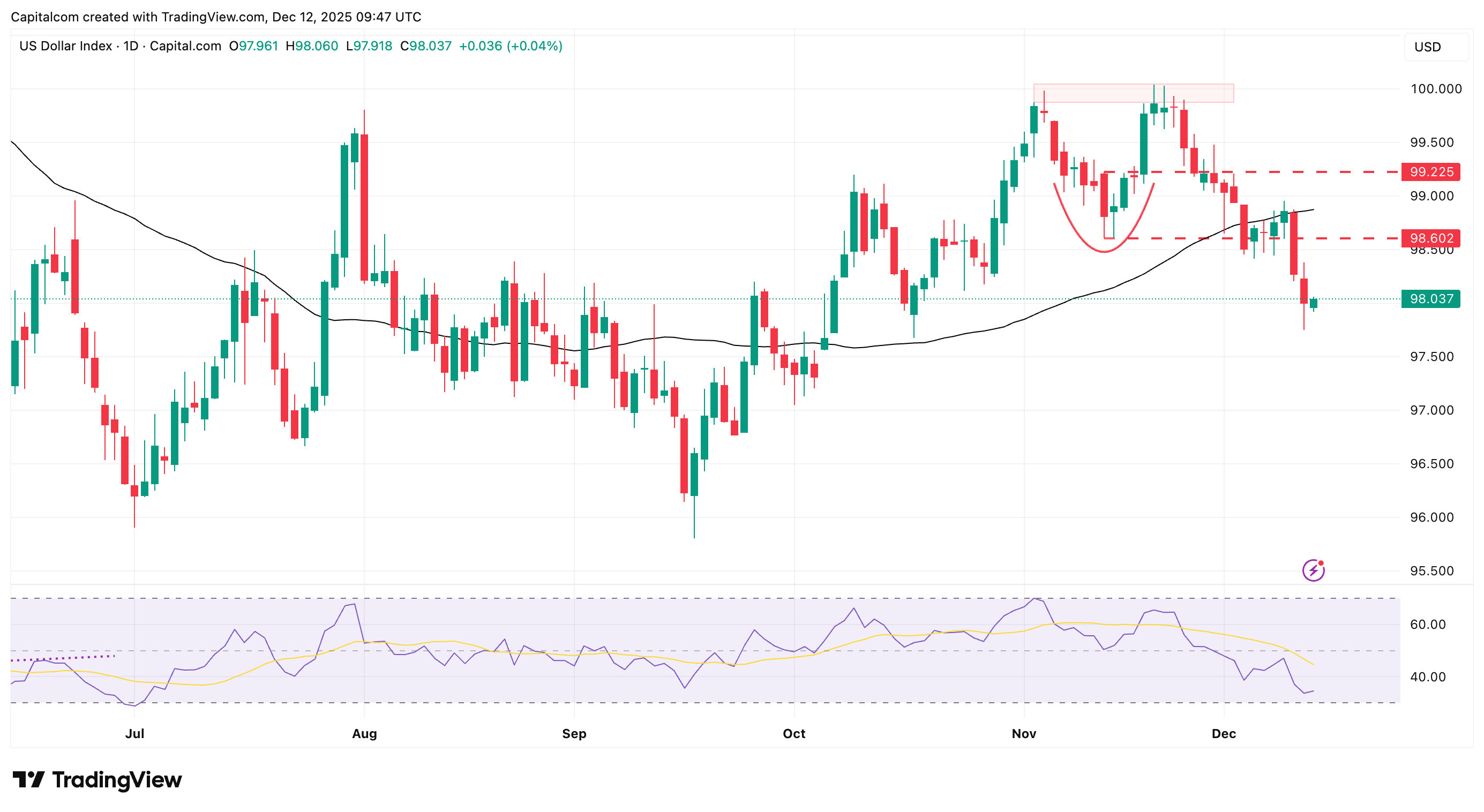
US dollar index (DXY) daily chart
Past performance is not a reliable indicator of future results.
Where the FX opportunities lie: EUR and JPY in focus
Two currencies stand out in the current environment:
Euro (EUR)
The euro benefits when US yields fall, though its upside is somewhat constrained by still weak eurozone growth. However, if the ECB becomes less dovish than the Fed heading into early 2026, EUR/USD could drift higher as rate differentials narrow.
Japanese Yen (JPY)
With the Bank of Japan slowly moving toward possible tightening and the Fed leaning towards more easing, USD/JPY has more room to fall. Any drop in US yields or a risk-off turn in global markets could strengthen the yen further.