

ECB Meeting Preview: markets look beyond the decision to policy signals
The European Central Bank is expected to keep rates unchanged this week as focus centres on Lagarde's press conference
Markets head into the European Central Bank meeting with a high degree of confidence that policymakers will hold interest rates unchanged, as the ECB continues to assess the impact of easing delivered last year. With policy now firmly in restrictive territory, the focus has shifted away from the decision itself and toward forward guidance, economic projections, and President Lagarde’s tone.
Inflation across the euro area has continued to cool, but progress remains uneven. While headline inflation has eased, services inflation and wage growth remain sticky, keeping the ECB cautious about committing to further easing. As a result, markets are not expecting any strong signals on near-term rate cuts but will listen closely for hints about how comfortable the Governing Council is with the disinflation trend.
What markets will be watching
The language around inflation risks will be critical. Any acknowledgment that price pressures are easing more sustainably could strengthen expectations for further cuts later in the year. Conversely, emphasis on persistent domestic inflation or tight labour markets may temper those expectations and reinforce the ECB’s data-dependent stance.
President Lagarde’s press conference will likely be the main event. Investors will parse her comments for clues on timing rather than pace, with the ECB keen to avoid pre-committing while still acknowledging improving conditions.
With growth fragile and inflation still a concern, the ECB finds itself walking a tightrope. This meeting is unlikely to deliver fireworks, but the messaging will matter.
Market impact and the euro
For the euro, the meeting presents a delicate balance. A more confident tone on disinflation could weigh on the single currency as rate-cut expectations are pulled forward. In contrast, a cautious or hawkish tilt, particularly if Lagarde stresses the need for prolonged restriction, could provide near-term support for EUR crosses.
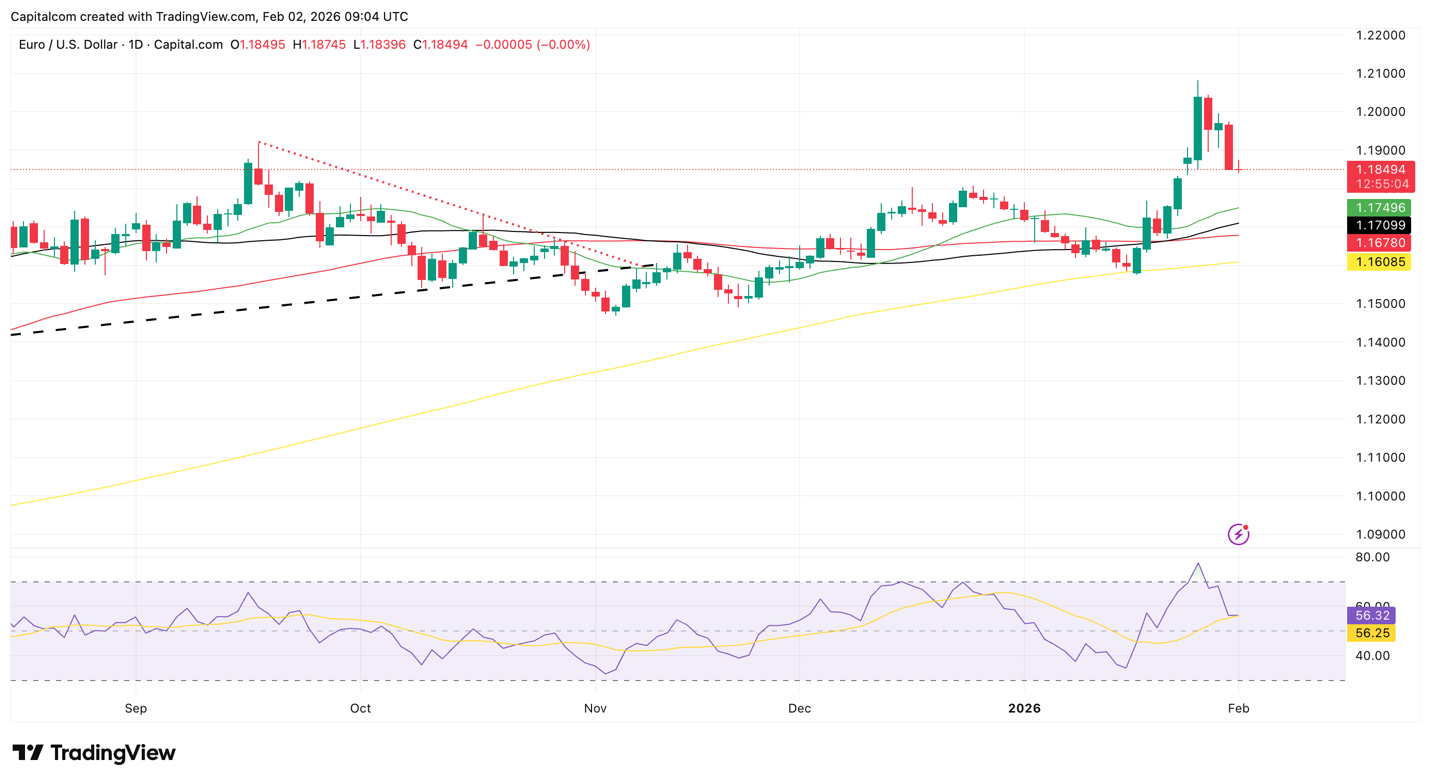
After a strong run at the start of the year which saw four-and-a-half-year highs – mostly on the back of the weaker dollar – EUR/USD has dipped back below 1.19 as the dollar recovers some bullish momentum. There may be increased focus on Lagarde’s language regarding the euro at this meeting, after the euro’s strength began to attract quiet concerns amongst policymakers.
While the ECB does not target exchange rates, officials have previously acknowledged that a strong euro can complicate the inflation outlook by tightening financial conditions and dampening imported price pressures. If Lagarde highlights the exchange rate as a factor in the policy assessment it could be interpreted as a subtle dovish signal, reinforcing expectations that further easing may be needed later in the year. That said, the ECB is likely to tread carefully. Explicit concern about euro strength risks being seen as verbal intervention, something policymakers typically avoid. As a result, any reference is likely to be measured and conditional, framed within the broader context of financial conditions rather than direct currency targeting.
For EUR/USD further pushback against euro strength could act as cap in the near future, possibly limiting another re-test above 1.20. On the flipside, the absence of any reference to the exchange rate may be interpreted as tacit acceptance, allowing the euro to remain supported.
EUR/USD daily chart
Past performance is not a reliable indicator of future results.
Bond markets are likely to react more sharply than equities, with European yields sensitive to any shift in guidance around the policy path into 2026. A dovish surprise could steepen curves, while a reaffirmation of caution may keep yields elevated.