

Are oil markets underestimating escalation risks between Iran and the US?
Oil markets have remained slightly subdued in recent weeks despite the rising tensions between the US and Iran.
Oil markets are once again being asked to price geopolitical risk in an environment where escalation feels possible, but not yet inevitable. Tensions between Iran and the United States have intensified against a backdrop of domestic unrest inside Iran, renewed military signalling in the Gulf, and increasingly confrontational rhetoric from both sides. While headlines have been crowded out by broader global political noise, the implications for energy markets remain significant.
Geopolitical pressure rises beneath the surface
Iran is facing what may be the most serious internal unrest of its modern history, while the US has stepped up its military presence in the region following last year’s strikes on Iranian nuclear facilities. With American naval assets gathering in the Gulf and Iranian officials warning that any further action could trigger a regional war, the situation has moved firmly into a phase of brinkmanship. From a market perspective, the concern is not political instability per se, but the risk of disruption to oil supply, either directly through Iranian production or indirectly via regional spillovers.
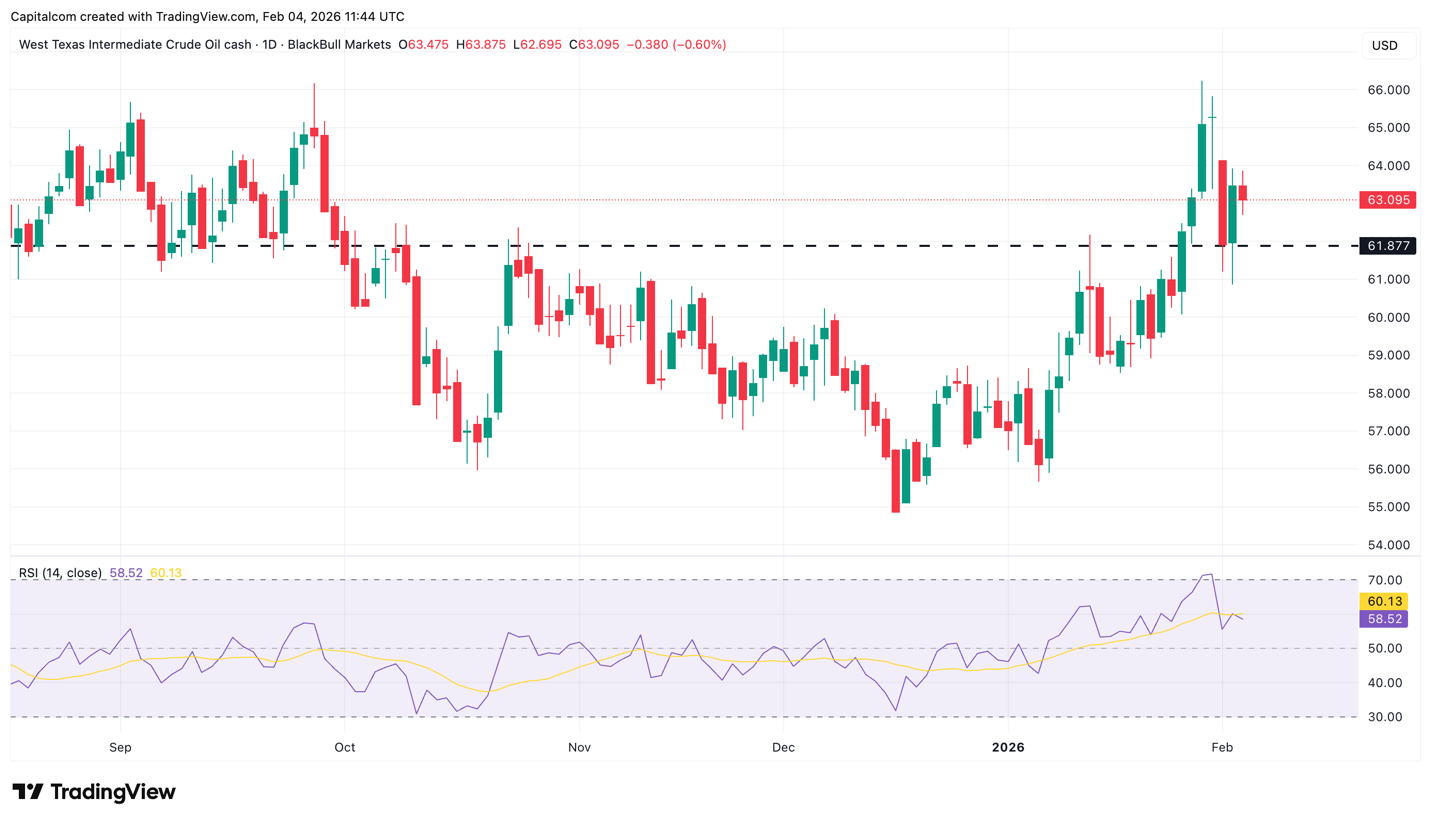
US crude daily chart
Past performance is not a reliable indicator of future results.
Despite this backdrop, oil’s price response has so far remained relatively contained. Crude prices rose sharply earlier in the year as tensions escalated, only to retrace part of those gains amid renewed diplomatic headlines and a broader cooling in risk sentiment. This pattern suggests that markets are acknowledging the risk but not yet pricing a worst-case scenario. That contrasts sharply with historical episodes where supply disruptions were imminent or unavoidable.
Why the market’s calm may be misleading
The key vulnerability lies in the Strait of Hormuz. Any sustained conflict involving Iran would raise the risk of disruption to one of the world’s most critical energy chokepoints, through which roughly a fifth of global oil consumption flows. Unlike previous episodes of tension, the current environment carries additional complexity: advanced military capabilities, the risk of internal fragmentation within Iran, and the potential for miscalculation amid heightened political pressure. Even temporary disruptions could have outsized effects on prices, given already tight spare capacity and fragile global supply chains.
A useful historical comparison is the oil market’s reaction to Iraq’s invasion of Kuwait in 1990. At that time, prices surged rapidly as supply was physically removed from the market. Today, the geopolitical risk arguably carries similar, or even greater, potential impact, yet price action remains far more subdued. That disconnect highlights the extent to which markets are betting on containment rather than confrontation. Part of the reason is the fact that both Iran and the US have confirmed that talks are in place and progressing, diffusing the media hype that they are on the brink of war.
Meanwhile, energy equities have responded more decisively than crude itself, echoing patterns seen during previous supply shocks such as Russia’s invasion of Ukraine. The outperformance of energy stocks suggests that equity investors may be more sensitive to tail risks than the oil futures market, positioning for higher prices even as spot crude remains range bound.
Political pressure caps the upside—for now
Another factor tempering oil’s reaction is political pressure from Washington, particularly President Trump’s long-standing preference for lower energy prices. Trump has repeatedly framed cheap oil as critical to controlling inflation, supporting consumers and sustaining economic momentum, making it unlikely that the administration would welcome a sustained spike in crude prices. This creates a delicate dynamic: while geopolitical risk in the Middle East argues for a higher risk premium, markets are simultaneously factoring in the possibility of diplomatic restraint, strategic signalling, or even policy intervention aimed at keeping prices in check. As a result, traders appear reluctant to price an aggressive upside scenario unless supply disruption becomes unavoidable rather than hypothetical.
Asymmetric risks leave oil vulnerable to sudden repricing
The central question for markets is whether current tensions remain a war of words and positioning, or whether they tip into action that materially threatens supply. It is arguable that the scale and speed of the US military buildup increase the risk of escalation, even if neither side is actively seeking full-scale conflict. For oil markets, this creates an asymmetric risk profile: limited downside from de-escalation, but significant upside if supply fears intensify.
For now, crude prices reflect a market that is wary but not convinced. That may change quickly if rhetoric hardens further, shipping routes are threatened, or diplomatic channels narrow. In that sense, oil is not pricing calmness, it is pricing hope. And history suggests that when geopolitical risks are underestimated, the adjustment can be abrupt.