

Spread betting explained: a guide for traders

If you’ve ever wondered what is spread betting in practical terms, it simply means trading on price movements without owning the underlying asset.
Spread betting may offer specific tax advantages for UK residents, although tax treatment depends on individual circumstances and can change. Spread betting also carries significant risk and isn’t suitable for everyone.
Key takeaways
- Spread betting lets you speculate on price movements in markets such as indices, forex, commodities and shares without buying or selling the underlying asset directly.
- Profits and losses are calculated in £ per point of movement using a simple formula: P&L = (exit price − entry price) × £/point stake (excluding costs).
- You trade on margin, meaning you only need to deposit a fraction of a position’s full value, but leverage magnifies both profits and losses.
- Retail clients benefit from negative balance protection, although it’s still possible to lose all the funds in your account.
- Risk-management tools such as stop-losses, guaranteed stop-loss orders (GSLOs), take-profit orders and price alerts can help you monitor and control exposure.
What is spread betting?
Spread betting is a form of derivative trading. Instead of buying or selling the underlying instrument, you speculate on whether its price will rise or fall. You choose a stake in £ per point, and your profit or loss depends on how far the market moves between the price at which you open and close your position.
A concise way to express this is:
For example, if you buy the UK 100 at 7,500 with a £10/point stake and later close at 7,530, the movement is 30 points. Before costs, your P&L is:
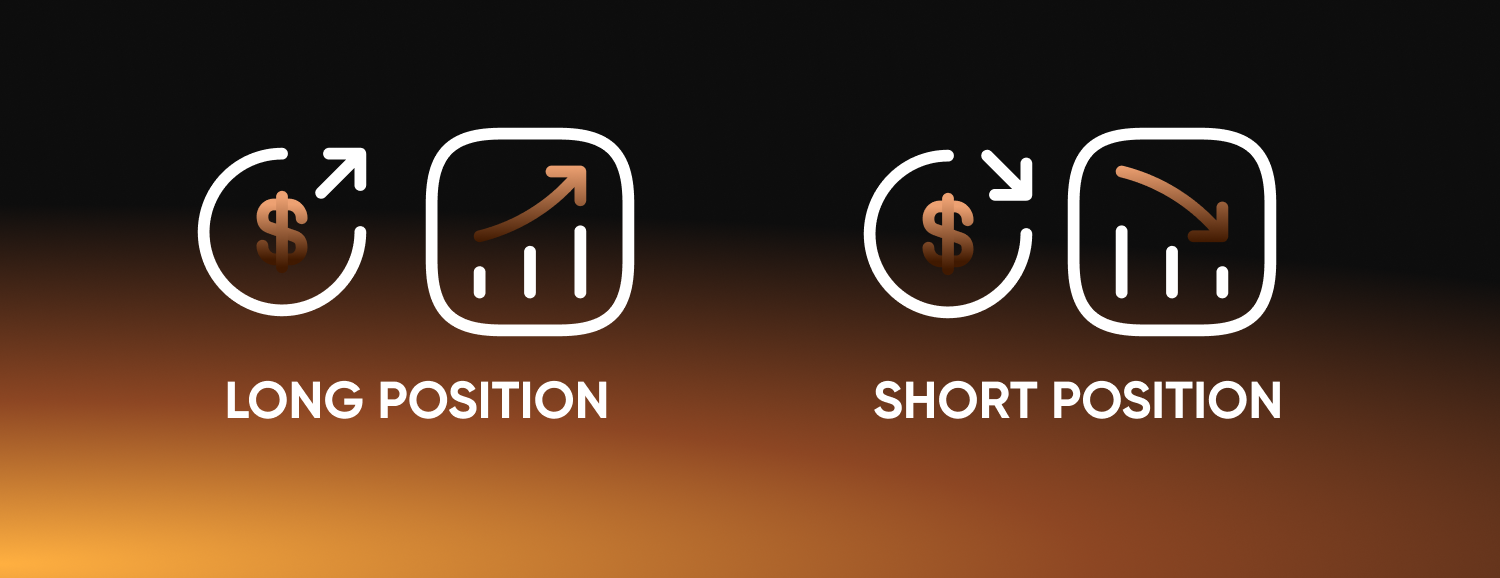
You can go long (buy) if you expect prices to rise or go short (sell) if you think they may fall, allowing you to trade in both rising and falling markets.
How does spread betting work?
Spread betting can be broken into three core components: the spread, the stake and the bet duration.
- The spread: Every market has two quoted prices: a buy (offer) price and a sell (bid) price. The spread is the difference between them and represents the main cost of trading. You pay part of this spread when you open a trade and the remainder when you close it.
- The stake: Your stake is the amount you choose to risk per point of movement.
Bet duration (DFB vs Forward markets):
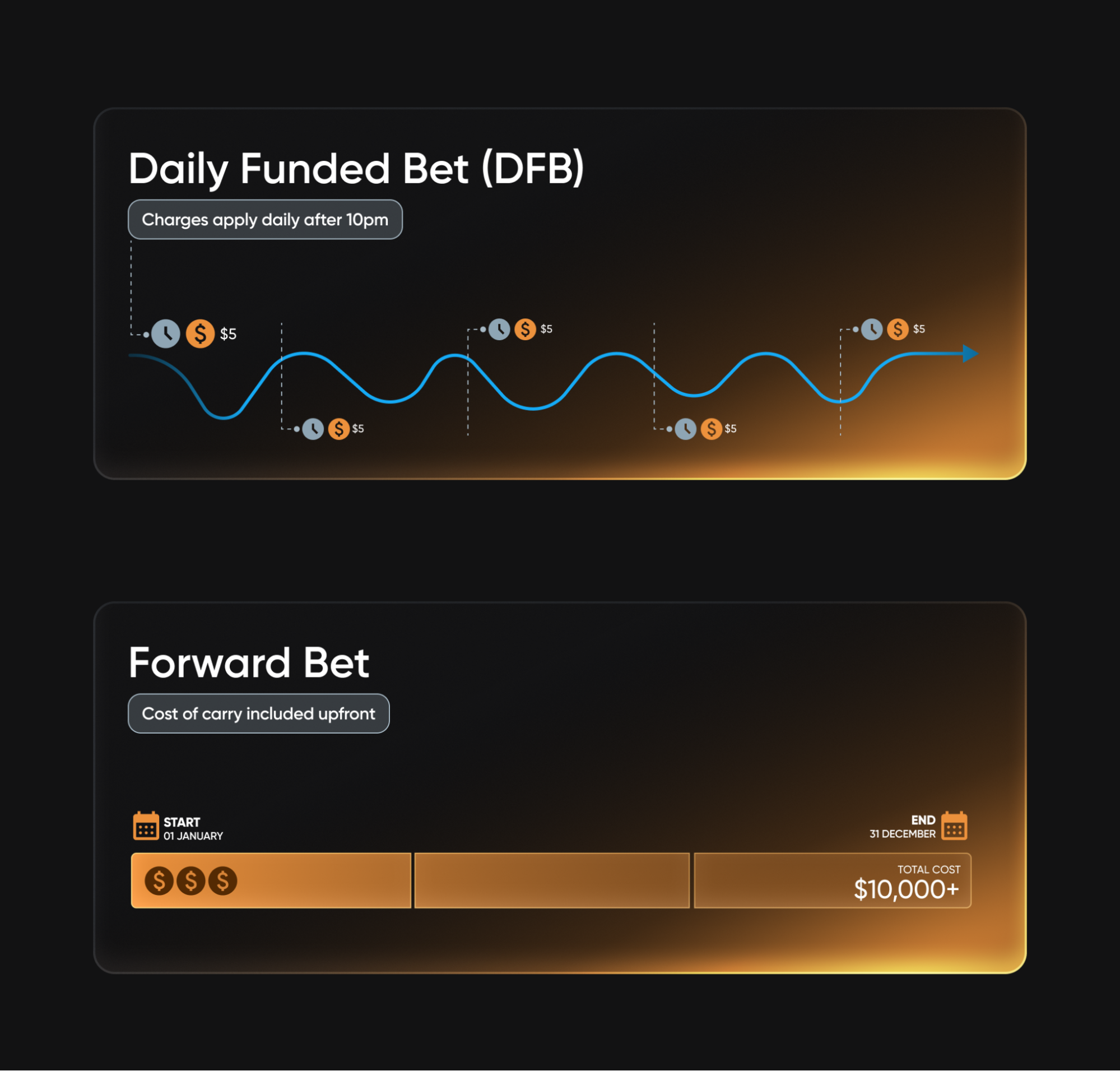
- Daily funded bets (DFBs), sometimes called 'cash' markets. These have no fixed expiry and remain open until you close them (or they’re closed automatically). If you hold a DFB overnight, an overnight funding adjustment is applied.
- Forward bets, which have a fixed quarterly expiry date. The cost of funding is built into a wider spread, so there are no daily overnight charges, although the spread is usually larger than on an equivalent DFB.
Key features of spread betting
Leverage and margin
In CFD trading and spread betting, margin is the amount you need to deposit to open and maintain a position; it’s only a fraction of your total exposure, but profits and losses are based on the full value.
- Initial margin is the amount required to open a position.
- Maintenance margin is the minimum equity required to keep that position open.
- Major indices: around 5% margin (20:1 leverage equivalent)
- Major forex pairs: around 3.33% margin (30:1 leverage equivalent)
- Individual shares: around 20% margin (5:1 leverage equivalent)
If your equity falls towards the maintenance requirement, you may receive a margin call.
At Capital.com, notifications are usually sent when your equity-to-margin ratio reaches around 100% (initial warning) and 75% (follow-up). If it falls to around 50% or below, an automatic close-out process may begin, starting with the most losing positions.
Stake (bet size)
Spread bets use a £/point model. Each 'point' corresponds to one unit of price movement in that market, such as one index point, one pip in forex or a penny in a share price, depending on how the market is quoted.
- You buy the UK 100 at 7,500 with a £10/point stake.
- Your total exposure is £75,000 (7,500 × £10).
If the index rises 30 points and you close at 7,530, your gross profit is £300 (30 × £10), before costs.
The spread
The spread is the embedded cost of trading, and its size can vary throughout the day.
Spreads may be tighter in highly liquid, active markets and wider in less liquid or more volatile conditions.
They may also widen during major economic releases or outside core trading hours.
Spread bet duration: DFB vs forward bets
- DFBs (cash markets) have no fixed expiry – positions can be held as long as margin requirements are met. Overnight funding is applied daily for positions held past the cut-off time (typically 10pm UK time).
- Forward bets have a fixed quarterly expiry date. The cost of carry is built into the spread, so there are no daily overnight funding charges, although spreads are wider.
Long and short trading
Like with CFDs, spread betting lets you:
- Go long (buy) if you expect the market to rise.
- Go short (sell) if you expect the market to fall.
This flexibility means spread betting can be used for directional trading or for hedging existing exposure in other portfolios.
Dividend adjustments
When you hold spread bets on individual shares or certain equity indices through dividend dates, a cash adjustment may apply:
- Long positions are typically credited a proportion of the gross dividend (for example, 80–90% after withholding tax).
- Short positions are typically debited up to 100% of the gross dividend.
These adjustments help ensure scheduled dividend events don’t create an advantage or disadvantage compared with holding the underlying asset.
Costs involved in spread betting
There are several costs to consider when placing spread bets. These depend on the type of market you trade, how long you hold a position and whether you use optional risk-management tools.
The spread
The spread is usually the primary cost and is built into the difference between the buy and sell price of each market. Most spread betting trades at Capital.com don’t involve a separate dealing commission, as the cost is included within the spread.
Spreads can vary depending on liquidity, volatility and the time of day.
Overnight funding
For DFB (cash) markets, positions held overnight incur a funding adjustment. This is typically based on an industry reference rate plus or minus an administrative fee and may differ for long and short positions.
For example, on an index DFB you might see an effective daily funding rate of around 0.01096% of exposure, with:
- Long positions paying an additional spread over the reference rate.
- Short positions potentially receiving the reference rate minus a fee.
Exact funding rates vary by instrument and market conditions, and the platform displays these details for each market.
Guaranteed stop-loss order (GSLO) fees
A GSLO guarantees your exit price even if the market gaps through your stop level. Because of this added protection, a GSLO usually carries a fee (charged if the GSLO is triggered), which is often calculated as:
What affects the spread?
Several factors can influence how tight or wide a spread is:
- Market liquidity – more trading activity often leads to tighter spreads.
- Volatility – higher volatility can widen spreads as prices move quickly.
- Time of trading – out-of-hours trading may have wider spreads than during core market hours.
- Economic announcements – key data releases or central bank decisions can cause temporary spread widening.
- Instrument type – major forex pairs and liquid equity indices tend to have tighter spreads than less actively traded shares or niche markets.
Before placing a trade, it’s good practice to review the live spread and overnight funding details shown on the platform, as these may change throughout the day.
Spread betting examples
Example 1: UK 100 index (long position)
- You buy the UK 100 at 7,500 with a £10/point stake.
- Your total exposure is £75,000 (7,500 × £10).
- With a 5% margin factor, the initial margin required is £3,750.
If the UK 100 moves to 7,530 and you close the position:
- Movement: 30 points
- Gross P&L: (7,530 − 7,500) × £10 = +£300
Your net result will be £300 minus the cost of the spread and any funding or GSLO fees.
If the UK 100 moves to 7,470 and you close the position:
- Movement: −30 points
- Gross P&L: (7,470 − 7,500) × £10 = −£300 (excluding costs)
Example 2: GBP/USD (short position)
- You sell GBP/USD at 1.2500, which may be quoted as 12,500 on the platform.
- With a £10/point stake, your total exposure is £125,000 (12,500 × £10).
- With a 3.33% margin factor for major forex pairs, the required margin is £4,162.50.
If GBP/USD moves from 12,500 to 12,550:
- Movement: 50 points
- Gross P&L: (12,550 − 12,500) × £10 = −£500
If GBP/USD moves from 12,500 to 12,450:
- Movement: −50 points
- Gross P&L: (12,450 − 12,500) × £10 = +£500
P&L formula (recap)
This applies whether you’re long or short; the sign of the movement reflects whether the market has moved for or against your position.
Risk management
Spread betting is a leveraged product, so effective risk management is central to how many traders use it. Because profits and losses are calculated on total exposure rather than the margin paid, price movements can have a significant impact on your account. A range of tools can help you monitor and control this risk.
Key tools
Stop-loss orders
These automatically close your position if the market reaches a chosen price level. They can help limit potential losses, although standard stop-loss orders aren’t guaranteed, and may be filled at a worse price than requested if the market moves quickly (slippage).
Guaranteed stop-loss orders (GSLOs)
GSLOs guarantee your exit level even if the market gaps beyond it. Because they remove the risk of slippage, they involve a fee that’s usually charged only if the GSLO is triggered.
Take-profit orders
Take-profit orders close your position automatically when the market reaches your selected profit level. They can help lock in gains without requiring you to monitor the market continuously.
Price alerts
Price alerts notify you when a market hits a level you’ve chosen. They don’t close positions, but they can prompt you to review conditions and decide whether to open, adjust or close trades.
Key risk considerations
- Leverage risk: Profits and losses are based on your full exposure, not the amount you deposit. For example, with 5% margin, a 10% move against the full position value would result in a loss twice the size of your initial margin.
- Volatility and slippage: Rapid or unexpected price movements may cause slippage, where orders execute at a different level to the one requested. This is more common during news events, in out-of-hours trading or in less liquid markets.
- Overnight funding: Keeping leveraged positions open overnight may generate funding costs. These costs can accumulate over time and may reduce returns on longer-term trades.
- Margin calls: If your account equity falls below the maintenance margin, some or all positions may be closed automatically to prevent the account from entering a significant deficit.
Spread betting vs CFDs
Spread betting and contracts for difference (CFDs) are both leveraged derivatives, but they differ in how positions are structured, how funding is applied and how they may be treated for tax purposes in the UK. Many traders use them for similar objectives, such as short-term speculation or hedging, but each product has its own characteristics.
| Category | Spread betting | CFDs |
|---|---|---|
| Structure | Positions are sized using a £/point stake, with profit or loss based on how many points the market moves. | Positions are sized in contracts, each with a defined contract value. |
| Expiry | DFB (cash) markets have no fixed expiry; Forward bets have quarterly expiries. | Most CFDs don’t have a fixed expiry unless trading specific futures-style contracts. |
| Tax (UK) | Profits are usually exempt from capital gains tax and stamp duty in the UK. | Profits may be subject to capital gains tax, though realised losses can sometimes offset other gains.Tax treatment depends on individual circumstances and can change, or may differ outside the UK. |
| Dividends | Dividend adjustments are credited to long positions and debited from short positions where applicable. | Similar dividend credits and debits apply on relevant share and index CFDs. |
| Currency | Often denominated in GBP, which may suit UK-based traders. | Available in a range of base currencies, depending on account setup. |
| Commission | Trading costs are generally included in the spread, with no separate dealing commission for most markets. | Some markets, especially share CFDs, may involve separate dealing commissions in addition to the spread. |
| Typical use cases | Often used for short- to medium-term speculation in GBP. | Commonly used for hedging, institutional strategies or accessing a wider choice of base currencies and instruments. |
When it comes to spread betting, UK traders may benefit from favourable tax treatment, but tax rules depend on your individual circumstances and jurisdiction.
For a more detailed comparison, you can refer to Capital.com’s education materials on the differences between CFDs vs spread betting.
Spread betting benefits with Capital.com
Capital.com offers spread betting on a wide range of global markets through intuitive web and mobile platforms. The platform has received a number of industry awards in recent years, reflecting ongoing development of its tools, features and user experience.
Recent awards include:
- Spread Betting Provider of the Year – IC Celebration of Investment Awards 2024 (5-star rating)
- App of the Year – IC Celebration of Investment Awards 2024
- CFD Provider of the Year – IC Celebration of Investment Awards 2024
- Best Trading Platform – Good Money Guide Awards UAE 2025
Key aspects of Capital.com’s spread betting service
- Access to thousands of spread betting markets, including indices, forex, commodities, and shares.
- Integration with TradingView.
- No capital gains tax or stamp duty on spread betting profits in the UK, although tax treatment depends on individual circumstances and may change.
- Fast withdrawals, with around 98% of requests typically processed within one business day based on recent internal data.
- 24/7 customer support with multilingual availability.
- Risk-management features, including GSLOs, take-profit orders and hedging mode, which allows you to hold long and short positions on the same instrument in separate directions.
- Fully featured web platform and mobile apps, offering real-time data, advanced charting and customisable price alerts.
- Extensive educational content, including videos, webinars and trading guides to help you understand markets and trading products in more depth.
FAQ
What are DFB and Forward markets?
Daily funded bets (DFBs) are spread bets with no fixed expiry. They remain open until you close them, or until they’re closed automatically because of margin requirements or corporate action events. If you hold a DFB beyond the platform’s daily cut-off time (commonly 10pm UK time), an overnight funding adjustment is applied.
Forward markets are spread bets with fixed quarterly expiry dates. The funding cost is included within a wider spread at the outset, so there are no daily overnight funding adjustments. Because of this structure, Forward bets are often used for longer-term directional views, while DFBs are more commonly used for shorter-term trading.
How is margin calculated and what is a margin call?
Margin for a spread bet is usually calculated by multiplying the margin factor by your total exposure, so if your exposure on the UK 100 is £75,000 and the margin factor is 5%, you’d need £3,750 to open the position. A margin call occurs when your account equity moves towards, or falls below, the maintenance margin required to keep positions open. You may receive notifications at predefined thresholds, such as 100% and 75%, signalling that you may need to add funds or reduce your exposure. If equity falls further, for example to 50% or below, some or all positions may be closed automatically to limit the likelihood of a large negative balance.
Can I lose more than my deposit?
For retail clients, spread betting accounts come with negative balance protection under FCA rules. This means losses are limited to the funds available in your account, and you shouldn’t owe additional money as a result of trading losses.
For professional clients, negative balance protection doesn’t apply. Professionals can lose more than their initial deposit and may need to add funds to cover any negative balance.
Are spread bets tax-free in the UK?*
In the UK, profits from spread betting are usually exempt from capital gains tax and stamp duty because you’re not buying the underlying asset. However, if spread betting forms your main source of income, or if your trading activity resembles organised business activity, profits could be treated differently and taxed accordingly. Tax rules vary between jurisdictions, and individual circumstances can affect your tax position, so the treatment of spread betting profits may differ outside the UK and is subject to change.
How do dividends affect spread bets?
When an individual share, or a company within an index, goes ex-dividend, the underlying market price typically adjusts by approximately the dividend amount. Spread betting accounts reflect this by making a cash adjustment: long positions are usually credited a proportion of the gross dividend after withholding tax, while short positions are typically debited up to the full gross amount. These adjustments are intended to keep the economic impact of holding a spread bet broadly in line with the effect a dividend would have on someone holding the underlying shares.
Can I hedge with spread bets?
Spread betting can be used for hedging because it allows you to open long or short positions without owning the underlying asset. For example, if you hold a physical share portfolio worth £10,000 and are concerned about a short-term market decline, you might choose to open a short spread bet on a related index to offset some of the potential downside. The effectiveness of a hedge depends on factors such as size, structure and market correlation, so there’s no guarantee it will fully offset movements in your underlying holdings.
What are stop-loss and guaranteed stop-loss orders?
A stop-loss order closes your position at the best available price once the market reaches a preset level. It’s designed to limit losses, but in fast or illiquid markets the actual fill price may differ from the requested level because of slippage.
A guaranteed stop-loss order (GSLO) also closes your position when a chosen price is reached, but guarantees the exit level even if the market gaps through it. This removes slippage risk but involves a premium fee, which is usually charged only if the GSLO is triggered.
What moves the spread?
Spreads change throughout the trading day and are influenced by several factors working together. High market liquidity typically results in tighter spreads, while periods of elevated volatility can cause spreads to widen as market makers manage rapid price movements. Trading hours also play a role: spreads are often tighter during core market sessions and wider during overnight periods or weekends (where trading is available). Major economic or political announcements can lead to temporary spread adjustments, and different instruments naturally have different spread profiles, with widely traded forex pairs and benchmark indices generally offering tighter pricing than smaller or less liquid markets.
How do I calculate the total cost of a spread bet – including spread, financing and any platform fees – before I place the trade?
To understand the potential cost of a spread bet, where available, review the headline spread, stake per point, margin requirement, bet duration, overnight financing for daily funded bets, platform or payment costs where applicable, and any guaranteed stop-loss premium where available. Spread betting brokers can earn revenue through spreads and financing. Because spread betting is leveraged, profit and loss are based on total exposure, not only the margin deposit.
Which order types are typically available with spread betting brokers – stop-loss, guaranteed stop and limit – and what are the trade-offs?
Spread betting platforms may offer order types such as market orders, limit orders, stop-losses, guaranteed stops where available and take-profits. A standard stop-loss may not execute at the exact level during gaps or fast markets, while a guaranteed stop may involve a premium if triggered. You can’t always prevent gaps, slippage or fast-market movement, but reviewing the order type, trigger level, spread, market hours and platform notifications can make the outcome easier to understand. If you trade mostly from a phone, key mobile features you may wish to review include charting, alerts, order history, the order ticket and review checks before submission.
Can you explain how margin works in spread betting and what triggers a margin call?
Where spread betting is available, margin is the deposit needed to support the leveraged exposure created by the stake per point. A margin call or closeout risk can arise if the market moves against the position, account equity falls, margin requirements change or several leveraged bets use too much available margin.

