


World stock market trading hours are important to understand for indices and shares CFD traders. The opening hours of individual exchanges are your window to execute trades, respond to market changes, and manage your portfolio throughout the day. As a result, strong planning and decision-making depend on an awareness of world stock market trading hours.
Some exchanges pause trading for a lunch break, which enables system maintenance, administrative tasks, and may support operational processes and market functioning. This break allows traders to reflect on positions and prepare for the second half of the trading day. However, other exchanges operate continuously without a break, meaning it’s important to stay aware of potential market shifts throughout the entire session.
All times shown in this article are in the UTC time zone.
Why do stock exchanges have different trading hours?
Stock exchange opening times reflect the geographic location and working culture of the region in which they operate. By concentrating trading into defined hours, exchanges aim to ensure that buyers and sellers are present in sufficient volume for efficient price discovery and order execution.
A key consequence of this geographic spread is that the world’s major exchanges overlap at certain points in the day. The most significant overlap is between European and US markets – for several hours each afternoon, the London Stock Exchange and New York Stock Exchange are both open, historically a period of higher trading volume and activity.
It is also worth noting that stock exchange hours can shift seasonally. Many countries observe daylight saving time, which means the local hours of an exchange may change relative to your own time zone twice a year, even though the exchange’s own trading schedule remains constant.
What happens if you place a trade outside market hours?
What time does the UK stock market open?
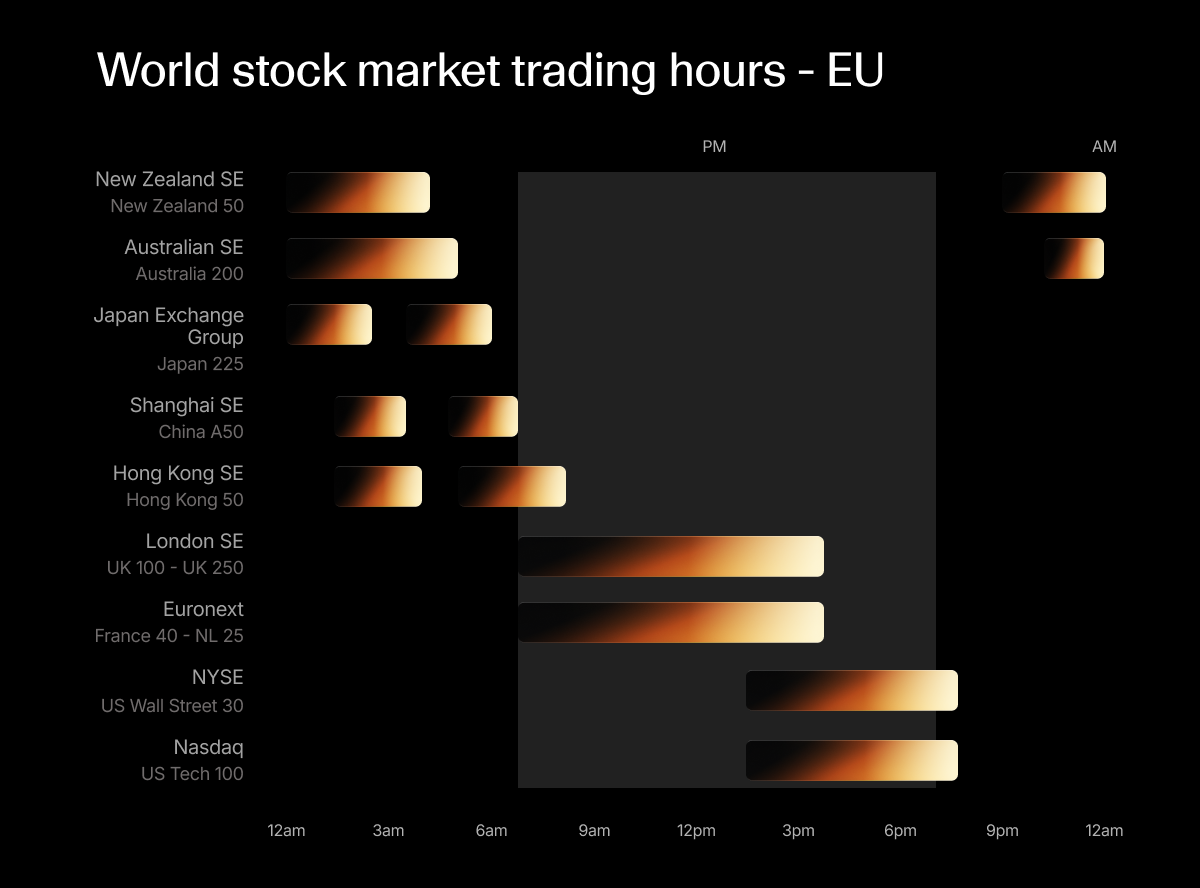
The UK stock market (London Stock Exchange) opens at 7am UTC and closes at 3.30pm with no lunch break, impacting the UK 100 index.
The LSE is closed on UK public holidays, including Good Friday, Easter Monday, the Early May Bank Holiday, the Spring Bank Holiday, Christmas Day, and Boxing Day. Note that when the UK shifts to British Summer Time (BST, UTC+1) between late March and late October, the UTC equivalent of LSE trading hours adjusts accordingly.
What time does the US stock market open?
The US stock market (New York Stock Exchange) opens at 1:30pm UTC and closes at 8pm, with no lunch break, impacting CFDs such as the US Wall Street 30 (which tracks the Dow Jones) and the US 500 (S&P 500).
What time do Asian markets open?
Asian markets open and close at different times depending on the exchange. The Japan Exchange Group, from which the Nikkei 225 (Japan 225) is compiled, opens at 12am UTC and closes at 6am, while the Shanghai Stock Exchange, covering the SSE Composite (China A50) opens at 1:30am UTC and closes at 7am. Meanwhile, the Hong Kong Stock Exchange, from which the Hang Seng (Hong Kong 50) is compiled, also opens at 1:30am UTC and closes at 8am. All of these exchanges have lunch breaks (see below table).
What time do European markets open?
European markets mostly open and close at the same times. The Euronext Paris, from which the CAC 40 (France 40) and the AEX (Netherlands 25) are compiled, opens at 7am UTC and closes at 3:30pm. The Frankfurt Stock Exchange, from which the DAX 40 (Germany 40) is compiled, the Bolsa de Madrid, for the Ibex 35 (Spain 35), and the Borsa Italiana (Italian Stock Exchange) for the Italy 40, share the same hours.
What time do Australasian markets open?
The Australian Securities Exchange (ASX), from which the ASX 200 (Australia 200) is compiled, opens at 11pm UTC and closes at 5am. The New Zealand Stock Exchange, for the New Zealand 50, is open from 9pm UTC to 3:45am.
What are the major exchange opening and closing times?
Here is a complete list of the major stock exchange opening and closing times to be aware of, showing the exchange as well as the related indices we offer, with the specific Capital.com market to look for in brackets.
| Stock exchange | Opening hours (UTC) | Closing hours (UTC) | Lunch break(UTC) | Related stock indices |
|---|---|---|---|---|
| London Stock Exchange | 7am | 3:30pm | NA | FTSE 100 (UK 100). FTSE 250 (UK 250) |
| New York Stock Exchange | 1:30pm | 8pm | NA | Dow Jones, (US Wall Street 30), S&P 500 (US 500) |
| Nasdaq Stock Market* | 1:30pm | 8pm | NA | US Tech 100 |
| Euronext | 7am | 3:30pm | NA | CAC 40 (France 40), AEX (Netherlands 25) |
| Shanghai Stock Exchange | 1:30am | 7am | 3:30am-5am | SSE Composite (China A50) |
| Japan Exchange Group | 12am | 6am | 2:30am-3:30am | Nikkei 225 (Japan 225) |
| Hong Kong Stock Exchange | 1:30am | 8am | 4am-5am | Hang Seng (Hong Kong 50) |
| Winter Overnight session | 1:00am | 9:00am | NA | CFDs on selected 24/5 US shares |
| Summer Overnight session | 12:00pm | 8:00am | NA | CFDs on selected 24/5 US shares |
*Nasdaq Stock Market® is a trademark of Nasdaq Inc. The information provided herein is for informative purposes only.
Past performance is not a reliable indicator of future results.
What is after-hours trading?
After-hours trading, also known as extended-hours trading, refers to the period when shares and indices can be traded outside of the regular hours of the exchange to which they relate. Therefore, after-hours trading enables you to react to news and events that occur outside of the regular session. However, if you’re planning to trade after hours, it’s important to factor into your trading plan that overall volume can vary significantly compared to regular hours, potentially meaning lower liquidity and higher volatility. Find out more about the markets you can trade after hours with us.
Trading CFDs on indices and shares with Capital.com
Our mission to help you make better trading decisions is the driver for everything we do, and our multi-award-winning, user-friendly web trading platform and mobile apps are built with this goal in mind. You’ll find advanced tools, integrated financial news, personalised watchlists and much more – paired with 24/7 support.
Trading CFDs on indices and shares with Capital.com starts with our simple sign-up process. Once approved, you'll be able to speculate on the price movements of a wide range of indices and shares, as well as forex and commodity instruments, with 5,500+ assets to choose from.

