

Lockheed Martin stock forecast: Third-party price targets
Lockheed Martin is a US-listed aerospace and defence company whose shares are actively traded, with prices influenced by company results, defence budgets, contract activity and wider equity-market conditions. Explore LMT’s recent price action, third-party price targets and technical analysis.
Lockheed Martin Corporation (LMT) is trading around $572.71 on 15 January 2026 as of 1:52pm UTC, with the price moving between an intraday low of $553.74 and a high of $577.31 on Capital.com’s USD-denominated stock CFD feed. The intraday range of approximately $23.57 points to active two-way trading. Past performance is not a reliable indicator of future results.
The stock is trading amid a relatively supportive backdrop for US defence names following President Trump’s recent push for a higher future US military budget, which lifted defence shares (Reuters, 8 January 2026). This comes against a wider US equity market that recently saw the S&P 500 close near 6,926.6 (Trading Economics, 15 January 2026). Company-specific sentiment is also shaped by Lockheed Martin’s latest reported quarterly results, where the group posted third-quarter 2025 sales of about $18.6bn and net earnings of roughly $1.6bn, or $6.95 per share, compared with sales of $17.1bn a year earlier (Yahoo Finance, 21 October 2025).
Lockheed Martin stock forecast 2026–2030: Third-party price targets
As of 15 January 2026, third-party Lockheed Martin stock predictions show a wide range of 12-month targets, reflecting differing views on valuation, defence spending trends, and contract momentum. Analysts generally frame these targets as 12-month price objectives rather than guarantees, and the figures below represent headline reference points from published research or survey snapshots.
MarketBeat (consensus snapshot)
MarketBeat reports that Lockheed Martin carries a consensus rating of 'Hold' with an average analyst 12-month price target of about $517.12, based on recent coverage changes and target updates collated on that date. The note adds that this average reflects a mix of 'outperform,' 'neutral,' and 'hold' stances, as analysts balance defence budget prospects against competitive dynamics across the sector (MarketBeat, 11 January 2026).
Truist (single-stock update)
Truist upgraded Lockheed Martin from 'hold' to 'buy' and lifted its LMT stock forecast to $605 from $500 as of that date. The analyst cites what is described as an 'attractively valued' starting point for the year, referencing the stock’s relative underperformance versus the S&P 500 over the prior 12 months and comparisons with sector peer valuation multiples (CNBC, 9 January 2026).
Goldman Sachs (house view on LMT)
Goldman Sachs maintained a 'sell' rating on Lockheed Martin with a 12-month price target of $430. The report outlines a more cautious stance, flagging valuation considerations, macro-economic headwinds, and programme-timing risks, while also acknowledging upgraded earnings guidance from the company (Investing.com, 7 January 2026).
TipRanks (aggregated 2025 survey)
A TipRanks forecast page summarises LMT stock forecasts from 12 analysts, showing an average price target around $547.69, with a high of $605 and a low of $430 at that snapshot. The service notes that these figures reflect individual Wall Street models incorporating assumptions on US defence budgets, backlog conversion, and the broader equity-market backdrop (TipRanks, 15 January 2026).
Predictions and third-party forecasts are inherently uncertain, as they cannot fully account for unexpected market developments. Past performance is not a reliable indicator of future results.
LMT stock price: Technical overview
The LMT stock price is trading around $572.71 as of 1:52pm UTC on 15 January 2026, holding well above its key simple moving-average cluster, with the 20-, 50-, 100- and 200-day SMAs grouped near $503, $479, $480 and $470 respectively. The 20-over-50 alignment remains intact, while the 10-day SMA around $525 sits below the current price. The 9-period Hull moving average near $570 offers a nearer dynamic reference within the session’s $553.74–$577.31 intraday range.
The 14-day RSI is elevated above 70 at roughly 77, while the ADX near 24 suggests a developing, but not yet firmly established, trend. MACD and 10-day momentum indicators are currently flagged on 'buy' settings. On the topside, the first area to monitor is the classic R1 pivot near $504.50, with R2 around $525.33 becoming relevant on a sustained daily close above that zone, even as spot prices trade higher intraday. On pullbacks, the classic pivot around $470.87 serves as an initial support reference, followed by the 200-day SMA near $469.53 as a longer-term level. A break below this area could expose the S1 zone around $450.05 (TradingView, 15 January 2026).
This technical analysis is provided for informational purposes only and does not constitute financial advice or a recommendation to buy or sell any instrument.
Lockheed Martin share price history (2024–2026)
Lockheed Martin’s share price has trended higher overall over the past two years, moving from around $430–$460 in early 2024 to the mid-$500s and above by January 2026. The stock spent much of 2024 consolidating within a $420–$580 range, closing the year at $486.15 on 31 December 2024 before easing back towards the mid-$400s during the first quarter of 2025.
From there, the price formed a base near $430 in April 2025 before pushing into a higher range. It closed at $482.49 on 2 January 2025 and at $484.12 on 31 December 2025, tracking a choppier but generally upward path through the year. Into 2026, momentum has accelerated, with LMT rising from $497.35 at the 2 January 2026 open to close at $572.71 on 14 January 2026, leaving it roughly $86 above late-2025 levels as of mid-January.

Past performance is not a reliable indicator of future results. Share prices are indicative and may differ from live market prices.
Lockheed Martin (LMT): Capital.com analyst view
The LMT stock price has moved from the mid-$400s in early 2024 to around $572.71 as of 1:52pm UTC on 15 January 2026, with recent months marked by a renewed push towards the $600 area last seen in late 2024. This advance followed a volatile 2025, during which the stock briefly dipped towards the low-$430s before recovering into year-end, highlighting how defence-sector shares can respond quickly to changes in news flow and broader equity sentiment.
One area of support for the current price has been sustained sector interest following President Trump’s call for US defence spending to rise towards $1.5tn in 2027, which has drawn renewed attention to long-term programmes such as the F-35. At the same time, market participants remain alert to potential headwinds, including political debate around US fiscal sustainability, proposals affecting defence-sector dividends and buybacks, and ongoing concerns over supply-chain constraints and margin pressure across the aerospace and defence industry. Shifts in any of these factors could influence valuations if expectations change.
Capital.com’s client sentiment for Lockheed Martin CFDs
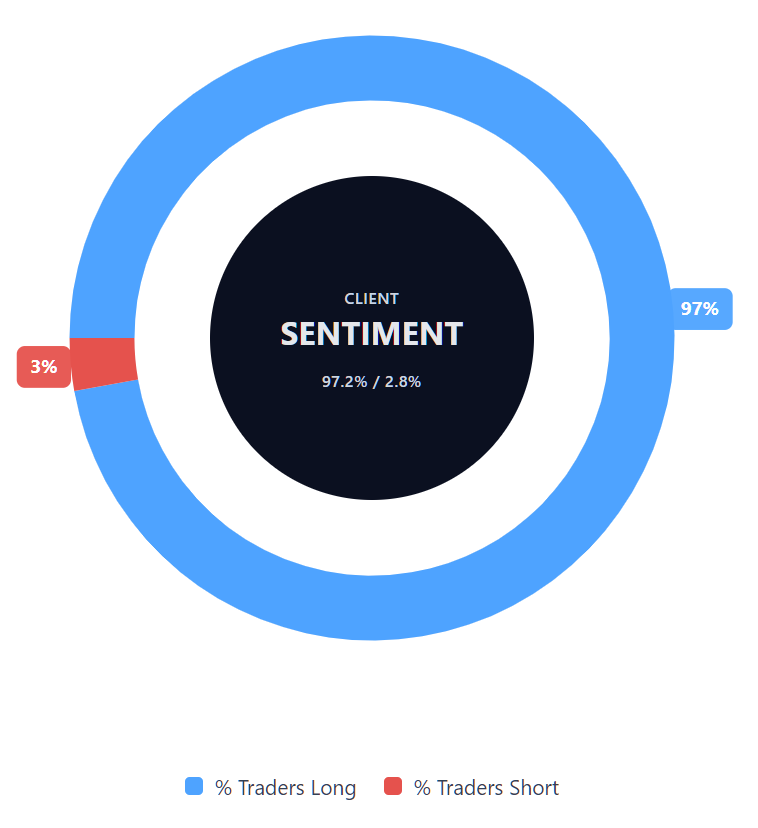
As of 15 January 2026, Capital.com client positioning in Lockheed Martin CFDs is currently skewed towards long positions, with buyers at 97.2% versus sellers at 2.8%. This places buyers ahead by around 94.3 percentage points. The data reflects open positions on Capital.com at the time of the snapshot and can change as traders adjust their exposure.
Summary – Lockheed Martin stock price
- Lockheed Martin’s share price spent 2025 moving from the high-$480s in early January to around the mid-$480s by year-end, after dipping towards the low-$430s in April.
- The stock traded within a broad $430–$520 range for much of the year, with multiple recoveries from spring and summer pullbacks helping to re-establish an upward bias into the fourth quarter.
- Technical signals into late 2025 and early 2026 showed price holding well above key daily moving averages, with a 20-over-50-day alignment and an elevated RSI pointing to strong short-term momentum.
- Lockheed Martin (LMT) last traded near $572.71 on 14 January 2026, well above its late-2025 closing levels, underlining how quickly defence-sector shares can reprice as sector expectations and news flow evolve.
Past performance is not a reliable indicator of future results.
FAQ
Who owns the most Lockheed Martin stock?
Lockheed Martin has a widely distributed shareholder base, with ownership dominated by large institutional investors rather than any single controlling shareholder. Major holders typically include global asset managers such as Vanguard, BlackRock, and State Street, which manage funds on behalf of pension schemes, ETFs, and other investment vehicles. Insider ownership represents a much smaller portion of the total. Ownership levels can change over time as institutions rebalance portfolios or respond to evolving market conditions.
What is the five-year Lockheed Martin share price forecast?
There is no single, agreed five-year LMT stock forecast. Most publicly available forecasts focus on 12-month targets rather than longer horizons, reflecting the difficulty of projecting defence spending, geopolitical developments, and programme execution over several years. Longer-term expectations tend to focus on factors such as US defence budgets, contract backlogs, margins, and ongoing technological investment. Any multi-year outlook remains inherently uncertain and subject to change.
Is Lockheed Martin a good stock to buy?
Whether Lockheed Martin is considered a 'good' stock depends on individual objectives, time horizons, and risk tolerance. Analysts typically assess the company using factors such as earnings visibility, defence spending trends, valuation metrics, and competitive positioning. However, opinions vary, and published ratings range from positive to cautious. For CFD traders, short-term price movements and volatility may be more relevant than longer-term fundamentals. No single stock is suitable for all participants.
Could Lockheed Martin stock go up or down?
Lockheed Martin’s share price can move both higher and lower, influenced by factors including defence budget decisions, contract announcements, earnings results, broader equity market conditions, and geopolitical developments. Technical considerations, such as momentum and market positioning, can also shape short-term price behaviour. As with any listed company, unexpected news or shifts in expectations can increase volatility, meaning price movements cannot be predicted with certainty.
Should I invest in Lockheed Martin stock?
This depends on personal financial circumstances, objectives, and risk appetite. Information about Lockheed Martin’s share price, forecasts, and market drivers is provided for educational purposes only and does not constitute investment advice. Investing or trading, including via CFDs, involves risk and the potential for losses as well as gains. Individuals may wish to carry out their own research and, where appropriate, seek independent financial guidance before making decisions.
Can I trade Lockheed Martin CFDs on Capital.com?
Yes, you can trade Lockheed Martin CFDs on Capital.com. Trading share CFDs lets you speculate on price movements without owning the underlying asset and to take long or short positions. However, contracts for difference (CFDs) are traded on margin, and leverage amplifies both profits and losses. You should ensure you understand how CFD trading works, assess your risk tolerance, and recognise that losses can occur quickly.