

Tesla stock forecast: record deliveries, robotaxi expansion
Tesla reported record Q2 2026 deliveries of 480,126 vehicles, while revenue beat forecasts and earnings missed, keeping focus on its automotive, AI and robotaxi plans. Explore third-party TSLA price targets and technical analysis. Past performance is not a reliable indicator of future results.
Tesla, Inc. (TSLA) last traded at $327.84 as of 2:27pm UTC on 23 July 2026, near the lower end of its intraday range of $325.84–$379.95. Past performance is not a reliable indicator of future results.
The move followed Tesla's second-quarter 2026 earnings report; revenue beat consensus estimates, but earnings per share fell short, prompting a decline in the share price after the release (Investing.com, 22 July 2026). The report followed another volatile period for the stock earlier in July, after Tesla announced record second-quarter vehicle deliveries of 480,126 units, exceeding Wall Street forecasts (Reuters, 3 July 2026). The result initially failed to lift the shares, which instead fell around 7% on the day of the announcement (CNBC, 2 July 2026). A subsequent expansion of Tesla's robotaxi service to Miami briefly reversed some of that decline (Teslarati, 3 July 2026).
Trading around the earnings release remained volatile, with options markets pricing in a swing of roughly 7% in either direction ahead of the report (Knockout Stocks News, 17 July 2026), as investors weighed Tesla's artificial intelligence and autonomous driving plans against the performance of its core automotive business (CNBC, 20 July 2026).
Third-party Tesla outlook: earnings miss, Robotaxi expansion
As of 23 July 2026, third-party Tesla stock predictions showed a broad range of expectations. Analysts weighed stronger second-quarter deliveries against continuing uncertainty over margins and the potential value of Tesla's autonomous driving operations. The following figures summarise recent third-party projections for TSLA shares.
Truist Financial
Truist Financial raised its Tesla price target to $430 from $400, while maintaining a Hold rating. The target implied roughly 8.9% upside from the prevailing share price. The bank cited expectations of stronger second-quarter deliveries as the basis for the increase (MarketBeat, 1 July 2026).
Morgan Stanley
Morgan Stanley maintained its Tesla price target at $415 and reiterated an Equalweight rating. The firm projected that the shares could trade near that level over the following 12 months. It also identified the early-stage robotaxi rollout in Miami as a factor it was monitoring when considering future target revisions (Investing.com, 6 July 2026).
UBS
UBS raised its Tesla price target to $442, from $364, while keeping a Neutral rating. The revised estimate reflected the bank's expectation that stronger delivery volumes could continue into subsequent quarters (MarketBeat, 9 July 2026).
Jefferies
Jefferies raised its 12-month Tesla price target to $400 from $375, while retaining a Hold rating. The firm linked the revised target to expected vehicle volume trends, although its projection remained below the broader Wall Street average. This reflected a comparatively cautious view of margin recovery (Investing.com, 13 July 2026).
Predictions and third-party forecasts are inherently uncertain, as they cannot fully account for unexpected market developments. Past performance is not a reliable indicator of future results.
Tesla latest earnings: Q2 2026 results
Tesla released its second-quarter 2026 financial results on 22 July 2026, alongside a live webcast at 4.30pm Central Time (Tesla Investor Relations, 22 July 2026). Revenue of $28.24bn beat consensus estimates of roughly $25.53bn to $25.64bn, though earnings per share of $0.33 missed forecasts of about $0.47 to $0.49 (Electrek, 22 July 2026).
Automotive gross margin fell to 16.3% from 19.2% a year earlier, and energy margins dropped to 20.4% from 39.5%, which Tesla attributed to pricing pressure and one-off cost adjustments (Investing.com, 22 July 2026). The quarter also saw record deliveries, with 60% sequential growth in the Americas, and energy storage deployments of 13.5 GWh (Tesla Investor Relations, 2 July 2026).
Management guided 2026 capex above $25bn and said Tesla is pursuing up to $30bn in debt facilities to fund robotaxi, Optimus and AI chip expansion (Moomoo, 23 July 2026). Tesla's next earnings report is scheduled for 28 October 2026 (Investing.com, 22 July 2026).
TSLA stock price: technical overview
As of 2:27pm UTC on 23 July 2026, the TSLA stock price traded at $327.84, well below several key moving averages. According to TradingView data, the 20-, 50-, 100- and 200-day simple moving averages (SMAs) stood at approximately $392, $405, $395 and $415, respectively.
The 20-day exponential moving average (EMA) was around $386, while the Hull moving average stood near $356. These readings showed how far the price had moved below its recent averages. The 20-day SMA also remained below the 50-day SMA, so the averages did not show a short-term bullish crossover.
Momentum indicators also pointed to weaker price momentum. The 14-day relative strength index (RSI) stood near 30.5, a level commonly described as oversold, according to TradingView. The 14-day average directional index (ADX) read 16.2. This was below the range generally associated with a clearly established trend and suggested that directional momentum remained limited.
The first technical reference area above the prevailing price was the classic R1 pivot near $447. A sustained move above that level could bring the R2 pivot near $473 into focus, although technical levels do not predict a specific outcome.
On the downside, the classic pivot near $408 provided an initial reference, followed by the 100-day SMA at around $395. A move below the latter could place the S1 pivot near $382 in focus, based on the reported TradingView levels. These reference points may change as new price data becomes available (TradingView, 23 July 2026).
This technical analysis is for informational purposes only and does not constitute financial advice or a recommendation to buy or sell any instrument.
Tesla share price history (2024–2026)
TSLA’s stock price recorded substantial price movements over the previous two years, alongside changes in vehicle deliveries, expectations surrounding artificial intelligence and shifts in investor sentiment.
TSLA started July 2024 near $216 before climbing through the autumn. During the US election period, the stock rose from around $250 in early November 2024 to more than $400 in December.
The stock continued to rise into late 2025 and reached an all-time high of approximately $489.88 in December 2025. It then declined during the first half of 2026 amid concerns about electric vehicle demand and margin pressure.
TSLA fell as low as $215.30 in March 2026. Its price also reached $448.42 in February 2026 and $442.45 in May 2026, as delivery results and changing market expectations contributed to further volatility.
More recently, the shares declined from a close of $394.05 on 8 July 2026 to $327.84 on 23 July 2026 following the company's second-quarter earnings update. This left TSLA roughly 33% below its all-time high.

Past performance is not a reliable indicator of future results. Share prices are indicative and may differ from live market prices.
Tesla (TSLA): Capital.com analyst view
Tesla's share price showed pronounced volatility over the previous year, moving between an all-time high of approximately $489.88 in December 2025 and levels below $220 during 2026.
This pattern coincided with a divergence between Tesla's operational metrics, including record vehicle deliveries and energy storage deployments, and its financial results. Margin compression and lower-than-expected earnings periodically weighed on the share price.
Some market participants may interpret this difference as evidence that the shares reflect expectations for the long-term potential of Tesla's autonomy and robotics initiatives. Others may view it as a sign that the valuation has moved away from near-term financial fundamentals and could face pressure if these projects are delayed or generate lower-than-expected returns.
Analysts have cited Tesla's expanding energy storage business and early robotaxi rollout as potential supporting factors. However, these sit alongside risks including lower regulatory credit revenue, higher capital expenditure, execution uncertainty and increased competition in the electric vehicle market.
The analyst target range of approximately $25–$600 illustrates the extent of disagreement over Tesla's valuation.
Capital.com’s client sentiment for Tesla CFDs
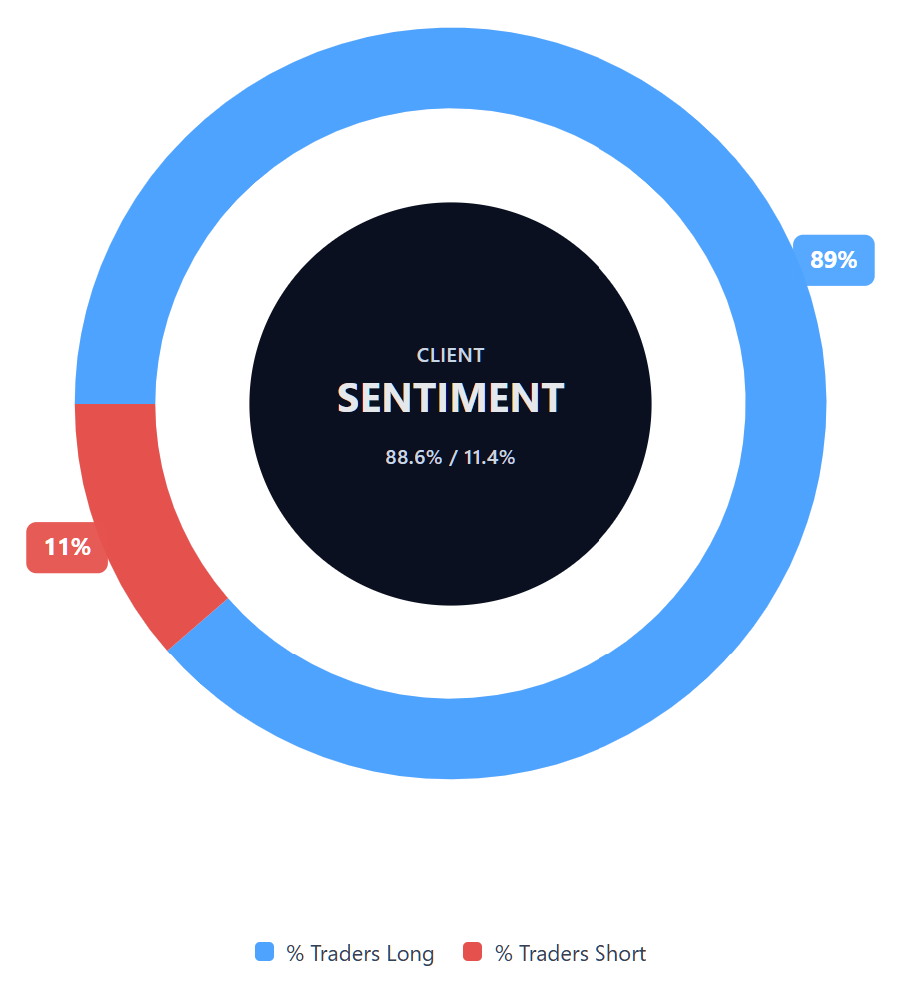
As of 23 July 2026, Capital.com client positioning in Tesla CFDs was weighted towards buyers at the time of the snapshot. Buyers accounted for 88.6% of open positions, compared with 11.4% held by sellers, a difference of 77.2 percentage points.
Client sentiment reflects positions held by Capital.com clients and does not necessarily indicate the future direction of the market. The figures can change over time.
Summary – Tesla 2026
- Tesla traded near $327.84 at 2:27pm UTC on 23 July 2026, below its December 2025 all-time high of approximately $489.88.
- The RSI stood near 30.5, a level commonly described as oversold, while the price remained below several key moving averages. The ADX reading suggested limited trend strength.
- Factors affecting the price included second-quarter vehicle deliveries, margin compression, capital expenditure, robotaxi developments and differing assessments of Tesla's autonomy-related valuation.
- Recent developments included Tesla's second-quarter earnings, in which revenue exceeded consensus estimates but earnings per share fell short, and the reported expansion of its robotaxi service to Miami.
Past performance is not a reliable indicator of future results.
FAQ
Who owns the most Tesla stock?
The article doesn’t identify Tesla’s largest shareholder. Ownership figures can also change as institutional investors, company insiders and other shareholders adjust their holdings. Investors typically review Tesla’s latest regulatory filings and shareholder disclosures for the most current information. A large holding doesn’t indicate how the share price may perform, as Tesla’s valuation also reflects earnings, margins, vehicle deliveries, capital expenditure and expectations around its autonomy and robotics businesses.
Is Tesla a good stock to buy?
Whether Tesla is suitable depends on an individual’s objectives, financial circumstances, risk tolerance and assessment of the company. The article highlights potential supporting factors, including vehicle deliveries, energy storage growth and robotaxi development. It also notes risks such as margin pressure, high capital expenditure, execution uncertainty and competition. Analyst targets vary widely, showing that market participants hold different views. This information doesn’t constitute a recommendation to buy Tesla shares.
Should I invest in Tesla stock?
The article can’t determine whether investing in Tesla is appropriate for a particular person. That decision depends on factors including investment goals, time horizon, financial position and tolerance for loss. Anyone assessing Tesla may wish to consider both the company’s operational progress and the risks linked to margins, capital expenditure, competition and project execution. Third-party forecasts rely on assumptions and may be revised as new financial and market information becomes available.
Can I trade Tesla CFDs on Capital.com?
Yes, you can trade Tesla CFDs on Capital.com. Trading share CFDs lets you speculate on price movements without owning the underlying asset and to take long or short positions. However, contracts for difference (CFDs) are traded on margin, and leverage amplifies both profits and losses. You should ensure you understand how CFD trading works, assess your risk tolerance, and recognise that losses can occur quickly.