

From Caracas to Wall Street: how the U.S.–Venezuela crisis could move markets
The start of the new year has marked a dramatic escalation in the United States’ confrontation with Venezuela.
A dramatic escalation in U.S.–Venezuela relations
In an unprecedented move, U.S. forces carried out a military operation that resulted in the capture of Venezuelan President Nicolás Maduro and his wife, Cilia Flores. They were subsequently transferred to New York, where they are expected to face federal charges connected to alleged criminal activities under U.S. jurisdiction.
Washington has framed the operation as a law-enforcement action targeting an already-indicted foreign leader. However, the seizure of a sitting head of state has sparked intense international criticism and legal controversy. Numerous legal scholars and United Nations officials have questioned the legitimacy of the operation, warning that it may violate international law and long-standing norms of state sovereignty. China and Russia have condemned the action and called for Maduro’s release, while criticism has also emerged within the United States, with some political figures describing the move as unlawful and strategically dangerous.
In Caracas, the political vacuum has deepened uncertainty. Vice-President Delcy Rodríguez has assumed the role of interim president, but questions over legitimacy, governance, and Venezuela’s future political trajectory remain unresolved.
U.S. pressure shifts to Venezuelan oil
Alongside the political shock, the United States has intensified its campaign against Venezuela’s energy sector. In recent months, U.S. authorities have seized Venezuelan-linked oil tankers under existing sanctions and imposed a blockade and quarantine on vessels carrying Venezuelan crude. These measures are aimed at cutting off revenue streams that have historically sustained the Maduro government.
Washington has signalled that control over Venezuelan oil resources could be leveraged as part of a broader strategic framework, potentially tying cooperation to conditions such as severing ties with adversarial states and curbing drug trafficking. While years of sanctions and underinvestment have severely constrained Venezuela’s production capacity, the country still holds some of the world’s largest proven oil reserves. This makes the energy dimension of the confrontation geopolitically significant, even if its immediate impact on global supply appears limited.
Oil markets remain surprisingly calm
Despite the scale of the political and military escalation, oil markets have reacted in a muted, and at times counterintuitive, manner. Global crude prices have not surged and have, in some instances, remained under pressure. This reflects the reality that Venezuela’s current oil output is only a fraction of its historical peak and represents a relatively small share of global supply.
In addition, the global oil market has remained well supplied, supported by strong production from the United States and other major producers. These dynamics have helped offset concerns about the loss of Venezuelan barrels. That said, longer-term risks remain. Prolonged disruptions could tighten supplies of heavy crude, potentially affecting refiners that rely on this grade, even if benchmark prices remain relatively stable.
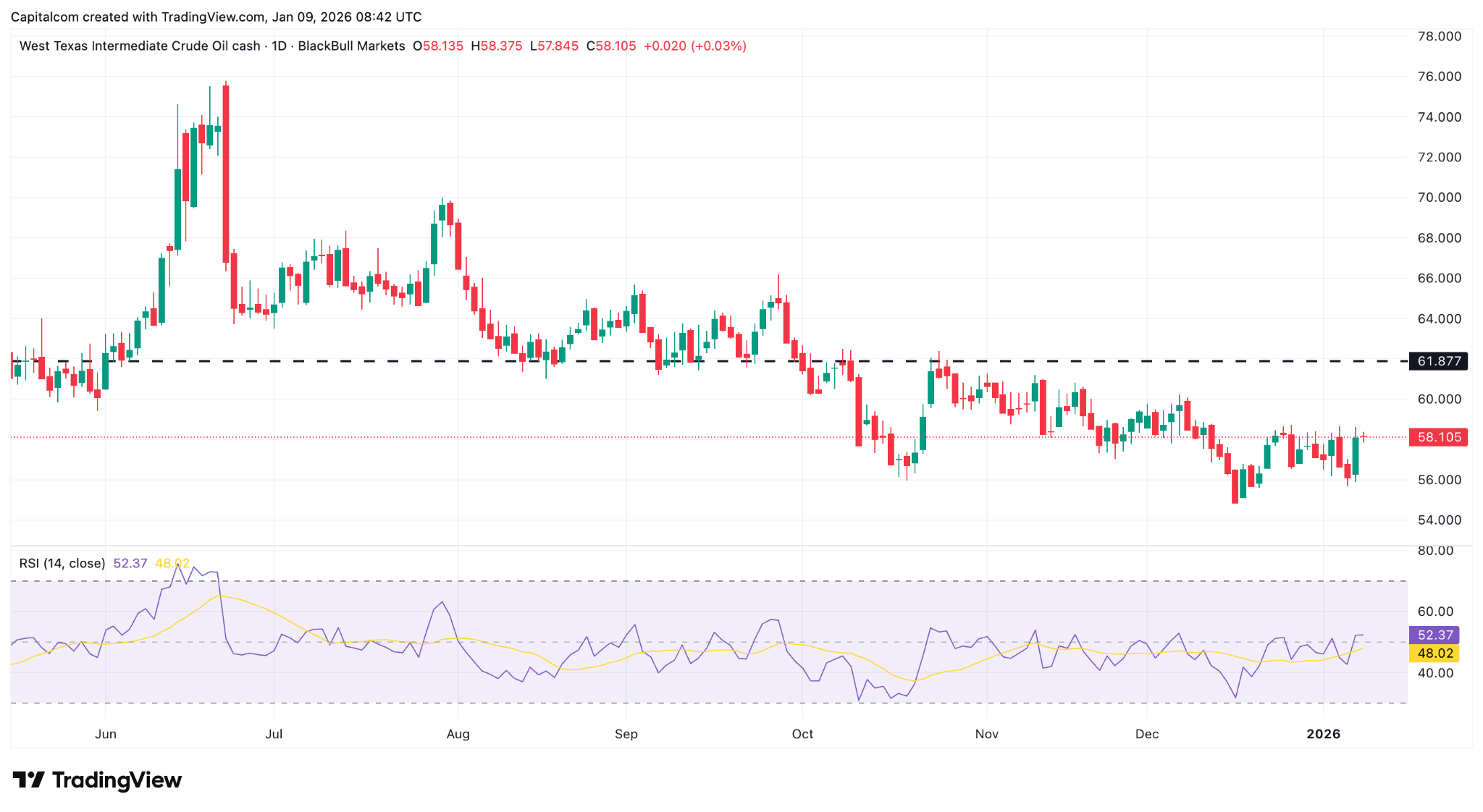
The daily chart shows the RSI still hovering around the mid-line, suggesting a clear direction is still absent. The downside remains supported by ample supply and weak demand, with a move below $54.80 possibly seen as a sign of further downside ahead. Meanwhile, the momentum could turn upwards if concerns about future supply arise, which could see WTI breaching the $60 mark in an attempt to recover some bullish traction.
US crude (WTI) daily chart
Past performance is not a reliable indicator of future results.
The U.S. dollar benefits from risk-off flows
From a currency perspective, heightened geopolitical uncertainty has provided support for the U.S. dollar. In periods of global tension, investors typically reduce exposure to riskier assets and shift toward dollar-denominated instruments, reinforcing the dollar’s role as a safe-haven currency.
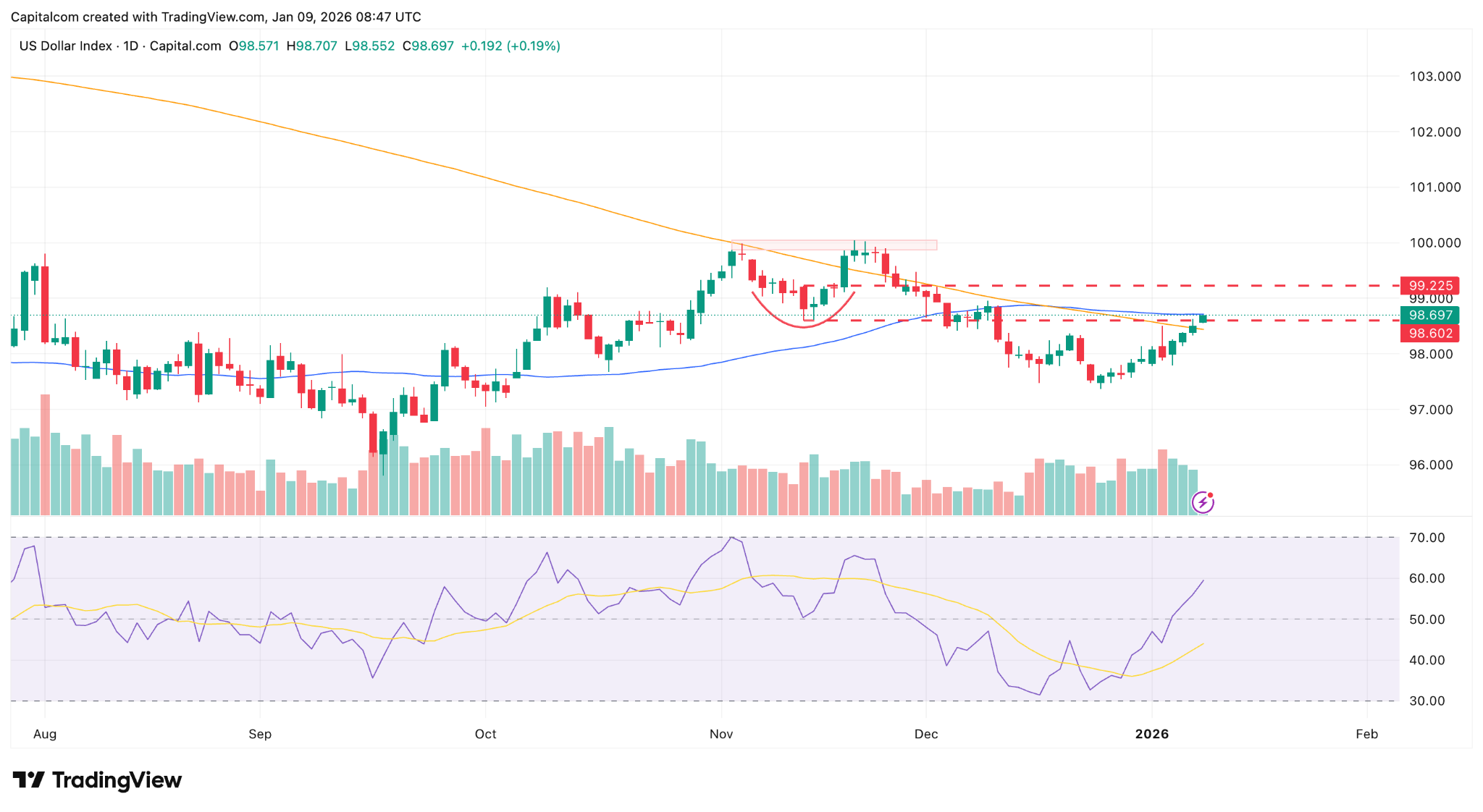
This dynamic has been amplified by broader concerns over unilateral military action and the legal and diplomatic fallout surrounding Maduro’s capture. However, while geopolitical stress could drive short-term dollar strength, the longer-term outlook for the currency will continue to depend primarily on macroeconomic fundamentals, Federal Reserve policy decisions, and global growth conditions. For now, the dollar has now entered a critical test for bullish appetite between 98.60 and 98.95 where it has been rejected before. The RSI remains constructive but a move above 99 may be necessary to confirm the continuation of the bullish trend. On the flipside, a dip back below 97.80 could see the bears return.
US dollar index (DXY) daily chart
Past performance is not a reliable indicator of future results.
Gold shines as geopolitical risk rises
Gold has emerged as one of the clearest beneficiaries of the renewed geopolitical stress. Historically, periods of political conflict and elevated uncertainty prompt investors to increase exposure to safe-haven assets, with gold traditionally at the forefront.
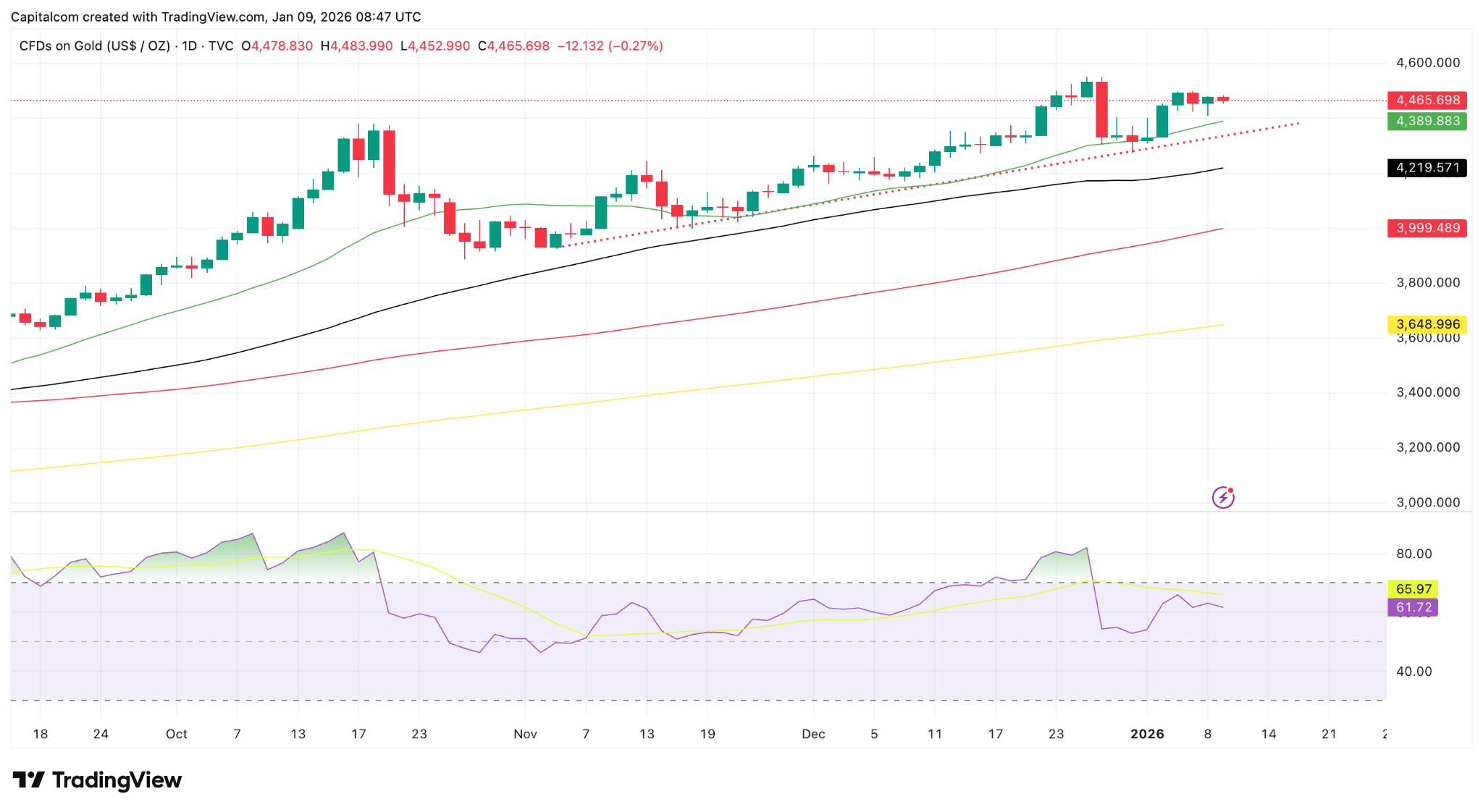
The U.S.–Venezuela confrontation has reinforced this pattern, contributing to upward pressure on gold prices as investors hedge against market volatility, geopolitical spillovers, and broader instability. This demand may persist as long as tensions remain unresolved, particularly if combined with concerns about inflation or a slowdown in global economic growth. However, markets may dismiss the conflict in the coming weeks, which could weigh on precious metals.
Gold (XAU/USD) daily chart
Past performance is not a reliable indicator of future results.
Outlook: contained market reaction, elevated uncertainty
Overall, the U.S.–Venezuela crisis, now defined by the capture of a sitting president, intensified sanctions, and the seizure of oil assets, has triggered a classic risk-off response across financial markets. The U.S. dollar has drawn safe-haven inflows, gold has rallied, and oil prices have remained relatively restrained due to prevailing supply dynamics.
While immediate market reactions have been contained, the longer-term implications remain highly uncertain. Much will depend on how Venezuela’s political transition unfolds, how international legal challenges evolve, and whether this confrontation expands into a broader regional or geopolitical flashpoint.