

BMW stock forecast: Third-party price targets
BMW shares are actively followed by traders due to the company’s global manufacturing footprint, exposure to key markets such as China, and ongoing investment in electrification. Explore BMW’s recent price action, third-party price targets and technical analysis.
Bayerische Motoren Werke AG (BMW) is trading around €90.84 in the European session on 14 January 2026, with intraday moves so far contained between a low of €88.27 and a high of €91.52, according to prices quoted on Capital.com at 2:55pm UTC. Past performance is not a reliable indicator of future results.
The stock is moving against a broadly firm German equity backdrop, with Germany’s DAX index reported marginally higher and tracking a twelfth consecutive session of gains (Reuters, 14 January 2026). At the same time, BMW continues its 2025–2027 share buyback programme, having recently disclosed the repurchase of 390,000 ordinary shares between 2 and 11 January 2026 (TipRanks, 14 January 2026).
BMW stock forecast 2026–2030: Third-party price targets
As of 14 January 2026, third-party BMW stock predictions reflect a range of views on the automaker’s earnings outlook, China exposure and capital allocation plans. The following summaries focus on recent, dated projections and the assumptions cited by each source.
UBS (investment bank)
UBS cut its 12-month BMW price target to €93 and downgraded the stock to neutral, noting that the shares were trading around €92.02 on 9 January 2026, close to the revised target. The bank cited pressure on China volumes, a relatively flat 2026 revenue guidance range of around −1% to +1% year over year, and expectations for an auto EBIT margin of 4%–6% as key factors behind the lower target (Investing.com, 13 January 2026).
DBS Bank (equity research)
DBS Bank maintained coverage of BMW in a January 2026 report that includes a stated target price and valuation framework for the shares. The note bases its target on earnings forecasts through 2026 and a sector-relative valuation approach, with analysts flagging BMW’s investment cycle, electrification strategy and China demand trends as central to their assumptions (DBS, 5 January 2026).
Simply Wall St (discount discussion)
Simply Wall St assessed BMW’s fair value at approximately €135 per share, Simply Wall St highlighted that BMW shares were trading at roughly a 31% discount to the service’s intrinsic value estimate at that time, without publishing a separate numeric target. The piece highlights stronger-than-expected 2025 share price performance alongside capital spending on electrification and margin considerations as reasons why they considered the stock continued to be undervalued within its framework (Simply Wall St, 14 January 2026 ).
Predictions and third-party forecasts are inherently uncertain, as they cannot fully account for unexpected market developments. Past performance is not a reliable indicator of future results.
BMW stock price: Technical overview
The BMW stock price hovers near €90.84 as of 2:55pm UTC on 14 January 2026, with the price hovering below the Classic pivot at 92.89 as shorter-term moving averages lean lower. On the daily chart, the simple 20-, 50-, 100- and 200-day moving averages cluster around approximately 93, 90, 87 and 83 respectively, signalling a mixed configuration. Shorter-term averages remain above longer-term levels, while the 10- and 20-day signals point to recent softness.
The 14-day RSI sits near 46 and remains mid-range, while an ADX reading around 15 points to a weak or non-directional trend rather than a strong directional move. On the topside, the first area to watch is the classic R1 pivot at 98.18. A daily close above this level would bring the 103.23 R2 zone back into view as the next resistance area. On pullbacks, initial support lies near the 92.89 pivot, followed by the 100-day simple moving average around 87. A sustained break below this area could expose the S1 zone at 87.84 (TradingView, 12 January 2026).
This technical analysis is provided for informational purposes only and does not constitute financial advice or a recommendation to buy or sell any instrument.
BMW share price history (2024–2026)
BMW’s stock price has advanced over the past two years, moving from the mid-€70s in early 2025 to around the low-€90s by mid-January 2026. The stock closed at €76.12 on 14 January 2025 and reached €90.86 by 14 January 2026, representing a gain over the period, with notable swings along the way.
After spending much of early 2024 in triple-digit territory above €100, BMW slipped back through the second half of that year, ending 2024 closer to the high-€70s. During 2025, the share price dipped towards the high-€60s in April before recovering steadily. A firmer phase from late summer saw the stock trade between the high-€80s and mid-€90s into December, followed by consolidation just below €91 in early 2026.

Past performance is not a reliable indicator of future results. Share prices are indicative and may differ from live market prices.
BMW: Capital.com analyst view
BMW’s share price has climbed from around the mid-€70s in early 2025 to the low-€90s by mid-January 2026, reflecting a recovery from the pullbacks that followed its period above €100 in early 2024. This move has unfolded through gradual swings rather than a straight-line advance, with rallies periodically interrupted by volatility as markets digested changing expectations for earnings, regional demand and the broader auto cycle.
From a fundamentals perspective, investors have been weighing BMW’s push into electrified models and the upcoming Neue Klasse line against mixed regional trends in vehicle demand and ongoing share buybacks. Improved performance in electrified vehicle sales and progress towards margin targets may be viewed as supportive, while softer demand in China, tariff uncertainty and guidance adjustments underline that earnings and cash flows remain exposed to macro conditions, competition and policy developments in either direction.
Capital.com’s client sentiment for BMW CFDs
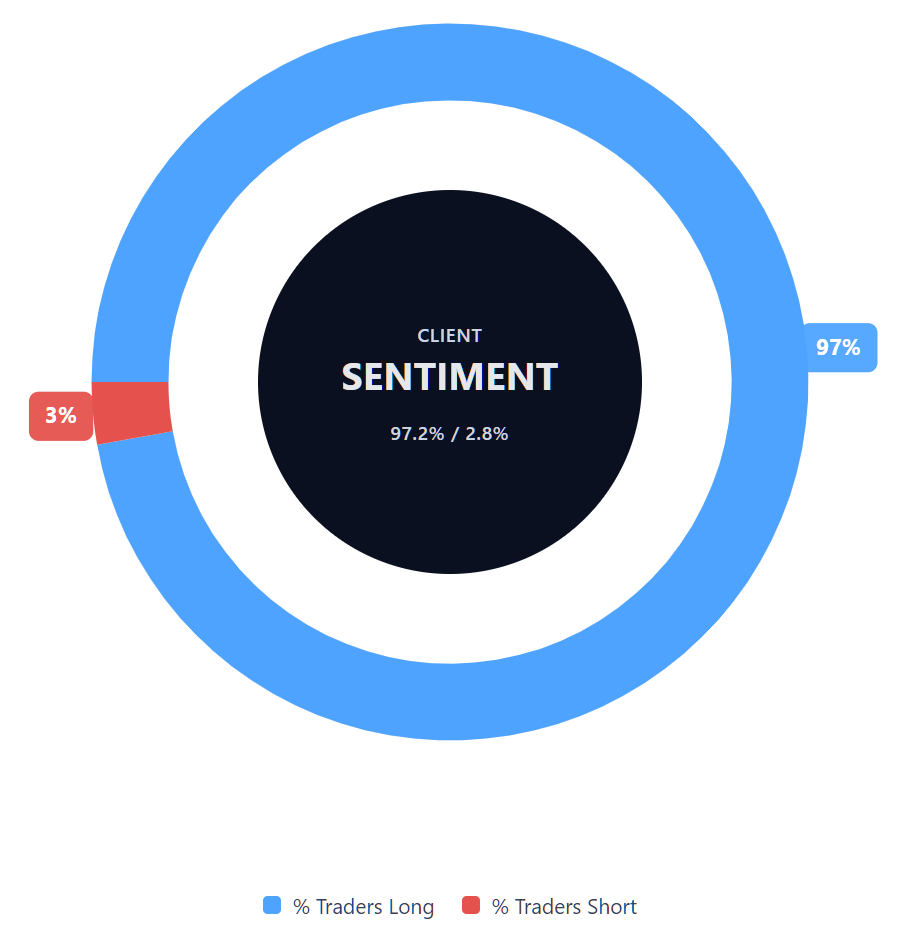
As of 14 January 2026, Capital.com client positioning in BMW CFDs shows 97.2% buyers versus 2.8% sellers, indicating a heavily one-sided tilt towards long positions. This places buyers ahead by approximately 94.3 percentage points. The data reflects open positions on Capital.com at the time of reporting and can change as traders respond to news, price movements and broader market conditions.
Summary – BMW stock price
- BMW traded mostly between the high-€60s and mid-€90s during 2025, rebounding from April lows near €66–€70 to end the year around the low-to-mid €90s.
- The recovery followed a weaker phase linked to concerns around China demand, tariffs and earnings guidance, with later months reflecting a more constructive assessment of sales trends and capital returns.
- Technical signals during the year showed shifting momentum, with shorter-term moving averages turning higher into late 2025, while longer-term trends remained broadly supportive above the low-€80s.
Past performance is not a reliable indicator of future results.
FAQ
Who owns the most BMW stock?
BMW is majority-owned by the Quandt family, primarily through investment vehicles linked to Stefan Quandt and Susanne Klatten, who together control a significant shareholding in the company. Alongside this long-term family ownership, BMW’s shareholder base includes institutional investors, asset managers and free-float shareholders. This ownership structure is often cited in analyst coverage when discussing governance, capital allocation decisions, and the company’s approach to dividends and share buybacks.
What is the 5-year BMW share price forecast?
There is no single, agreed five-year BMW share price forecast. Longer-term projections vary widely depending on assumptions around global vehicle demand, electrification, margins and regional exposure, particularly to China. Some valuation models extend several years ahead, while many analysts focus on shorter horizons, such as 12 to 24 months, due to uncertainty. As with most large automakers, longer-dated forecasts are generally treated as scenario-based estimates rather than precise predictions.
Could BMW stock go up or down?
Whether BMW is a good stock to buy depends on individual objectives, time horizons and risk tolerance. Analysts highlight potential positives such as premium brand positioning, electrification plans and shareholder returns, alongside risks linked to competition, margins, regulation and demand in key markets. Views differ across institutions, as reflected in a wide range of price targets and ratings. This information is provided for educational purposes only and does not constitute financial advice.
BMW’s share price can move up or down in response to a range of factors, including earnings updates, changes in vehicle demand, developments in China, cost pressures and broader equity market conditions. Technical levels and investor positioning may also influence shorter-term moves. Like all equities, BMW shares are subject to market volatility, and past price behaviour does not provide a reliable indication of future performance.
Should I invest in BMW stock?
Deciding whether to invest in BMW stock is a personal decision that depends on financial circumstances, investment goals and an individual’s understanding of the risks involved. While analysts discuss potential opportunities and challenges facing the company, outcomes are uncertain and no scenario is guaranteed. Investors typically consider factors such as valuation, diversification and time horizon before making decisions. This content is not intended as a recommendation to buy or sell BMW shares or related instruments.
Can I trade BMW CFDs on Capital.com?
Yes, you can trade BMW CFDs on Capital.com. Trading share CFDs lets you speculate on price movements without owning the underlying asset and to take long or short positions. However, contracts for difference (CFDs) are traded on margin, and leverage amplifies both profits and losses. You should ensure you understand how CFD trading works, assess your risk tolerance, and recognise that losses can occur quickly.