

Holy grail trading setup: How ADX works

Learn what the holy grail trading strategy is, how it works, and how to use this approach to identify potential pullbacks in a trend.
The holy grail trading strategy is a technical analysis setup built around two core tools: the average directional index (ADX) and a moving average, typically the 20-period simple moving average (SMA), though some descriptions use a 20-day exponential moving average (EMA). It's commonly associated with traders Linda Bradford Raschke and Larry Connors.
Despite the name, the strategy does not offer a perfect or risk-free way to trade. Instead, it's a pullback setup that aims to identify retracements within a strong trend, rather than act as a complete or fail-safe trading system.
Highlights
What is the holy grail trading strategy?
The holy grail trading strategy is a trend-following pullback setup. It's designed to help traders identify potential entry points after a market has already shown strong momentum.
Traders first use ADX to assess trend strength rather than direction. If the indicator points to stronger trend conditions, traders then watch for price to pull back towards a moving average. They may treat that retracement as a possible opportunity to rejoin the prevailing trend, rather than trade against it.
In its standard form, the strategy uses:
- A 14-period ADX.
- A 20-period moving average.
- Optional momentum confirmation from the relative strength index (RSI).
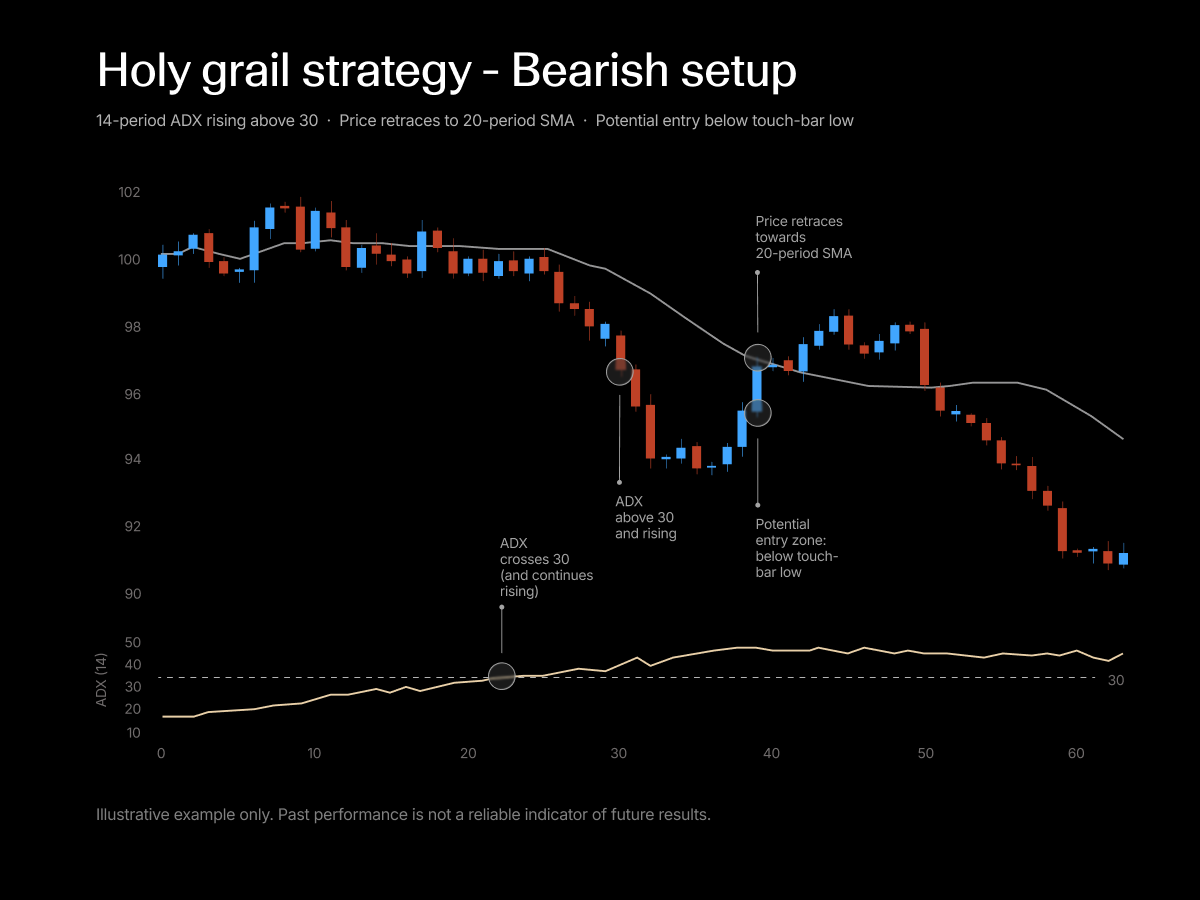
For a bearish setup, the same logic applies in reverse. Traders may look for the ADX to rise above 30 and continue rising while price remains in a downtrend. If price then retraces towards the 20-period moving average, that pullback may be treated as a potential short entry zone.
The strategy is also described as focusing on the early pullback after a strong move. Some traders consider this phase important because it may offer clearer risk parameters than entering after an extended price run.
Calculating the holy grail trading strategy
The two main components of the setup are ADX and a moving average.
ADX is a technical indicator developed to measure the strength of a trend on a scale from 0 to 100. A low reading suggests weak or range-bound conditions, while a higher reading suggests a stronger trend. In the holy grail strategy, traders often focus on readings above 30. Some also look for ADX to be rising, which may support the case for a stronger trend.
The moving average is used differently. Rather than measuring strength, it acts as a reference point during a retracement once a trend is in place. The most common versions use a 20-period SMA, although some descriptions refer to a 20-day EMA.
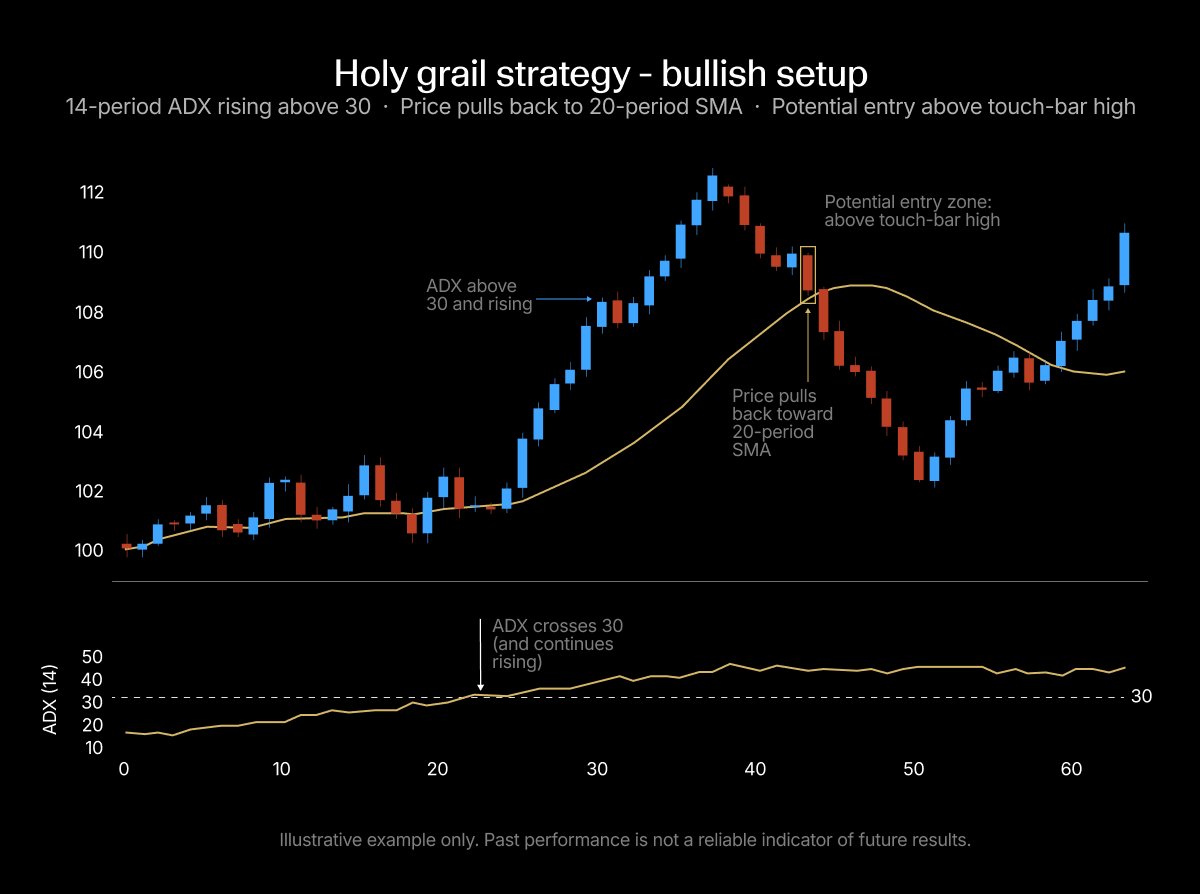
Bullish holy grail
A typical bullish setup includes the following elements:
- The 14-period ADX rises above 30.
- The market is already in an uptrend.
- Price pulls back towards the 20-period moving average.
- Traders watch the bar that touches the moving average.
- A buy order may be placed above the high of that bar.
Bearish holy grail
A typical bearish setup follows the same structure in reverse:
- The 14-period ADX rises above 30.
- The market is already in a downtrend.
- Price retraces towards the 20-period moving average.
- Traders watch the bar that touches the moving average.
- A sell order may be placed below the low of that bar.
Some traders add RSI as a filter. In that case, an RSI reading above 50 may support a bullish view, while a reading below 50 may support a bearish one.
How to use the holy grail trading strategy
The strategy is usually used as a framework rather than a complete system. That means traders often combine it with price action, support and resistance, and risk-management rules.
- Step 1: Identify trend conditionsTraders often start by identifying trend conditions. If the ADX is below 20, it may indicate weaker or range-bound conditions. Readings above 25 are commonly treated as showing stronger trend conditions, while holy grail rules themselves typically look for ADX above 30 and rising.
- Step 2: Signal and entryNow, the moving average becomes the main reference point. Traders wait for price to return towards the 20-period SMA or EMA, rather than entering immediately after a breakout. This can provide a clearer chart reference for the pullback and may help them avoid entering after an extended move.
- Step 3: MonitorAfter entry, traders watch whether price continues in the direction of the trend or whether the pullback deepens.
Timeframe matters as well. The setup can be applied to both intraday and daily charts, but there is no single standard timeframe for using it.
It is also worth noting that a very high ADX reading is not a timing signal on its own. Readings above 60 are relatively uncommon, and the indicator measures trend strength rather than when the trend may end.
Because of that, many traders use extra confirmation before acting on a signal. This can include:
- RSI to assess momentum
- Volume indicators to judge whether the pullback is losing force
- Support and resistance levels for added context
- Price action patterns such as pin bars or engulfing candles
Past performance is not a reliable indicator of future results.
Advantages and disadvantages of the holy grail trading strategy
Like other trading strategies, the holy grail setup has strengths and limitations. Its appeal comes from its structure: it's relatively simple, trend-focused, and based on clear conditions. At the same time, it remains vulnerable to false signals and changing market conditions.
Advantages
- Defined framework: the ADX helps filter for stronger trends, while the moving average provides a visible pullback zone. This can make trade planning more structured.
- Trend alignment: the strategy aims to trade with the broader trend rather than against it. For traders who prefer momentum-based approaches, that may help align entries with prevailing market direction.
- Flexibility: the setup can be adapted to different markets and timeframes.
Disadvantages
- Trend dependence: the main limitation is that it works best in trending markets. In choppy or sideways conditions, the ADX may not provide a strong enough reading, or price may repeatedly test the moving average without developing a sustained move.
- Lag risk: there is also the risk of entering too late. Because the ADX is a lagging indicator, it confirms strength after a trend is already underway. If the trend is already extended, the pullback may not lead to a fresh continuation.
- Execution discipline: the setup does not remove the need for discipline. Stop-loss placement, position sizing, and trade review still matter. No single indicator combination can guarantee profitability, and backtested results don't guarantee live performance. More broadly, the name should not be taken literally: it describes a specific setup, not a risk-free method.

