

US midterm elections: could fuel prices decide the future of US politics?
Fuel prices are a regular topic in US election campaigns, but ahead of this year's midterms, they carry particular weight - gasoline prices are around 40% higher than a year ago, so every visit to the gas station reminds voters of the rising cost of living.
Fuel prices are a regular topic in US election campaigns, but ahead of this year's midterms, they carry particular weight - gasoline prices are around 40% higher than a year ago, so every visit to the gas station reminds voters of the rising cost of living. The midterm elections give voters an opportunity to judge the administration's policies so far, and this time, a significant part of the battle for control of Congress may be decided "at the pump".
But the impact of energy prices on the election results is only part of the story. In this article, I will also look at how a potential change in the balance of power in Washington could affect US energy policy, the outlook for the war with Iran and companies' willingness to invest in infrastructure.
Price of election promises
On 5 September 2024, during a speech at the Economic Club of New York, Donald Trump promised to bring gasoline prices below USD 2 per gallon. Today, that promise seems pretty distant. As shown in the chart below, on 24 October, the average price of regular gasoline stood at USD 4.30, compared with USD 3.07 a year earlier. Meanwhile, diesel cost USD 6.34, up from USD 3.64, an increase of more than 70%.
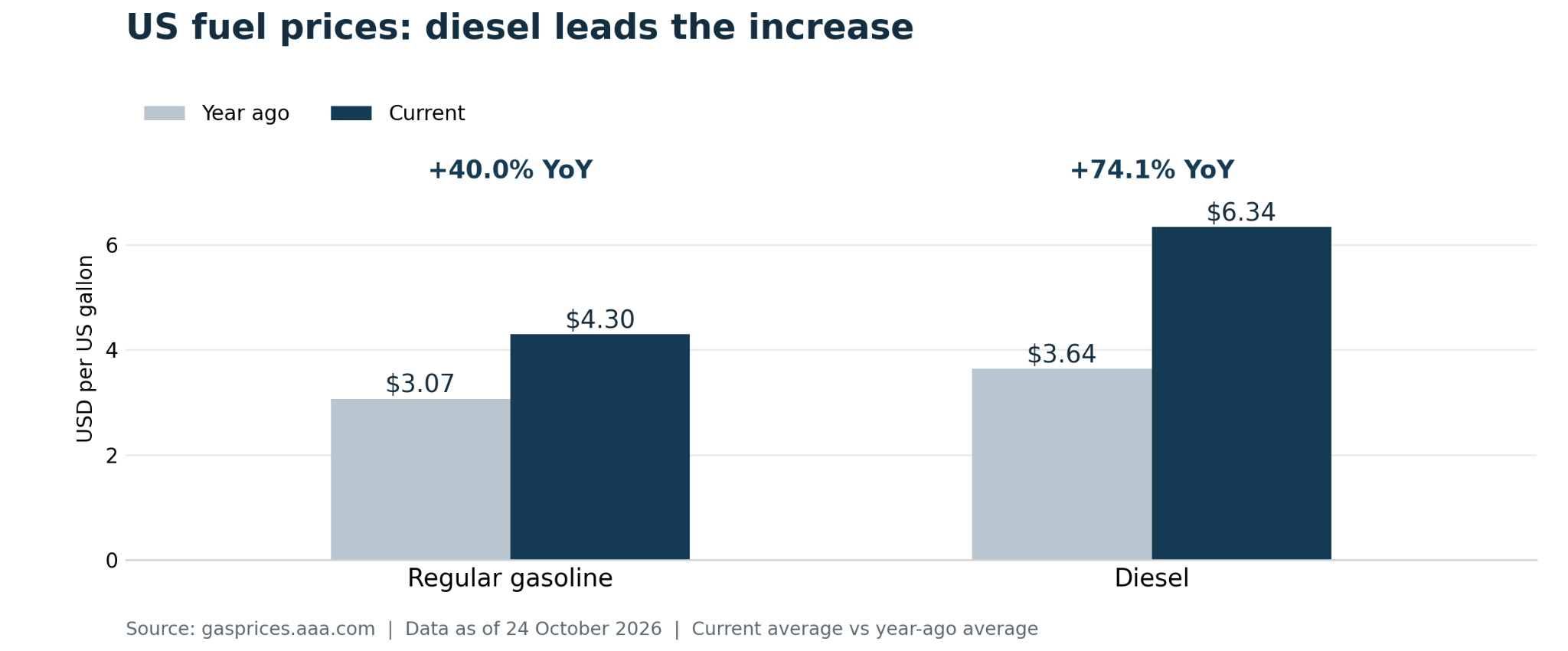
Source: gasprices.aaa. Data as of 24 October 2026. Own edition.
The political cost of these increases is visible in the polls. In a New York Times/Siena survey from 21 October, 73% of respondents disapproved of Trump's handling of gasoline prices, while 24% approved.
Why is diesel rising stronger?
Fuel price increases are being driven by disruptions at different levels of the supply chain: from crude oil availability and shipping to refinery operations and the components needed to produce fuels that meet specific quality requirements. Almost all of these disruptions are linked, directly or indirectly, to the ongoing conflict in the Middle East and Ukrainian attacks on Russian refineries.
One example showing how complex the situation is the link between India's LPG market and gasoline prices in California. A shortage of LPG used for cooking led Indian government to prioritise its production. As a result, Indian refineries reduced alkylate production, a component used in gasoline blending that is particularly important for meeting California's fuel quality requirements. According to Kpler data, alkylate exports from India fell from 61k b/d in March to 33k b/d in April.
However, diesel price increases appear to be particularly painful, not only because of their larger % increase, but also because diesel's importance goes far beyond the price paid by drivers "at the pump". Diesel is a major cost for goods transportation, agricultural machinery and a large part of industrial activity. The related heating oil market also affects household heating bills, particularly in the northeastern US.
The main problem remains the uneven recovery of supplies from the Middle East. Although crude oil flows are gradually recovering, fuel product exports from the Gulf remain almost 60% below pre-war levels. The problem is being made worse by Ukrainian attacks on Russian refineries.
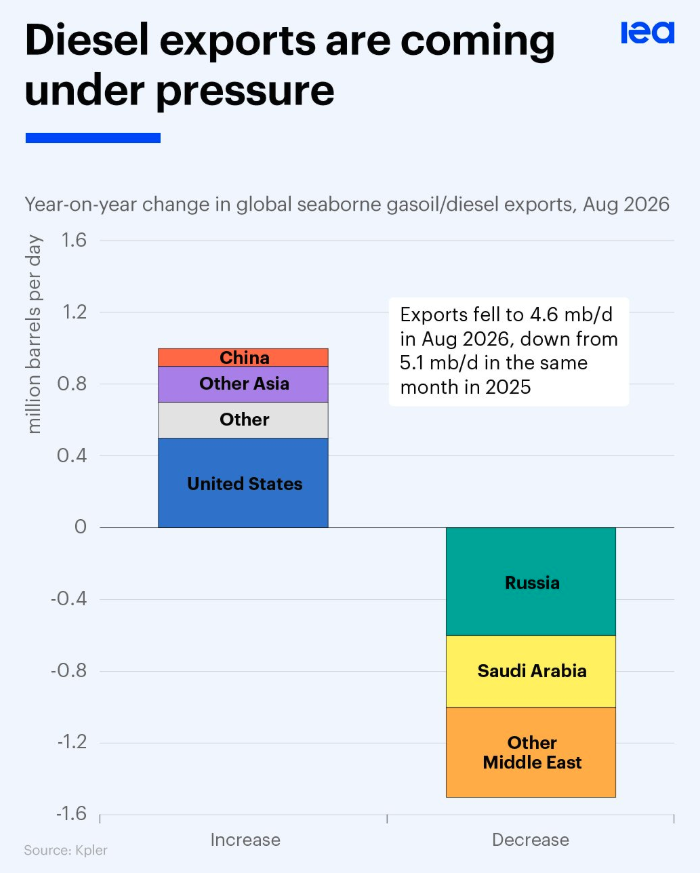
Source: iea.gov
According to IEA data, combined net diesel and gasoil exports from the Persian Gulf and Russia were around 1.6 million b/d lower in August than in February, before the war in the Middle East outbreak. The US helped replace part of global lost supply, since high margins encouraged American refineries to increase runs. US diesel exports rose from around 1 million b/d in February to a record 1.6 million b/d in August, an increase of around 60%.
Higher US production helped ease some of the pressure on global markets. For example, Brazil, which had to replace lost Russian supplies, imported around 208k b/d of diesel from the US Gulf Coast in August, accounting for 74% of its total diesel imports.
However, the decision to export additional fuel is not driven only by price differences between markets and arbitrage opportunities. Regulatory costs also matter, including US Renewable Volume Obligations (RVO), which are linked to renewable fuel requirements and settled through RIN credits. Selling conventional diesel on the domestic market generally increases these obligations, at the same time fuel produced and properly documented for export is excluded from their calculation.
There are logistical obstacles within the US as well, so a fuel surplus on the Gulf Coast does not mean that it can be delivered quickly and cheaply to every part of the country.
“New Congress” and future of the war
For the short and medium term outlook for the oil market, developments in the Middle East and Ukraine will remain key. This raises the question of whether potential changes in Congress could affect the current direction of US administration policy, particularly towards the Middle East, where further escalation remains one possible development.
Current polling suggests that a scenario in which Republicans lose control of the House of Representatives should be taken into account. However In the Senate the results in individual states matter more, so a nationwide Democratic lead cannot be directly translated into the number of seats.
A potential Democratic takeover of the House could make it harder for the administration to finance further stages of the war and increase pressure to explain the conditions under which it could end. In such a scenario, the administration's reaction would be important for the market, particularly whether a weaker Republican position would increase its willingness to negotiate. In this context it is worth remembering that the new Congress will not take office until 3 January 2027.
In relations between Washington and Moscow, the impact could be different. If the war is not over by the end of the year, stronger pressure from Congress to maintain support for Kyiv and limit concessions to Russia could make agreements similar to the one announced on 9 October more difficult. That agreement concerned Russian diesel supplies and was accompanied by a temporary easing of US sanctions. On the other hand, if Republicans retain control of both chambers, the administration would have more space to continue its current policy, provided it still wants to do so.
A broader factor behind these developments is the changing relationship between the US and oil-producing countries, which could weaken OPEC's unity. The United Arab Emirates left OPEC and OPEC+ on 1 May 2026, gaining greater freedom to use its production capacity. The decision is consistent with the US interest in increasing crude oil availability.
Media reports also linked the decision to discussions about a US dollar swap line for the UAE, which Scott Bessent confirmed. However, the fact that these events happened around the same time does not prove that leaving OPEC was a condition for US support.
Moreover, Bloomberg reported in August that Venezuela, which is strengthening its cooperation with the US, was also considering leaving the organisation. In Venezuela's case, the initial importance of such a decision would be mainly political, as the country is already exempt from production quotas.
Potential changes in Congress could be particularly important for agreements with Venezuela. Greater pressure for transparency and political conditions could complicate the opening of the oil sector to American companies - democrats have already raised such concerns. In February, Chuck Schumer and Adam Schiff (both members of Democratic Party) introduced the Venezuela Oil Proceeds Transparency Act, calling for an independent audit of the agreement and the management of revenues from Venezuelan oil sales.
However, it is important to remember that current decisions on sanctions licences remain largely in the hands of the administration.
Political certainty is a key to drive investment
Looking slightly further ahead, the question of how effective the "drill, baby, drill" policy can be becomes important again. For this policy to work, the industry needs confidence that major projects will operate under stable regulatory conditions, even after a change of administration.
The Keystone XL project showed how important this can be. It received approval during Trump's first term, but was abandoned in 2021 after Joe Biden revoked its permit. Trump's renewed support during his second term did not automatically lead to the project's restart.
Today, similar questions concern the stability of conditions for the Prairie Connector and Liberty Bridge projects, the latter being developed jointly with Bridger. Both projects aim to increase the capacity to transport Canadian crude to the US.
Another good example is South Bow, which has already secured 20-year customer commitments covering 465k b/d, but ahead of the final investment decision planned for mid-2027, the company continues to stress the need for lasting permits and regulatory certainty.
If Republicans lose the midterms, some companies may see this as a signal that the current policy direction could be less durable and become more cautious.
In this context, latest Dallas Fed survey also shows that higher cash flow does not necessarily shift mainly into new investment. In the Q3 survey, 50% of representatives of large oil and gas producers said that returning capital to shareholders or owners would be their main use of additional cash and 21% chose capital expenditure.
Among smaller companies, investment was the most common answer, selected by 31% of respondents. Some comments also raised concerns that frequent changes in administration priorities encourage companies to delay decisions.
Data centres and political cost of energy
The importance of energy in the midterms goes beyond oil and fuel prices. With the ongoing AI revolution, another important issue is whether the US energy system can support the expansion of data centres.
The IEA forecasts that US electricity consumption will increase by almost 2% annually between 2025 and 2030, with data centres accounting for around half of this growth. This makes the question of who will pay for the required power plants and grid expansion increasingly important.
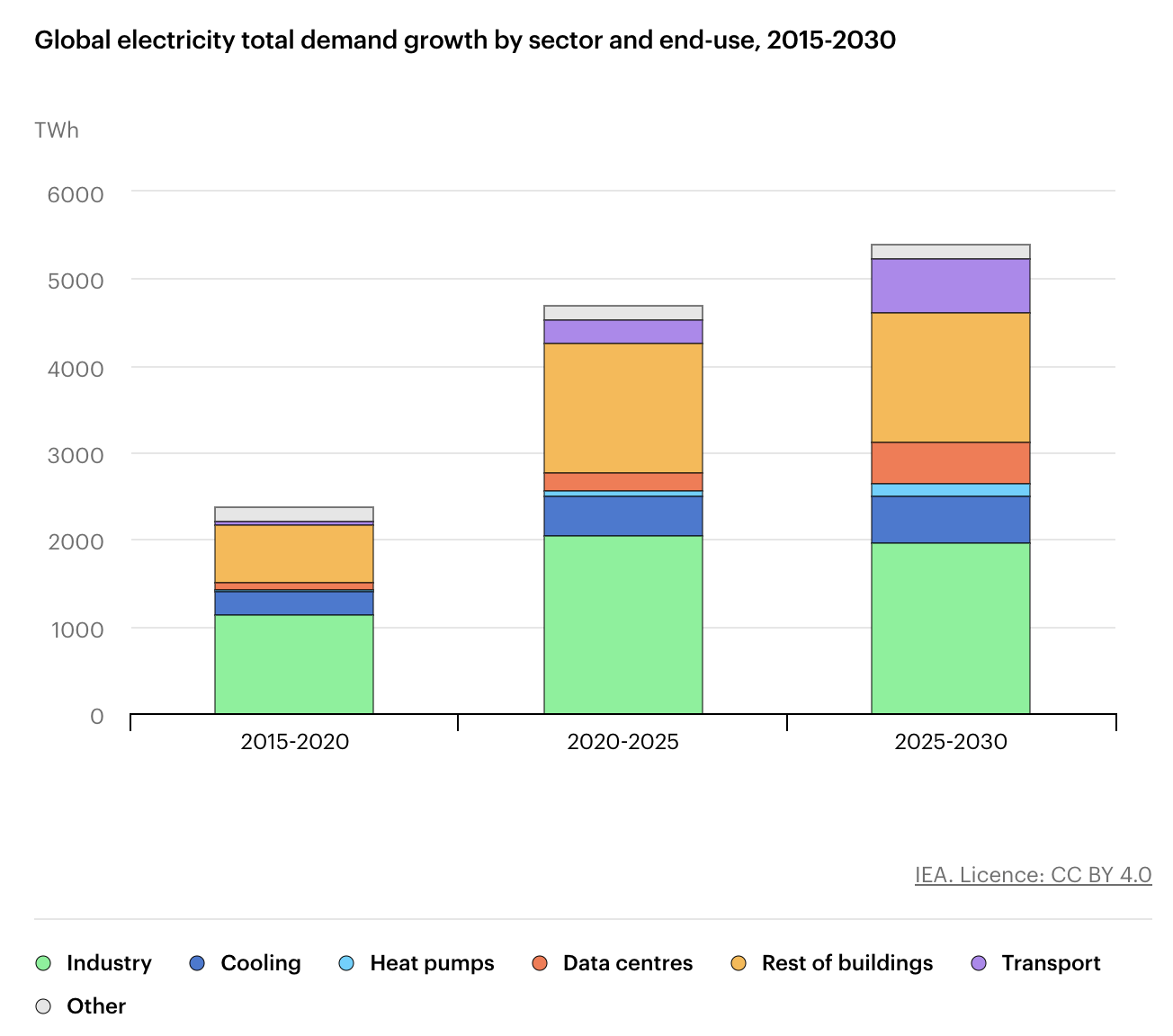
Source: iea.gov
A simple breakdown between parties supporting and opposing AI would be misleading. In September, the House of Representatives passed the Ratepayer Protection Act by 417 votes to 3. The bill would require state regulators to consider standards under which large electricity consumers would bear the infrastructure costs needed to serve them.
However, the bill failed to secure the required procedural majority in the Senate. On 30 September, 57 senators voted to move it forward, short of the required 60. Opponents. mainly Democrats, argued that simply requiring regulators to consider such standards would provide too little protection for consumers. This may suggest that Democratic gains could increase pressure for more binding rules to protect electricity consumers and require the technology sector to finance grid expansion.