

Europe finds its moment as US Tech faces a higher hurdle
European stocks stand out as AI concerns weigh on the areas most exposed to technology.
Markets are ending a week that has exposed an increasingly important divergence across global equities. US and Asian stocks have struggled under the weight of hotter inflation, elevated bond yields and renewed questions around the AI trade, while European equities have proved surprisingly resilient. The contrast says a lot about where investors currently see both risk and opportunity.
In the US, Wednesday's hotter CPI report was a key inflexion point. Persistent core services inflation challenged hopes that the Fed could comfortably pause after September's hike, pushing investors to reconsider the possibility of further tightening. The effect has been particularly uncomfortable for the Nasdaq: with Treasury yields already above 5%, the risk-free return available to investors is rising just as highly valued technology companies enter earnings season with an enormous amount to prove.
That pressure has been amplified by narrow market breadth. This week the Nasdaq is down around 2.8%, versus roughly 0.9% for the S&P 500, illustrating how quickly that concentration can become a vulnerability when AI expectations or interest-rate assumptions are challenged. Thursday's recovery provided some relief but did little to resolve the underlying valuation debate.
The same dynamic has been even more visible in Asia, where markets have greater exposure to the semiconductor supply chain. South Korea's Kospi is down 14% so far this week, while Japan's Nikkei is down around 5%, as concerns about AI financing and high US yields triggered a sharp unwind. Some of those losses are attempting to be recovered on Friday, but the episode highlights how dependent parts of Asia have become on continued confidence in the global technology investment cycle.
Why has Europe performed so much better?
Ironically, Europe's relative lack of exposure to the AI boom has become an advantage this week. European indices have a much larger weighting towards banks, healthcare, industrials, consumer staples and other value-oriented sectors, leaving them less exposed to the duration sensitivity affecting US and Asian technology stocks. Defensive sectors have attracted capital as investors look for alternatives to expensive AI names, while healthcare has been a particularly strong performer.
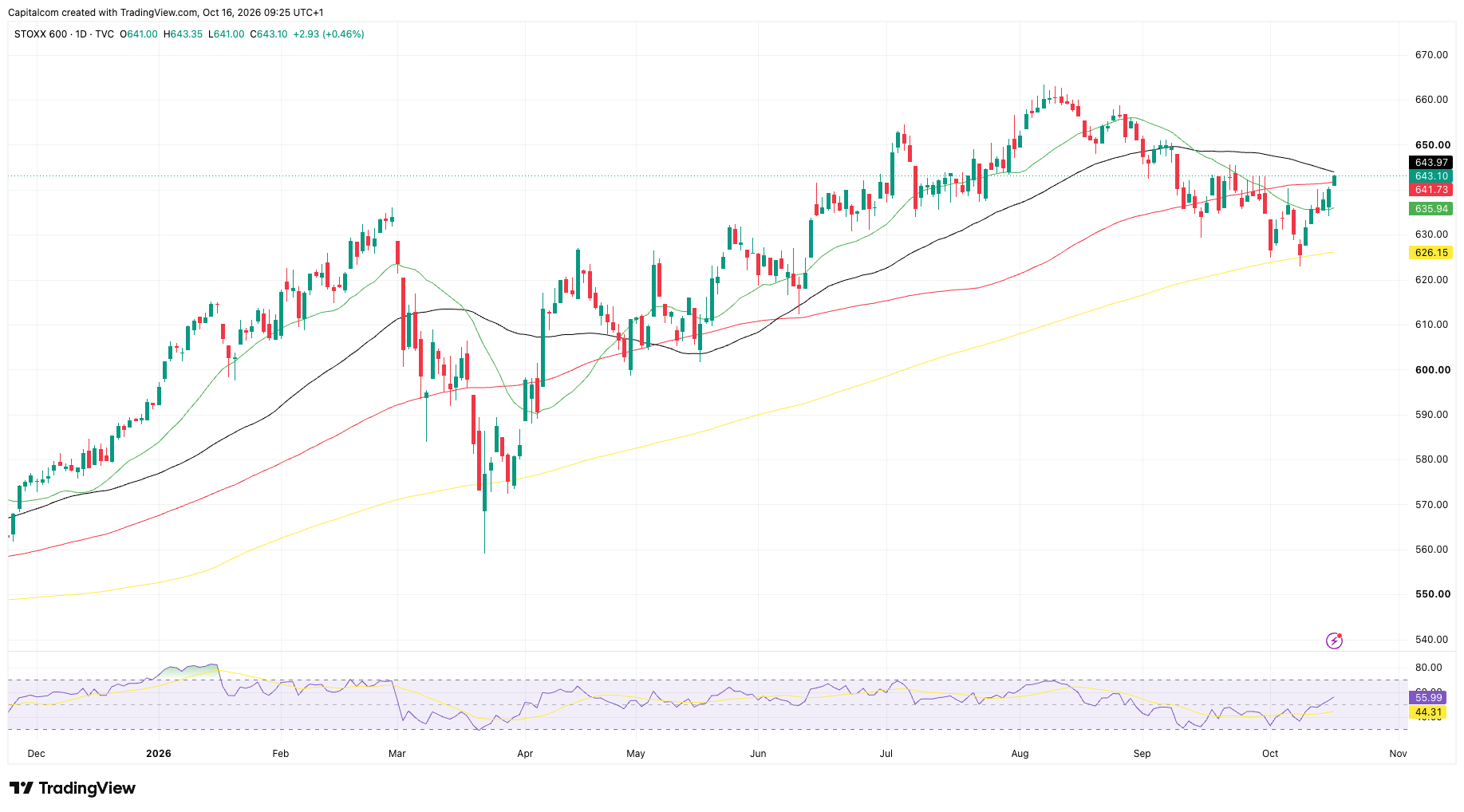
Corporate earnings have helped as well. The STOXX 600 reached its highest level in more than two weeks on Friday, supported by better-than-expected results from companies including Ericsson and strength in healthcare. Banks also started the week strongly, benefiting from an environment where higher rates can continue supporting margins.
Stoxx 600 daily chart
Past performance is not a reliable indicator of future results.
There is a degree of irony here. Europe has spent much of the year being criticised for lacking the technology exposure that propelled US markets higher. When investors become nervous about AI valuations and the cost of financing that investment, the same characteristic suddenly looks defensive.
That doesn't eliminate Europe's longer-term challenges—growth remains softer, political fragmentation persists and sovereign spreads remain an important risk—but it does mean the region currently offers investors greater sector diversification and generally less demanding valuations.
Earnings offer some reassurance—but the real test is still ahead
The first major US bank results have generally reinforced the idea that corporate America remains in relatively good health. Strong trading activity and resilient consumers have supported profits, even as elevated borrowing costs begin affecting some areas of lending and dealmaking. That is encouraging because the central question for equities is increasingly whether earnings can grow quickly enough to compensate for higher discount rates.
But banks are only the opening act. The more important test comes when companies at the centre of the AI investment cycle begin reporting. If hyperscalers can demonstrate that enormous spending on data centres, semiconductors and infrastructure is translating into accelerating revenue and cash flow, the technology rally could regain momentum. If returns disappoint while Treasury yields remain above 5%, the market may become much less forgiving.
Next week: Earnings take over from macro
After CPI dominated this week, corporate earnings should become the main market catalyst next week. The calendar includes Netflix, Tesla, Meta, IBM, General Motors, American Express and several other major companies.
For technology, the emphasis will increasingly shift from how much companies are spending on AI to what they are getting back from that spending. Meta's results will be particularly interesting given recent enthusiasm around its AI products, while Tesla will provide another test of how willing investors remain to pay for long-term growth narratives when near-term profitability faces pressure.
The macro calendar is comparatively lighter, although Friday's flash US PMIs should provide an important update on whether the economy remains strong enough to tolerate restrictive monetary policy. Weekly jobless claims and consumer sentiment will also help assess whether the deterioration seen in September's labour data is becoming more persistent.
The key takeaway from this week is that in the face of rising price pressures the hurdle rate for equities is rising. When government bonds offer returns above 5%, investors no longer need to accept expensive equity valuations purely for the promise of future growth. Companies increasingly need to demonstrate exceptional earnings, durable cash generation and convincing returns on investment.