

US inflation set to accelerate as oil prices complicate Fed outlook
Markets await the US CPI data for September to determine whether the latest inflationary pressures are primarily the result of higher energy prices or evidence of more persistent underlying inflation.
US inflation is back in the spotlight this week, with Wednesday's CPI report expected to show another acceleration in price pressures as elevated energy costs continue to filter through the economy. The release comes at a particularly sensitive moment for financial markets, with investors struggling with rising Treasury yields, a stronger US dollar and uncertainty over how aggressively the Federal Reserve will need to tighten monetary policy.
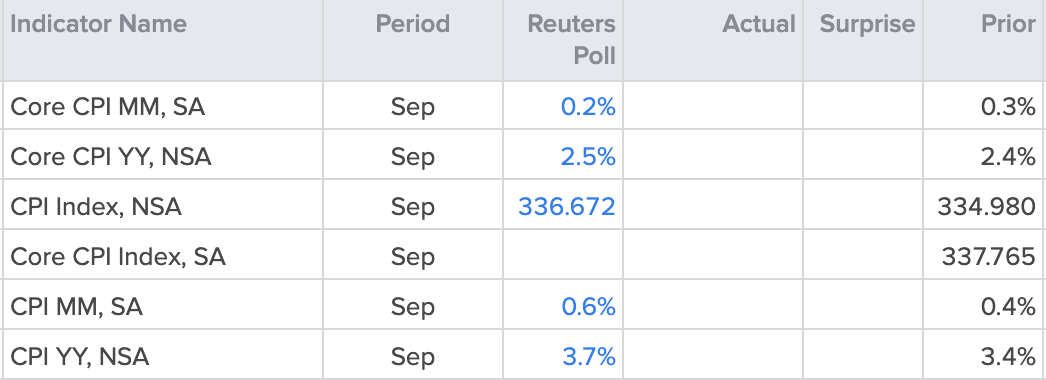
Economists expect headline inflation to rise to around 3.7% year-on-year in September, up from 3.4% in August. Core inflation is forecast to edge higher to 2.5% from 2.4%, although the monthly reading is expected to moderate to 0.2% from 0.3%. The breakdown will be important as investors attempt to determine whether the latest inflationary pressures are primarily the result of higher energy prices or evidence of more persistent underlying inflation.
Source: Refinitiv
Higher crude prices have translated into increased gasoline and transportation costs, feeding directly into headline inflation. The August CPI report already showed the impact, with gasoline prices rising 3.9% month-on-month and accounting for more than a third of the overall monthly increase in consumer prices. September's data is expected to reflect a continuation of those pressures, potentially pushing headline inflation further away from the Fed's 2% target.
However, the market will want to know whether these higher energy costs are beginning to spread into other areas of the economy. An increase in transportation and production costs can eventually filter through to consumer goods and services, creating the risk of more persistent inflation even if oil prices subsequently stabilise. This second-round effect is what policymakers will be particularly concerned about. For that reason, the core CPI reading may ultimately prove more influential for financial markets than the headline figure.
After last month’s 25 bps hike, the Fed has subsequently adopted a more cautious tone, suggesting that further tightening is not necessarily imminent. Markets have responded by scaling back expectations for another hike at the October meeting, with futures currently implying a probability of around 20%. As a result, Wednesday's inflation report in a potentially decisive position. A stronger-than-expected reading, particularly in core inflation, could revive expectations of another increase before year-end and challenge the view that the Fed can afford to remain patient. Conversely, a softer core reading would support the argument that the central bank has already done enough to contain underlying price pressures, allowing policymakers to look through some of the temporary inflationary impact of higher energy costs.
What does this mean for the US dollar, gold and equities?
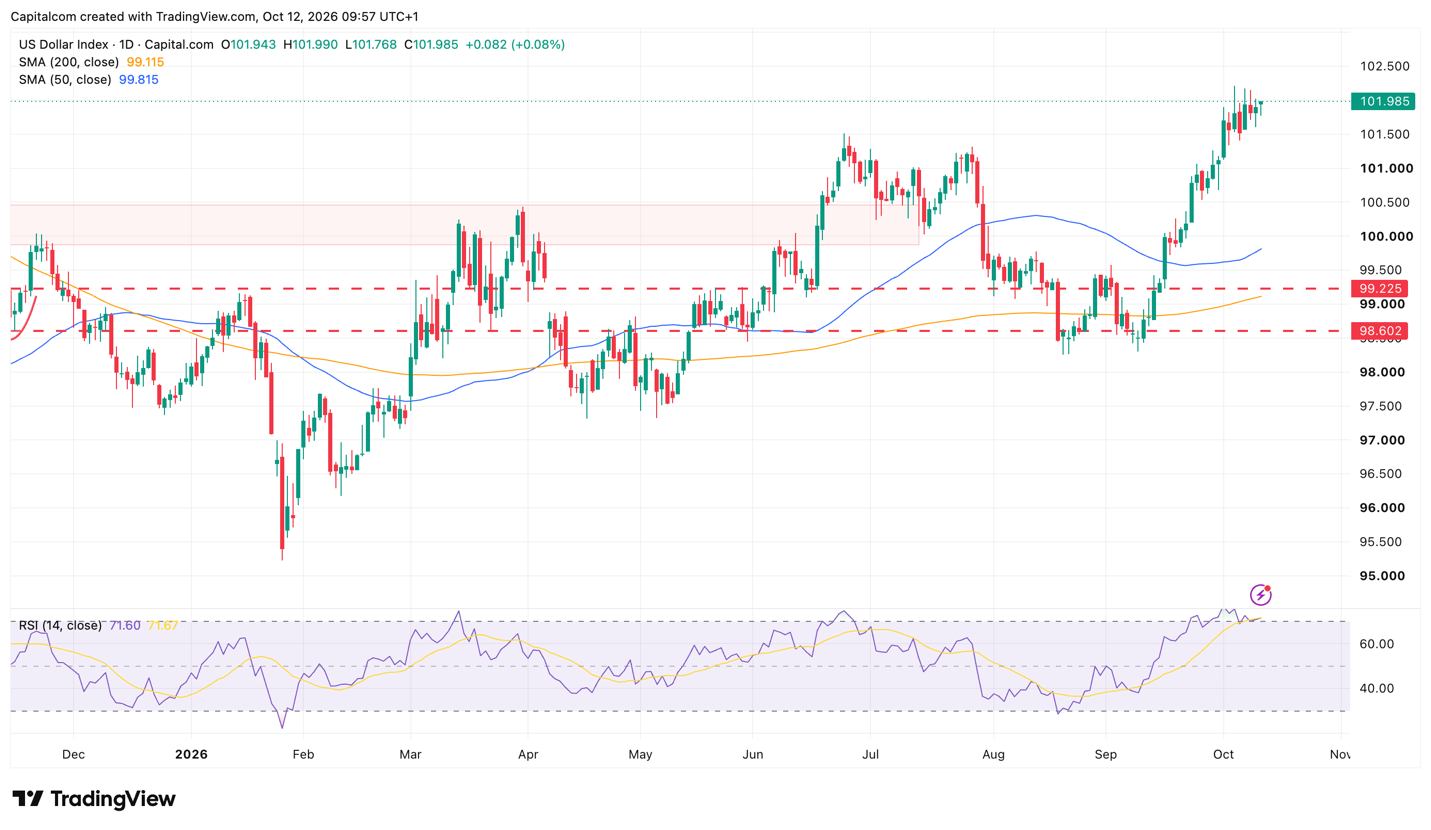
US dollar index (DXY) daily chart
Past performance is not a reliable indicator of future results.
US dollar: The dollar has benefited from rising Treasury yields and expectations that US monetary policy will remain restrictive. A hotter-than-expected CPI report could provide another boost, particularly if investors increase their expectations for additional Fed tightening. Conversely, softer inflation could trigger some profit-taking and allow currencies such as the euro and yen to recover.
Gold: Bullion remains caught between competing forces. Geopolitical uncertainty continues to underpin its longer-term appeal, but rising real yields and a stronger dollar have become significant short-term headwinds. An upside surprise in core inflation could put renewed pressure on gold, while evidence of easing underlying price pressures could provide some relief by pulling yields lower.
US equities: Equity markets have remained relatively resilient despite the challenging macroeconomic backdrop, with technology stocks continuing to benefit from optimism surrounding artificial intelligence and the start of the third-quarter earnings season. However, higher yields are particularly challenging for growth stocks, whose valuations depend heavily on expectations for future earnings. A hotter CPI reading could therefore trigger renewed volatility in the Nasdaq and S&P 500, particularly given the strength of their recent rallies.