

US equities retreat as 10-year yield pushes above 5%
US equities pull back from recent highs as yields move higher on the back of strong economic data.
US equities have spent much of September demonstrating remarkable resilience, but the latest surge in Treasury yields is beginning to test just how much higher borrowing costs the market can tolerate. Both the S&P 500 and the Nasdaq dropped on Wednesday, only days after technology stocks had pushed back towards record territory. The catalyst was not weaker growth or deteriorating earnings, but almost the opposite: US economic data were considerably stronger than expected.
The S&P Global composite PMI jumped from 56.0 to 58.4 in September, its highest since July 2021, with activity accelerating across both manufacturing and services. That is encouraging from a fundamental perspective because it suggests recession risk remains low and corporate revenues continue to benefit from a resilient economy. But it also makes last week's Fed hike look increasingly justified and strengthens the argument for additional tightening. Fed funds futures moved to price roughly a 73% probability of another hike in October following the release.
Target rate probability changes for Oct 28 Fed meeting

Source: CME FedWatch
Good news for the economy is becoming bad news for equities
Strong growth normally supports stocks because it improves the earnings outlook. But when inflation remains above target and the Federal Reserve has already restarted its tightening cycle, sufficiently strong economic data can become problematic because they imply interest rates may need to remain higher for longer.
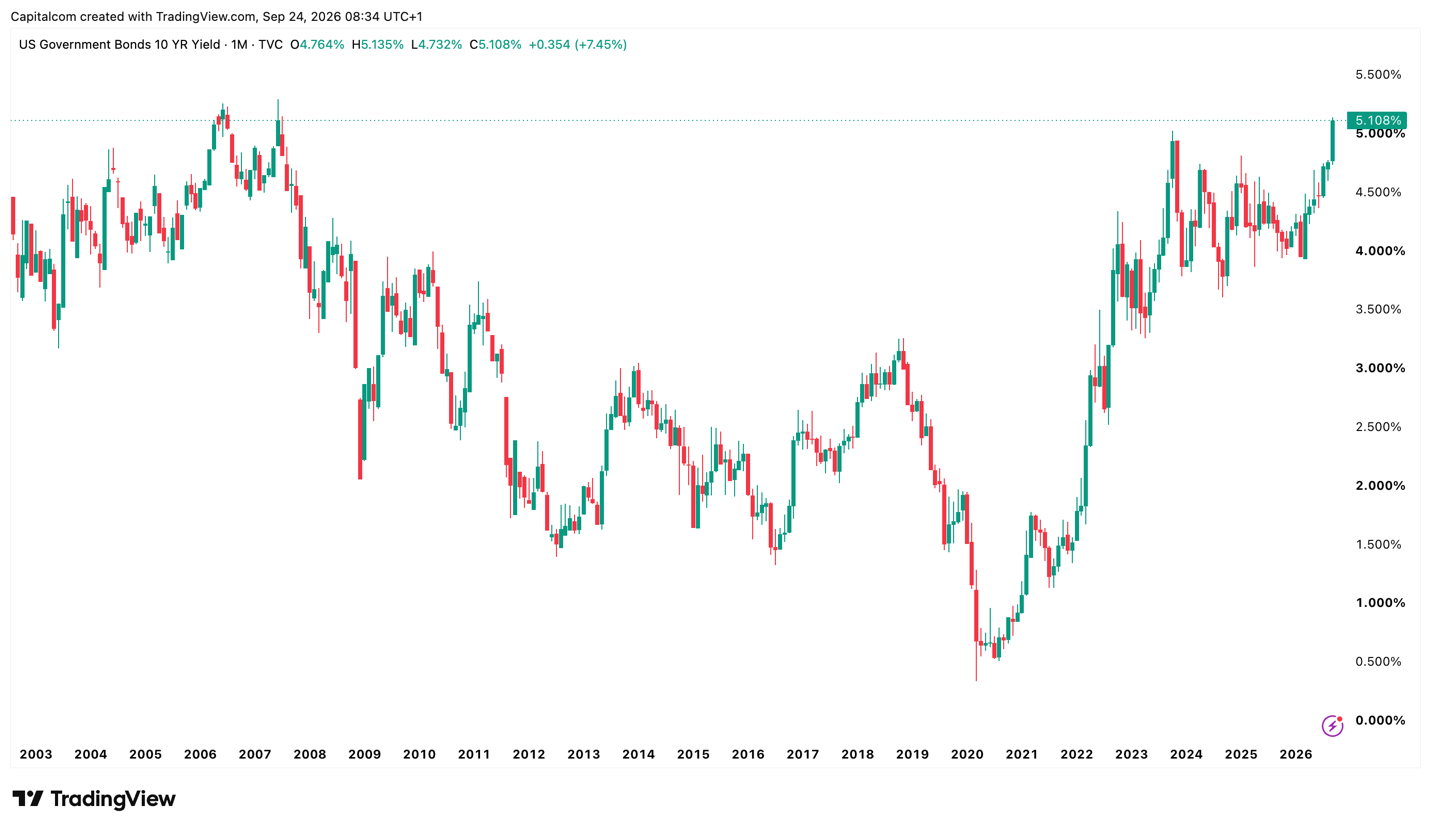
As a result, the 10-year Treasury yield surged above 5% and briefly approached 5.13%, its highest since 2007. The five-year yield has also moved through 5%, showing that the repricing is spreading across the curve rather than being isolated to the very long end. This has become a headwind for equities because a higher risk-free rate raises the discount rate applied to future corporate earnings and simultaneously gives investors a more attractive alternative to stocks. When Treasuries offer yields above 5%, equities—particularly companies trading on elevated multiples—have to work considerably harder to justify the additional risk.
US 10-year yield monthly chart
Past performance is not a reliable indicator of future results.
This is especially relevant for the technology sector. AI optimism remains strong and earnings expectations continue to provide fundamental support, but many technology companies derive a large proportion of their valuation from profits expected far into the future. Those cash flows become less valuable as real yields rise, explaining why the Nasdaq has been particularly sensitive to the latest bond sell-off.
This doesn't look like a conventional inflation scare
There is an important nuance behind the rise in yields. It would be easy to attribute the move to renewed inflation fears following the Middle East energy shock, but the evidence suggests that is only part of the story. Market-based longer-term inflation expectations have remained relatively contained. Instead, real yields have risen substantially, suggesting investors are demanding higher inflation-adjusted returns rather than simply pricing an uncontrolled acceleration in consumer prices.
The latest PMI reinforces that interpretation. The economy is not merely avoiding recession; it appears to be accelerating. S&P Global reported the strongest business activity growth in more than five years, alongside increasing capacity constraints and faster input-cost growth. That combination tells bond investors that the economy may be capable of sustaining higher real interest rates than previously assumed.
In that sense, this could be described as a relatively “good” bond sell-off: yields are rising partly because expectations for economic growth are improving rather than because investors are losing confidence in US inflation or fiscal credibility. The problem is that good reasons for higher yields do not necessarily make them good for equity valuations.
Furthermore, the psychological significance of the 10-year moving above 5% should not be underestimated. Mortgage rates have moved back above 7%, corporate borrowing costs are rising, and financial conditions are tightening even before the Fed decides whether another policy-rate increase is required. That creates an increasingly important question for Wall Street: at what point does economic resilience become self-defeating?
So far, corporate earnings have allowed equities to absorb much of the increase in yields. AI-related investment has also provided a powerful source of growth and investor enthusiasm. But the higher the risk-free rate climbs, the more earnings need to grow simply to justify existing valuations.
That does not automatically mean the equity rally has ended. If economic activity remains strong enough to produce continued earnings upgrades, companies can partially grow into their valuations. A strong economy combined with robust profit growth is fundamentally different from a stagflationary environment in which yields rise while earnings deteriorate. But the margin for disappointment becomes smaller.
There is also an interesting feedback loop developing between the AI boom and the bond market. The enormous investment required for data centres, semiconductors, power generation and networking infrastructure is helping support economic growth. But it is also increasing demand for capital at precisely the moment the US government is financing very large deficits.
That competition for capital can itself contribute to structurally higher real yields. In other words, one of the forces supporting equity earnings—AI investment—may simultaneously be contributing to the higher borrowing costs that pressure equity valuations. For the moment, investors have been willing to tolerate that trade-off because the earnings generated by the AI cycle remain compelling. But recent concerns around hyperscaler capex and returns on investment show that the market is becoming more selective. If AI earnings expectations weaken while bond yields remain above 5%, the valuation adjustment could become considerably more uncomfortable.