

Bond markets are exposing Europe’s uneven outlook
European bonds show a widening economic gap in Europe as the ECB continues to raise rates.
European equities have shown considerable resilience this year, but the economic backdrop underneath the rally is becoming increasingly uneven. Growth remains subdued, inflation has reaccelerated following the Middle East energy shock, and the ECB has restarted its tightening cycle. More recently, a sharp widening in sovereign bond spreads has added another source of uncertainty, highlighting growing differences in how investors perceive fiscal and political risk across the region.
The result is an increasingly fragmented European investment landscape. The economic picture is not uniformly negative. September's flash PMI showed euro-area business activity expanding at its fastest pace since April 2023, with the composite index rising to 53.1 from 52.0. Manufacturing has improved, particularly in Germany, helped by defence, infrastructure and AI-related investment, while France recorded its first expansion in activity in ten months. The ECB expects euro-area GDP to grow only 0.9% in 2026, followed by 1.4% in 2027 and 1.5% in 2028.
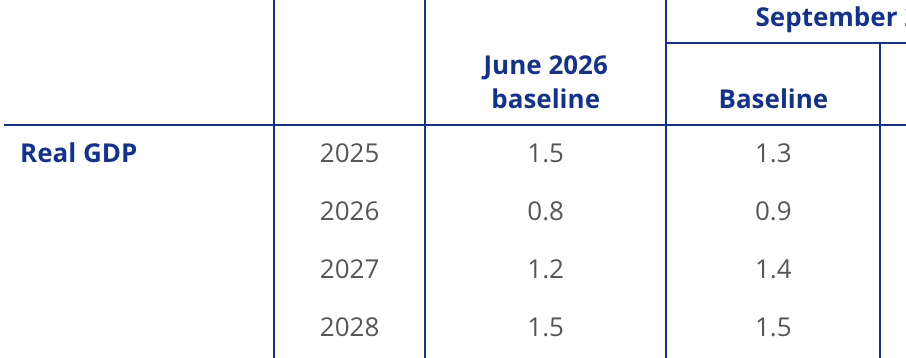
Source: ecb.europa.eu
However, Europe remains particularly exposed to energy. September inflation reached 3.8%, driven largely by the surge in oil and gas prices following the Middle East conflict. Core inflation is considerably more contained at 2.5%, suggesting the problem is still primarily external rather than evidence of a major domestic wage-price spiral. But that distinction only provides limited comfort if energy remains expensive for long enough to squeeze household incomes and corporate margins. That leaves the ECB facing an uncomfortable trade-off. It has already raised rates to prevent the energy shock becoming embedded in underlying inflation, but tighter policy is simultaneously being applied to an economy growing at less than 1% annually.
The bond market in focus
The more immediate concern is what is happening in sovereign debt. German Bunds have attracted strong safe-haven demand even as borrowing costs elsewhere in Europe have risen. The French-German 10-year spread recently reached around 150 basis points, its widest since 2012, while Italian yields have also come under renewed pressure.
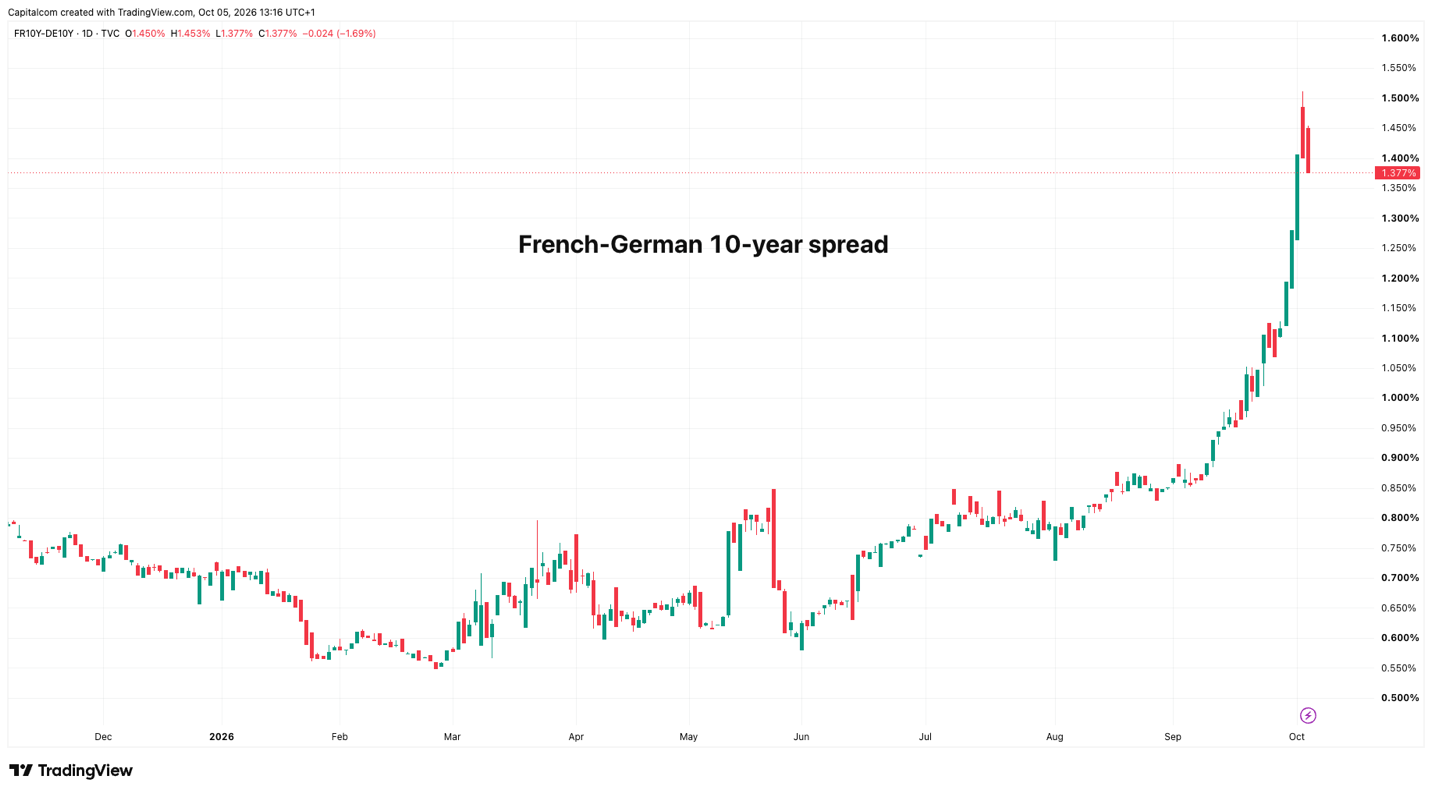
Past performance is not a reliable indicator of future results.
The divergence is important because the euro area shares a currency and a central bank, but it does not share a single fiscal authority or sovereign bond market. Germany enters this period with relatively greater fiscal credibility and lower debt, allowing its bonds to behave as a haven. France, by contrast, faces a much more difficult combination of weak growth, large deficits and rising debt, whilst Italy’s very high public debt means markets remain sensitive to any deterioration in fiscal credibility or rise in borrowing costs.
That creates a potentially damaging feedback loop. Higher sovereign yields increase debt-servicing costs, which make fiscal consolidation harder. Attempts to repair the fiscal position through aggressive spending cuts or tax increases can then weaken economic growth and reduce government revenues, making the debt dynamics harder to stabilise.
What does this mean for European equities?
European indices contain many multinational companies whose earnings depend more heavily on global demand than domestic European GDP. This helps explain why European equities have remained relatively resilient despite the deteriorating sovereign backdrop. There are also sectors that can benefit directly from the current environment. Banks have been one of the clearest winners. Defence and infrastructure companies also continue to benefit from structural increases in government spending, while parts of European manufacturing are receiving support from AI, electrification and supply-chain investment.
MSCI Europe Financials
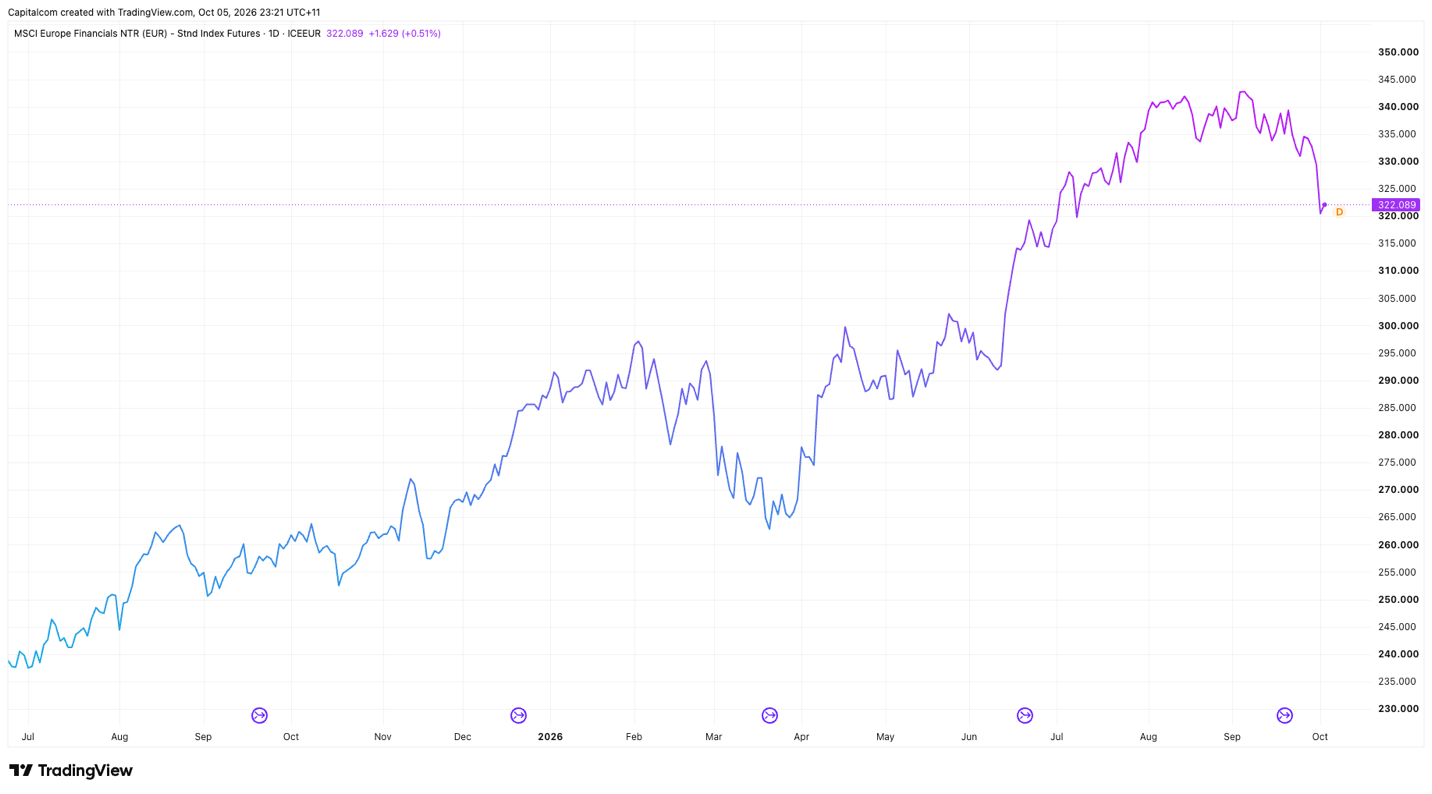
Past performance is not a reliable indicator of future results.
The difficulty is that those positives increasingly coexist with higher financing costs and greater country-specific risk. Companies dependent on domestic demand, particularly in property, construction, consumer discretionary businesses and highly leveraged companies, which could become more vulnerable if sovereign yields remain elevated and lending conditions tighten.
However, Europe still has one important advantage relative to the US: expectations are lower. US equity valuations have been driven higher by exceptional earnings growth and enthusiasm surrounding AI, while European markets continue to trade at a sizeable valuation discount. That gives Europe somewhat more room to absorb disappointing macroeconomic news without requiring the same degree of multiple compression.
But cheap valuations alone are not necessarily a catalyst. For that discount to narrow sustainably, investors need evidence that Europe can deliver stronger productivity growth, improve political stability and finance its strategic investment priorities without generating persistent fiscal stress. The widening in sovereign spreads works against that argument because it increases the cost of capital precisely when Europe needs more investment.
A more selective European market
Overall, the outlook for European equities is becoming increasingly selective. Germany's improving manufacturing backdrop and fiscal capacity create a different investment environment from France's combination of weak growth and fiscal uncertainty. Southern European economies have different growth dynamics again, while internationally exposed companies remain far less dependent on domestic conditions than local businesses. The sector divide may become equally important. Banks, defence, infrastructure and selected industrial companies have structural tailwinds, while highly leveraged businesses and companies heavily exposed to domestic consumption may struggle if borrowing costs remain elevated.
There is also a potentially positive scenario. Oil has fallen considerably from its September highs as US-Iran negotiations progress. If energy prices continue easing, inflation could fall more quickly, reducing pressure on the ECB to tighten further and improving household purchasing power. That combination would materially improve Europe's growth outlook.