

BAE Systems stock forecast: H1 results, guidance upgrade
BAE Systems is a UK defence and aerospace group listed in London. In August 2026, it secured a $149.8m US Navy award for work on the USS Boxer. Explore third-party BA. price targets and technical analysis. Past performance is not a reliable indicator of future results.
BAE Systems plc (BA.) is trading at £19.62 as of 11.19am UTC on 7 September 2026, within an intraday range of £19.52–£19.78. Past performance is not a reliable indicator of future results.
Recent trading has coincided with further contract news. BAE Systems secured a $149.8m US Navy award for maintenance and modernisation of the USS Boxer (IN Defence, 27 August 2026) and outlined an expected US contract covering 2,800 THAAD interceptor seekers (Defence Industry Europe, 5 September 2026). In Australia, the company laid the keel for the first Hunter-class frigate on 24 August (Asian Military Review, 7 September 2026) as governments continued to increase defence spending.
BAE Systems outlook: defence demand and share pullback
As of 7 September 2026, third-party BAE Systems stock predictions show a broad range of estimates, reflecting different approaches across brokers, consensus providers and quantitative models.
Stockscan.io (algorithmic model forecast)
Stockscan.io projects an average September 2026 target of $17.04 for BAE Systems' US over-the-counter (OTC) line, BAESF, with a range of $16.90–$17.83. The model uses historical price patterns rather than fundamental analysis (Stockscan.io, 19 August 2026).
MarketBeat (consensus snapshot)
MarketBeat reports an average 12-month target of £22.75 from five analysts, with estimates ranging from £21–£24.50. The consensus rating is Hold (MarketBeat, 5 September 2026).
Financhill (algorithmic forecast)
Financhill forecasts BAE Systems' US-listed ADR (BAESY) at $113.95 over the next 52 weeks, based on a proprietary model using 27 years of historical price data. Its Financhill Stock Score stands at 41 out of 100 (Financhill, 3 September 2026).
Investing.com UK (consensus estimates)
Investing.com UK reports an average 12-month analyst target of £23.43 from 19 analysts, with estimates ranging from £17–£26.20. The platform lists the consensus rating as Buy (Investing.com UK, 4 September 2026).
Goldman Sachs (buy rating)
Goldman Sachs raised its BAE Systems target to 2,440p from 2,400p while maintaining a Buy rating, following a wider series of broker updates across the sector (LSE, 13 August 2026).
Predictions and third-party forecasts are inherently uncertain, as they cannot fully account for unexpected market developments. Past performance is not a reliable indicator of future results.
BAE Systems latest and upcoming earnings
BAE Systems reported its half-year 2026 results on 30 July. Sales rose 9% to £15.772bn and underlying earnings before interest and tax (EBIT) increased 11% to £1.701bn, while underlying earnings per share grew 13% to 38.9p (Investegate, 30 July 2026).
Order intake reached £16.4bn, up from £13.2bn a year earlier, taking the backlog to a record £84bn. Free cash flow was £1.791bn, compared with a £368m outflow in H1 2025. BAE also raised its interim dividend by 11% to 15.0p and returned £933m through dividends and buybacks. The results prompted the company to upgrade its full-year guidance (Yahoo Finance, 30 July 2026).
Higher sales, orders and upgraded guidance may support earnings expectations, although delivery costs, contract timing or slower defence spending could affect future performance.
BAE Systems' financial calendar lists the interim dividend payment on 2 December as its next scheduled corporate event, with no further trading update or results announcement currently listed before then (BAE Systems, accessed 7 September 2026).
BA. stock price: technical overview
The BA. stock price trades at £19.62, below its 20/50/100/200-day simple moving averages (SMAs) at roughly £21.22/£20.30/£19.96/£19.91, according to TradingView. The 100-day and 200-day averages sit relatively close to the current price, while the shorter-term levels remain further above.
The 14-day relative strength index stands near 32.2, just above the commonly used oversold threshold of 30. The 14-day average directional index is 30.6, suggesting a more established trend without indicating its direction.
Above the market, the classic pivot near £21.19 provides the first reference, followed by resistance around £22.07 and £23.70. Below, the S1 pivot near £19.56 is the nearest level. A move higher could bring the upper references into focus, while a break below £19.56 could shift attention towards lower levels (TradingView, 7 September 2026).
This technical analysis is for informational purposes only and does not constitute financial advice or a recommendation to buy or sell any instrument.
BAE Systems share price history (2024–2026)
BA.’s stock price closed at £12.99 on 9 September 2024 before falling to a two-year low of £11.29 on 6 January 2025 amid changing expectations around Western defence budgets. By late February, the price had recovered above £14, and the shares ended 2025 at £17.12.
Price swings widened in 2026. BAE reached a two-year high of £23.63 on 18 March before falling back through the spring and summer. The shares closed at £19.63 on 7 September, around 14.6% higher year to date and 9.5% higher year on year.

Past performance is not a reliable indicator of future results. Share prices are indicative and may differ from live market prices.
BAE Systems (BA.): Capital.com analyst view
BAE Systems reported its half-year 2026 results on 30 July. Sales rose 9% to £15.772bn and underlying earnings before interest and tax (EBIT) increased 11% to £1.701bn, while underlying earnings per share grew 13% to 38.9p (Investegate, 30 July 2026).
Order intake reached £16.4bn, up from £13.2bn a year earlier, taking the backlog to a record £84bn. Free cash flow was £1.791bn, compared with a £368m outflow in H1 2025. BAE also raised its interim dividend by 11% to 15.0p and returned £933m through dividends and buybacks. The results prompted the company to upgrade its full-year guidance (Yahoo Finance, 30 July 2026).
Higher sales, orders and upgraded guidance may support earnings expectations, although delivery costs, contract timing or slower defence spending could affect future performance.
BAE Systems' financial calendar lists the interim dividend payment on 2 December as its next scheduled corporate event, with no further trading update or results announcement currently listed before then (BAE Systems, accessed 7 September 2026).
Capital.com’s client sentiment for BAE Systems CFDs
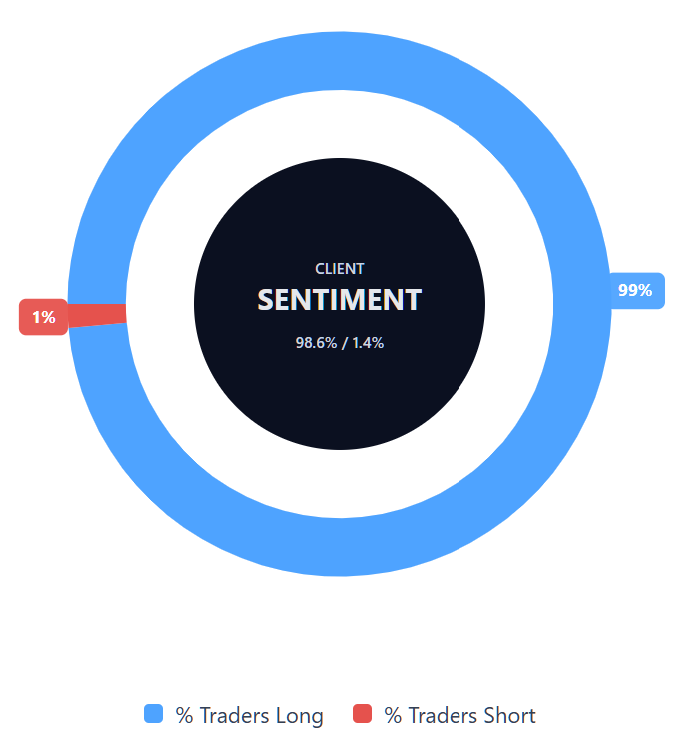
As of 7 September 2026, Capital.com client positioning in BAE Systems CFDs shows 98.6% buyers and 1.4% sellers, a difference of 97.2 percentage points. This reflects open positions among Capital.com clients rather than a market-wide indicator or forecast of future price direction, and it can change.
Summary – BAE Systems 2026
- As of 11.19am UTC on 7 September 2026, BAE Systems traded near £19.62, within an intraday range of £19.52–£19.78.
- According to TradingView data, the price was below its 20/50/100/200-day moving averages, with RSI at 32.2 and ADX at 30.6.
- Recent factors include defence contract awards, government spending and upgraded 2026 earnings guidance.
- Further contracts and defence spending could support expectations, while procurement delays, changing budgets or higher delivery costs could weigh on them.
- Recent news includes the $149.8m US Navy award, THAAD seeker production plans and progress on Australia's Hunter-class frigate programme.
Past performance is not a reliable indicator of future results.
FAQ
Who owns the most BAE Systems stock?
The article does not identify BAE Systems' largest current shareholder. Ownership can change as institutional investors, funds and other shareholders adjust their positions. For the latest breakdown, investors can review BAE Systems' shareholder disclosures, annual reports and regulatory filings, which provide the most reliable information on major holdings and changes in ownership over time.
What is the five-year BAE Systems share price forecast?
The article does not provide a five-year BA. stock forecast. The third-party estimates reviewed focus mainly on shorter-term targets, with London-listed analyst estimates ranging from £17–£26.20. Longer-term forecasts carry greater uncertainty because they depend on factors such as defence spending, contract wins, programme delivery, margins, geopolitical developments and broader market conditions.
Is BAE Systems a good stock to buy?
Whether BAE Systems is suitable depends on an individual's objectives, risk tolerance and wider portfolio, so this article does not make a buy or sell recommendation. Potential supportive factors include a large order backlog, higher defence spending and further contract wins. Risks include procurement delays, delivery costs, slower budget growth, currency movements and changes in geopolitical conditions or investor sentiment.
Could BAE Systems stock go up or down?
Yes. BAE Systems' share price can move in either direction as expectations change. Further defence contracts, higher government spending or stronger earnings could support the shares, while procurement delays, higher delivery costs or weaker budget growth could weigh on them. Geopolitical tensions may increase demand for defence equipment, whereas de-escalation or shifting defence priorities could have the opposite effect.
Should I invest in BAE Systems stock?
This article cannot determine whether BAE Systems is appropriate for any individual investor and does not provide investment advice. Factors to consider include earnings, order intake, defence budgets, contract execution and currency exposure. Recent analyst targets also span a wide range, reflecting differing assumptions about the outlook. Any investment decision should take account of personal objectives, risk tolerance and investment horizon.
Can I trade BAE Systems CFDs on Capital.com?
Yes, you can trade BAE Systems CFDs on Capital.com. Trading share CFDs lets you speculate on price movements without owning the underlying asset and to take long or short positions. However, contracts for difference (CFDs) are traded on margin, and leverage amplifies both profits and losses. You should ensure you understand how CFD trading works, assess your risk tolerance, and recognise that losses can occur quickly.