

BAE share price: record backlog and submarine contract
BAE Systems reported higher first-half 2026 sales, upgraded its full-year guidance and raised its order backlog to £84bn after securing a £5.9bn UK submarine contract. Explore third-party BA. price targets and technical analysis. Past performance is not a reliable indicator of future results.
BAE Systems plc (BA.) is trading around £22.09 at 8:42am UTC on 4 August 2026, after moving between £21.03 and £22.08 during the session, according to Capital.com’s price feed. Past performance is not a reliable indicator of future results.
The price action follows several company updates within a broadly supportive environment for the defence sector (Reuters, 30 July 2026). BAE Systems reported a 9% year-on-year increase in first-half 2026 sales to £15.77bn, an 11% rise in underlying earnings before interest and tax (EBIT) to £1.7bn, and a record £84bn order backlog (BAE Systems, 30 July 2026). The company also upgraded its full-year outlook amid higher defence spending and new orders, including a £5.9bn UK submarine contract announced in July (BAE Systems, 30 July 2026). More broadly, increases in government defence budgets in response to geopolitical and security concerns have influenced sentiment towards defence companies, including BAE Systems, in recent years (Reuters, 30 July 2026).
Third-party BAE outlook: guidance upgrade and record backlog
As of 4 August 2026, third-party BAE Systems share price predictions include broker views and consensus snapshots updated after the company published its half‑year results on 30 July 2026, reflecting estimates that may evolve as new information emerges.
Yahoo Finance analyst snapshot
Yahoo Finance lists a 12-month average analyst price target of 2,306.28p, or £23.06, for BAE Systems as of 2 August 2026. Its estimates range from 1,700p, or £17, to 2,610p, or £26.10. The spread between the lowest and highest estimates reflects differing assumptions about the company's earnings, valuation and operating outlook. The average target sits above the share price recorded after the late-July results update (Yahoo Finance, 2 August 2026).
MarketBeat consensus forecast
MarketBeat reports a consensus 12-month price target of 2,267.50p, or £22.68, as of 31 July 2026. The figure is based on five analyst ratings, with estimates ranging from 2,100p, or £21, to 2,450p, or £24.50. MarketBeat assigned the stock a 'Moderate Buy' consensus rating, based on the analyst ratings included in its calculation following the company's half-year earnings and upgraded 2026 outlook (MarketBeat, 31 July 2026).
JPMorgan Chase & Co. broker update
According to a MarketBeat report, JPMorgan Chase & Co. raised its BAE Systems price target from 2,400p, or £24, to 2,450p, or £24.50, on 31 July 2026 and maintained an 'overweight' rating. The revision followed the company's earnings update and upgraded guidance, with the report citing defence demand and growth in the order backlog as factors supporting the broker's assessment (MarketBeat, 31 July 2026).
Predictions and third-party forecasts are inherently uncertain, as they cannot fully account for unexpected market developments. Past performance is not a reliable indicator of future results.
BAE Systems latest earnings update
BAE Systems’ latest earnings release as of 4 August 2026 covers the six months to 30 June 2026 and was published on 30 July 2026.
The group reported sales of £15.8bn, up 9% on a constant-currency basis, while underlying EBIT rose 11% to £1.7bn; underlying earnings per share increased 13% to 38.90p, return on sales reached 10.8%, and the company raised its interim dividend by 11% to 15p a share.
Order intake reached £16.4bn during the period, taking the order backlog to a record £84bn, while free cash flow rose to £1.8bn, partly due to the timing of customer advances, and net debt fell to £3.2bn at the half-year point.
Following the results, BAE Systems upgraded its full-year 2026 guidance, saying it now expects sales growth of 8%–10%, underlying EBIT growth of 10%–12% and underlying earnings-per-share growth of 11%–13%, up from its previous ranges.
The company also raised its 2026 free cash flow guidance to more than £2bn and increased its three-year rolling free cash flow target for 2024–2026 to above £6.7bn, adding that it expects free cash flow of more than £6bn over 2026–2028. Management linked the outlook to demand across its air, maritime and munitions programmes, alongside defence spending in key markets, while also noting that the timing of contract awards, customer payments and programme delivery could affect reported results between periods (BAE Systems HY 2026 report, 30 July 2026).
BA. share price: technical overview
As of 8:42am UTC on 4 August 2026, the BA. share price trades around £22.09 as of 08:42 UTC on 4 August 2026. The price remains above several key trend measures, including the 10-, 20-, 50-, 100- and 200-day simple moving averages (SMAs), which stand near £20.40, £19.51, £19.21, £20.20 and £19.57 respectively.
The 10-day exponential moving average (EMA) is around £20.57, while the 20-day EMA stands near £19.95. The nine-day Hull moving average is higher at about £21.67, but remains below the latest price. Together, these readings place BAE Systems above several short- and medium-term trend indicators following its recent advance.
Momentum indicators also sit towards the upper ends of their typical ranges. The 14-day relative strength index (RSI) is near 78, while the Ultimate Oscillator stands around 70. The average directional index (ADX) is close to 27, indicating a discernible trend under this framework.
Other oscillators show similar conditions, with the stochastic oscillator (14, 3, 3) at 96, the fast stochastic RSI at 100 and the Williams %R near −1. These readings describe the strength of recent momentum but don’t, on their own, signal when or whether the price will reverse.
Under TradingView’s classic pivot framework, the nearest resistance levels are R1 near £22.99 and R2 near £25.03. Below the market, the classic pivot near £19.31 and the 200-day SMA near £19.57 form an initial technical reference area, followed by S1 near £17.27 (TradingView, 4 August 2026).
This technical analysis is for informational purposes only and doesn’t constitute financial advice or a recommendation to buy or sell any instrument.
BAE Systems share price history (2024–2026)
BA.’s share price rose from £12.68 on 5 August 2024 to £22.08 on 4 August 2026, although the move included several periods of decline and consolidation.
During the second half of 2024, the stock traded mainly between £12.70 and £13.80 before declining and ending the year at £11.50. The price then recovered in early 2025, rising from £11.54 on 2 January to £14.12 by 28 February.
A period of volatility followed in April, when the shares fell to an intraday low of £13.98 on 7 April. The price subsequently moved higher, closing at £18.87 on 29 May 2025 before ending the year at £17.12.
BAE Systems opened 2026 at £17.52 and continued higher during the first quarter, reaching £23.44 on 17 March. It traded as high as £23.09 again on 1 April before falling below £19.50 in June and mid-July.
More recently, the shares recovered from £18.20 on 17 July to £22.08 on 4 August 2026. This included a rise from £20.57 on 30 July to £22.08 on 4 August following the company’s half-year update.

Past performance is not a reliable indicator of future results. Share prices are indicative and may differ from live market prices.
BAE Systems (BA.): Capital.com analyst view
BAE Systems’ share price rose from £18.36 on 4 August 2025 to £22.09 on 4 August 2026, based on the saved price data. The move included periods of gradual appreciation as well as larger price changes around company announcements.
The latest rise followed the group’s half-year results on 30 July, when BAE Systems reported 9% sales growth, an 11% increase in underlying EBIT and a record £84bn backlog. It also upgraded its 2026 guidance.
These developments may influence how market participants assess the visibility of the company’s future revenue and earnings. A large order backlog can provide information about contracted work, although it doesn’t remove uncertainty around delivery schedules, margins or cash conversion.
A higher share price may also increase sensitivity to results that fall short of market expectations. Contract timing, cash conversion and programme execution could all affect future financial performance and investor assessments of the company’s valuation.
Recent contract news has also contributed to the market backdrop. Reuters reported on 29 July that BAE Systems had secured a £5.9bn UK contract linked to the next phase of the Dreadnought submarine programme.
The award adds to the company’s long-term order book and increases its exposure to a large, multi-year government programme. It may support longer-term revenue visibility, but the scale and duration of such projects also create delivery, cost and scheduling risks.
Reliance on government budgets and major defence contracts can therefore create both opportunities and risks. Changes to procurement schedules, fiscal priorities, programme requirements or delivery timelines could affect the pace at which orders convert into revenue and cash flow.
Capital.com’s client sentiment for BAE Systems CFDs
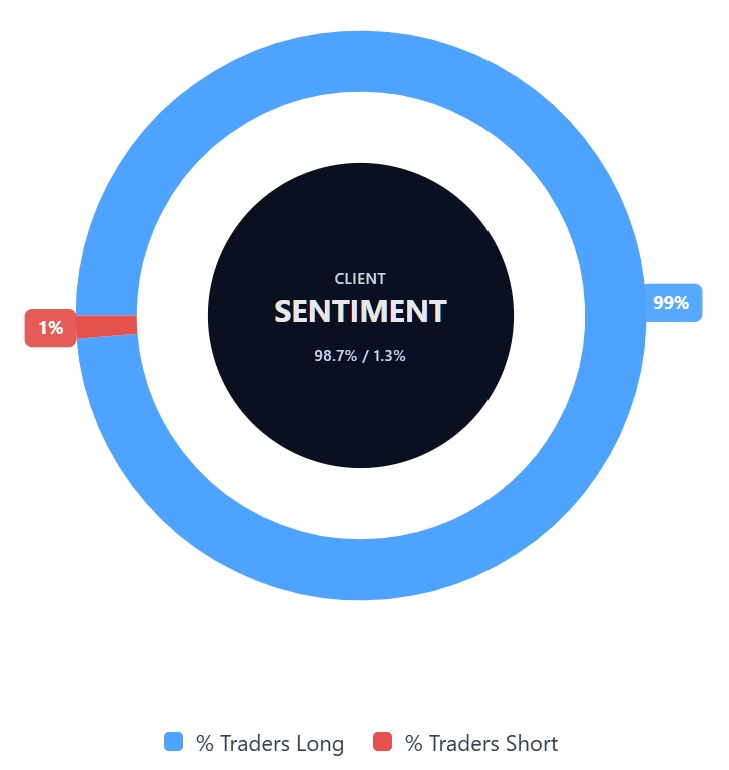
As of 4 August 2026, Capital.com client positioning in BAE Systems CFDs shows that 98.70% of open positions are long, compared with 1.30% that are short. This represents a difference of 97.40 percentage points between long and short positions.
The figures show how Capital.com clients are positioned at the time of the snapshot, rather than the number of individual clients holding each view. Client sentiment can change and isn’t an indicator of future market performance. It shouldn’t be used as the sole basis for a trading decision.
Summary – BAE Systems 2026
- As of 8:42am UTC on 4 August 2026, BAE Systems (BA.) trades near £22.09, compared with £12.68 in August 2024. The two-year period included an overall rise as well as several declines and phases of consolidation.
- On TradingView’s daily setup, the price remains above its 20-, 50-, 100- and 200-day moving averages. An RSI reading near 78 and an ADX reading near 27 indicate elevated recent momentum and a defined trend under this technical framework, although neither determines future price direction.
- Factors that may influence the BAE Systems share price include its upgraded 2026 guidance, £84bn order backlog, contract wins and changes in government defence spending. These sit alongside risks related to programme execution, cash conversion, procurement schedules and reliance on public-sector budgets.
- Recent developments include BAE Systems’ half-year 2026 results, its guidance upgrade and a £5.9bn UK contract for the Dreadnought submarine programme.
Past performance is not a reliable indicator of future results.
FAQ
Who owns the most BAE Systems shares?
BAE Systems doesn’t have a single controlling ordinary shareholder. Its shares are widely held by institutional investors, investment funds and individual shareholders, with the largest positions changing as fund managers adjust their holdings. The UK government also holds a special share designed to protect national-security interests, but this isn’t the same as owning the largest economic stake. Investors should consult the latest regulatory filings for current ownership data.
What is the five-year BAE Systems share price forecast?
The forecasts covered in this article focus mainly on 12-month analyst targets rather than a reliable five-year price estimate. Published targets captured between 31 July and 2 August 2026 range from £21 to £24.50, while consensus averages sit between £22.68 and £23.06. Over five years, the price could vary substantially as defence budgets, contract awards, programme delivery, costs and broader market conditions change.
Is BAE Systems a good stock to buy?
Whether BAE Systems is suitable depends on an individual’s objectives, risk tolerance and wider portfolio, so the article can’t determine whether it is a good stock to buy. Factors that may support the company’s outlook include its £84bn order backlog, upgraded 2026 guidance and major contract wins. However, investors should also consider execution, valuation, cash-conversion and government-spending risks. Analyst ratings and targets don’t guarantee future returns.
Could BAE Systems shares go up or down?
Yes. BAE Systems shares could move in either direction. The price may rise if earnings, contract awards, cash flow or guidance exceed market expectations. It could fall if programme delays, cost pressures, procurement changes or weaker-than-expected results alter investors’ assumptions. Technical indicators in the article show elevated recent momentum, but they don’t predict the next move. Past performance and third-party forecasts aren’t reliable indicators of future results.
Should I invest in BAE Systems shares?
The decision to invest in BAE Systems shares requires an assessment of personal circumstances, financial goals and capacity for loss. This article provides market data, third-party forecasts and information about the company’s results, but it doesn’t offer investment advice. Before making a decision, investors may wish to examine BAE Systems’ valuation, financial statements, dividend policy, order backlog and exposure to government defence spending, alongside the risks of holding individual shares.
Can I trade BAE Systems CFDs on Capital.com?
Yes, you can trade BAE Systems CFDs on Capital.com. Trading share CFDs lets you speculate on price movements without owning the underlying asset and to take long or short positions. However, contracts for difference (CFDs) are traded on margin, and leverage amplifies both profits and losses. You should ensure you understand how CFD trading works, assess your risk tolerance, and recognise that losses can occur quickly.