

How do fear and greed affect trading decisions?
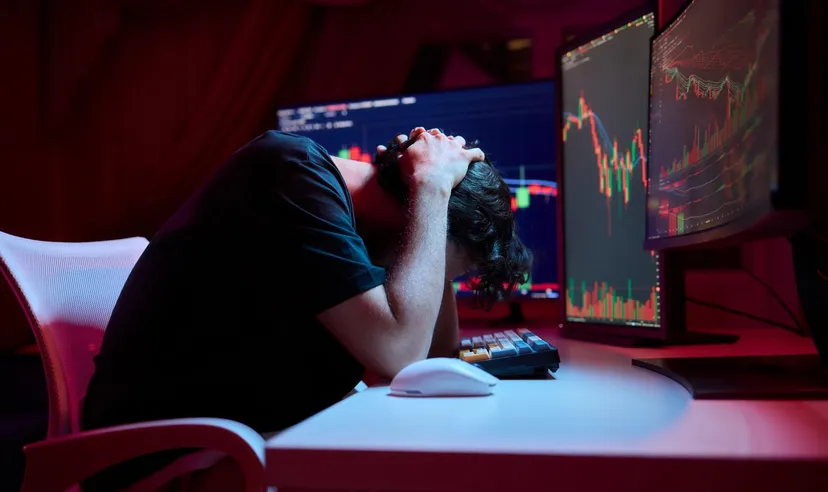
Emotional investing happens when feelings such as fear, greed, excitement, regret or anxiety start to play a bigger role than your trading plan. It can affect when you open a position, add to it, hold it, or close it.
This does not mean emotion is always a problem. Markets can move quickly, and it is natural to react. But when emotion takes the lead, decisions can move away from the structure you set in calmer conditions. Emotional investing is not a character flaw – it is a common response to the pressure of making decisions when money is at risk.
Takeaways
- Emotional investing is when feelings such as fear, greed, excitement or regret start to override your trading plan.
- Financial losses can trigger a stress response, which may make calm decision-making harder.
- Fear can lead to early exits, missed setups or hesitation. Greed can lead to larger position sizes, FOMO entries or reluctance to close losing trades.
- Lo, Repin and Steenbarger (AEA, 2005) found that more experienced traders showed smaller physical reactions to losses than beginners, suggesting emotional control may improve with experience and practice.
- Structure can help reduce emotional investing. This may include written trade plans, pre-set stop-loss levels and clear position-sizing rules.
- Psychological awareness can support more disciplined decisions, but it does not remove the risks of trading. Contracts for difference (CFDs) are traded on margin, leverage amplifies both profits and losses.
What is emotional investing in trading?
Emotional investing describes trading decisions that are driven more by your current mood than by a planned process. The decision to buy, sell, hold or resize a position is influenced less by the trade setup and more by what you feel in the moment.
For example, a market rises quickly and excitement pushes you to enter before your setup is confirmed. A position moves against you and fear makes you close it before your plan says to. A recent profit makes you feel more confident, so you open a larger trade than your normal risk rules allow.
These reactions are easy to understand. Trading involves uncertainty, and uncertainty can make emotions stronger. The issue is not that emotions exist, but that they can pull decisions away from the plan you made before the pressure started.
The psychology behind emotional investing: why it happens
Emotional investing often starts with a normal response to risk. Losses, gains and fast market moves can create pressure that makes it harder to follow a plan. The issue is not emotion itself, but whether emotion starts to drive the decision.
Financial loss can trigger a threat response
Research suggests the emotions of fear and stress associated with financial losses can activate the amygdala, the part of the brain involved in detecting threats (WebMD, 2024). This can trigger a stress response, even when the threat is financial rather than physical. That response can narrow attention, increase urgency and make action feel necessary. For traders, this can create pressure to react at the exact moment when calm analysis matters most (Investopedia, 2026).
Fear can lead to premature action
Fear can make traders close a position too early, skip a valid setup or hesitate when the plan calls for action (Investopedia, 2026). This often links to loss aversion: the possible pain of a loss can feel stronger than the possible reward of a gain (JSTOR, 1979). As a result, the trader may focus more on avoiding discomfort than following the process.
Greed can lead to excessive action
Greed can push traders towards larger positions, FOMO entries or extended profit targets after a winning run (Morningstar, 2025). It can also make losses harder to accept (Investopedia, 2024). Keeping a losing position open may feel like preserving the chance of recovery, but if the trade idea no longer holds, this can increase risk.
Emotion can affect the whole trade lifecycle
Emotion can influence every stage of a trade. At entry, excitement can lead to acting too soon. During the trade, anxiety can lead to stop-loss changes. At exit, fear can close winners early, while greed can delay taking profit. After the trade, emotion can also affect review. A trader may blame the market, ignore mistakes or focus only on the result. Research by Lo, Repin and Steenbarger (AEA, 2005) found measurable differences in how experienced and novice traders physically responded to losses, suggesting emotional control may improve with practice and a defined process.
Signs of emotional investing in your trading
Emotional investing often shows up when decisions start reacting to price movement, recent results or discomfort, rather than the original trading plan.
- You react to price movement rather than analysis. You open, close or resize a position mainly because the market has moved, not because the setup has changed.
- Your position size follows recent performance. You trade larger after wins or smaller after losses, instead of sizing based on entry level, stop level and account risk.
- You move stop-losses to avoid taking a loss. Adjusting a stop-loss can be valid if the analysis changes, but moving it mainly to avoid realising a loss can increase exposure.
- You check positions more often than needed. Frequent checking can create more chances for fear, hope or frustration to influence decisions, especially on shorter timeframes than the trade requires.
- One trade affects the next. A win leads to overconfidence, or a loss creates pressure to recover quickly, making the next trade less about the setup and more about the previous result.
How emotional investing could affect your performance
Emotional investing can affect performance in several ways. It can lead to early exits, late entries, larger-than-planned position sizes, poor timing and more frequent trading.
Barber and Odean (SSRN, 2000) analysed the trading records of 66,000 households over a six-year period and found that the most active traders significantly underperformed less active investors, mainly because of transaction costs and poor timing. This does not mean every active trade is emotional. But it does show how frequent trading can add cost and timing risk, especially when trades are driven by the urge to act rather than by a clear setup.
In CFD trading, leverage can make the effect more significant. An oversized position in a leveraged instrument can create losses that represent a large part of account equity. Fast-moving markets can also shorten the time between an emotional impulse and its outcome, leaving less space to reconsider.
How to manage emotional investing in trading
Managing emotional investing starts with moving key decisions out of the heat of the moment. A clear process can help reduce impulsive changes when fear, excitement or frustration builds.
- Step 1. Write a pre-trade plan. Before opening a significant position, record the entry criteria, position size, stop-loss level and exit plan. When the trade is live, you can return to the plan instead of relying on how the market feels ‘in the moment’.
- Step 2. Treat stop-loss levels as part of the risk plan.
A stop-loss set at entry can help turn a planned exit into an action. Adjusting it may be valid if the analysis changes, but moving it simply to avoid a loss can weaken the trade structure. Standard stop-losses aren’t guaranteed and may be affected by slippage. Guaranteed stop-loss orders (GSLOs) incur a fee if activated. - Step 3. Size positions independently of recent results.
Base position size on the trade’s risk parameters, such as entry level, stop level and account risk – not on how confident or cautious you feel after recent wins or losses. - Step 4. Pause before acting on impulse.
A short delay, even 60-90 seconds, can help separate emotion from action. This can be especially useful after a loss, or during fast market moves when FOMO or frustration can make a trade feel urgent.
The goal is not to remove emotion completely. It is to make sure fear, greed or stress don’t override the process you set before the pressure started.
Recovering from emotional investing: what to do after
If you notice that a trade, or a series of trades, was driven more by emotion than analysis, a structured review can be more useful than self-criticism. The goal is to find the decision points where the plan was not followed. Was the entry based on FOMO? Was the stop-loss moved to avoid taking a loss? Was the position size larger because of overconfidence? The purpose is not to judge the past trade, but to make the pattern easier to spot next time.
After an emotionally driven period, one possible reset is to reduce position sizes. This is not a punishment. It is a way to lower the emotional pressure while you rebuild consistency. Smaller trades can make it easier to focus on process rather than outcome.
Building long-term resilience against emotional investing
Building long-term resilience against emotional investing means making your trading process harder for emotion to disrupt. It comes from combining structure with self-awareness: clear rules before the trade, and a better understanding of how you tend to react once the trade is live.
For example:
- A fast-moving market makes you want to enter before your setup is confirmed.
- A losing trade makes you want to recover the loss quickly.
- A profitable run makes you feel more confident, so you increase position size.
- A slow-moving trade makes you check the position more often than your strategy requires.
- A missed opportunity makes the next trade feel more urgent than it should.
These reactions are common. The aim is not to become emotionless, but to recognise the moments when emotion is most likely to affect your process. Once those patterns are visible, they are easier to manage.
A trading journal can help with this. Alongside the trade details and outcome, record how you felt at entry, during the trade and at exit. Over time, this can show whether certain situations repeatedly affect your decisions.
You might track:
- The trade setup
- The reason for entry
- The position size
- The stop-loss level
- How you felt before entering
- Whether you changed the plan during the trade
- Why you exited
- What you would do differently next time.
The journal is not just for measuring performance. It is for spotting patterns. If the same emotional response keeps appearing – such as FOMO after missed moves, hesitation after losses, or overconfidence after profitable trades – you can build specific rules around that behaviour. That might mean pausing before entry, reducing position size after a losing run, or avoiding new trades immediately after a highly emotional outcome.
Emotional investing and risk management
Emotional investing can weaken risk management when pressure makes planned rules easier to bend. Pre-set stop-loss orders, platform-level limits and position-size caps, where available, can help reduce the number of decisions made in the moment. They don’t remove risk or guarantee a better outcome, but they can act as useful backstops. A measured approach is to set limits in calm conditions, align them with your risk tolerance and treat them as boundaries – not targets.