

Brent vs WTI: How the Strait of Hormuz is driving a wider oil price gap
The gap between Brent and WTI is widening as traders price is higher geopolitical uncertainty for the seaborne benchmark.
The widening gap between Brent and WTI crude prices is once again drawing attention, and the current geopolitical tensions surrounding the Strait of Hormuz are playing a central role in that divergence. While both benchmarks reflect global oil fundamentals, they are shaped by very different market dynamics.
Brent oil chart & Brent-WTI spread chart
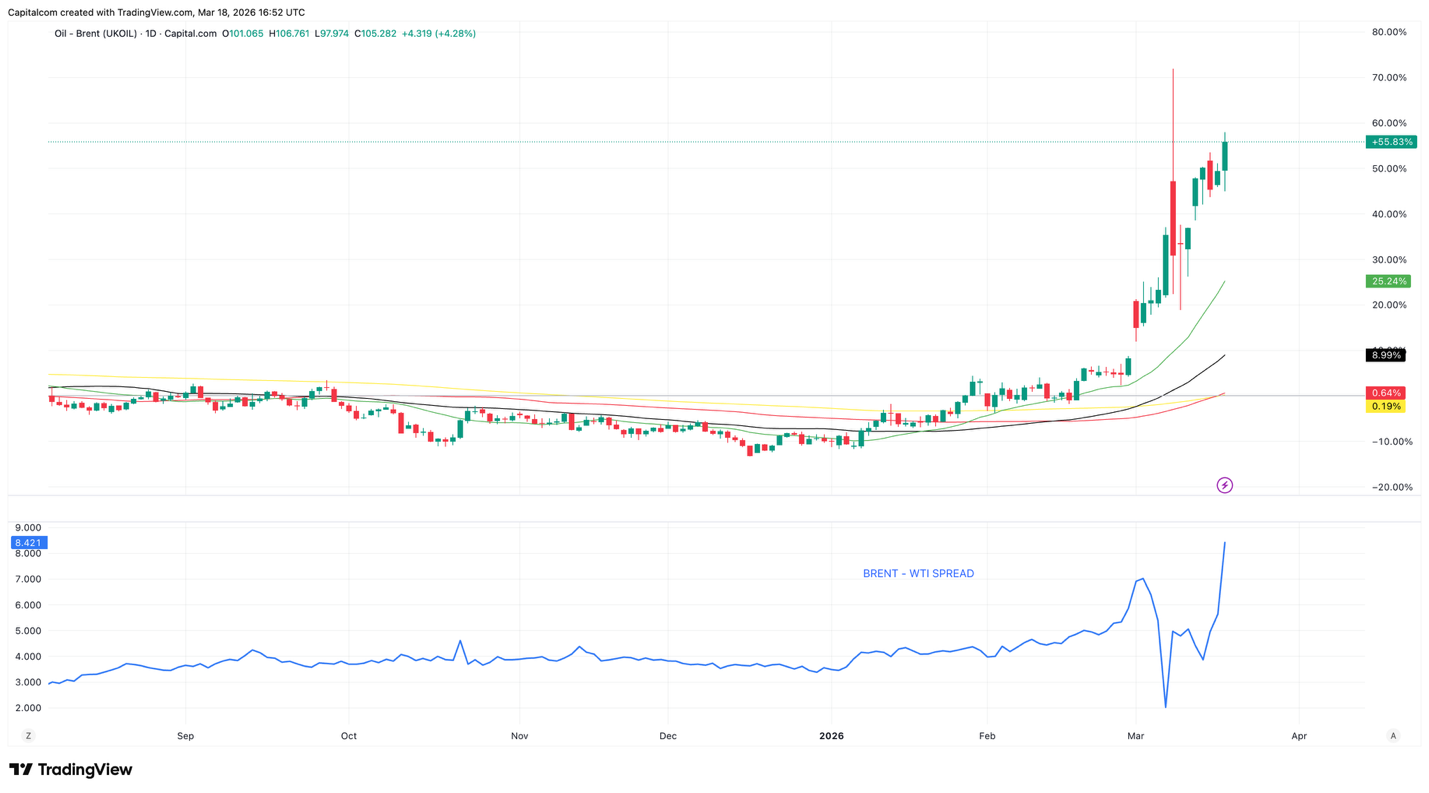
Past performance is not a reliable indicator of future results.
At a structural level, Brent is a seaborne benchmark that reflects the pricing of crude traded internationally, particularly from Europe, Africa and the Middle East. WTI, by contrast, is primarily a landlocked US benchmark, tied more closely to domestic supply and demand conditions. This distinction becomes critical when disruptions occur in global shipping routes. The Strait of Hormuz is one of the world’s most important energy chokepoints, with a significant share of global oil flows passing through it. Any disruption - whether through physical blockages, increased insurance costs or heightened security risks - directly affects the availability of crude to global markets.
As tensions escalate and shipping through Hormuz becomes more uncertain, Brent prices tend to rise more sharply because they embed a geopolitical risk premium tied to seaborne supply. Traders begin pricing in the possibility that fewer barrels will reach international markets, even if production itself is not significantly reduced. This tightening of “deliverable” supply is what drives Brent higher.
WTI, on the other hand, is relatively insulated from these immediate disruptions. The United States has significantly reduced its reliance on imported Middle Eastern oil over the past decade, thanks to the shale boom. Domestic production remains strong, and US refiners are less exposed to disruptions in Gulf shipping routes. As a result, WTI does not incorporate the same level of geopolitical risk premium as Brent in the short term.
There is also a demand-side element. Regions most dependent on Middle Eastern oil — particularly Europe and Asia — are directly affected by Hormuz disruptions. Buyers in these regions are forced to compete for alternative seaborne supply, pushing up Brent-linked prices. Meanwhile, the US market remains relatively self-sufficient, dampening upward pressure on WTI.
However, WTI is still rising because oil is ultimately a globally priced commodity. Even if US supply is relatively secure, global price benchmarks influence domestic pricing through arbitrage and export channels. Higher Brent prices increase the incentive to export US crude, tightening domestic supply at the margin. At the same time, rising global energy prices feed into broader inflation expectations and investor sentiment, lifting the entire oil complex. In other words, while WTI is less exposed to the direct disruption, it cannot fully decouple from global supply risks.
Why did the Brent–WTI spread initially tighten?
Interestingly, the early phase of the conflict saw the Brent–WTI spread narrow sharply, even dropping to nine-month lows. This may seem counterintuitive given the geopolitical nature of the shock, but it reflects how markets initially priced uncertainty rather than confirmed disruption.
In the first days of the conflict, the market reaction was driven more by broad risk-off positioning and financial flows than by a clear impairment to physical supply. The US dollar strengthened significantly, and yields moved higher, supporting US-linked assets. At the same time, WTI had been trading at a relative discount prior to the conflict due to ample domestic supply, leaving more room for a catch-up move as the entire oil complex repriced higher.
Crucially, the geopolitical risk premium in Brent had not yet fully materialised. Markets were still assessing whether the conflict would escalate into a sustained disruption of shipping through the Strait of Hormuz. Without clear evidence of restricted flows or infrastructure damage, Brent did not immediately reflect the full extent of potential supply risks.
As the situation evolved and attention shifted toward actual constraints on seaborne supply, including shipping risks, insurance costs and infrastructure threats, Brent began to price in a more pronounced geopolitical premium. WTI, by contrast, remained more anchored to domestic fundamentals. This marked the transition from an uncertainty-driven phase, where the spread tightened, to a disruption-driven phase, where the spread widened again.
Is the spread likely to widen further?
From a market perspective, the Brent-WTI spread is acting as a real-time indicator of geopolitical stress. A widening spread signals that global supply risks are increasing, while a narrowing spread would suggest easing tensions or improved flow through key routes. In the current environment, the persistence of disruption is enough to keep a risk premium embedded in Brent.
Looking ahead, the trajectory of the spread will largely depend on the duration and severity of the Hormuz disruption. If tensions ease and shipping normalises, the spread could compress as global supply chains stabilise. However, if uncertainty persists or escalates, Brent is likely to remain elevated relative to WTI, reflecting the continued fragility of global energy flows.
In essence, the divergence between Brent and WTI highlights two different market realities: a globally integrated oil market facing logistical and geopolitical constraints, and a US market that is more insulated by domestic production. As long as the Strait of Hormuz remains under pressure, that divergence is likely to remain a defining feature of oil markets.