
BNP Paribas stock forecast: Record earnings
BNP Paribas is a French banking group that reported record 2025 earnings and raised its 2028 targets, while its shares remained under pressure amid wider weakness in European banking stocks. Past performance is not a reliable indicator of future results. Explore third-party BNP price targets.
BNP Paribas SA (BNP) was trading at €83.03 at 4:40pm UTC on 2 April 2026, within an intraday range of €81.58–€85.25 on Capital.com's quote feed. Past performance is not a reliable indicator of future results.
Sentiment toward BNP weighed on the shares across the period, as broad European banking stocks faced pressure amid renewed US trade policy uncertainty. European bank indices extended losses during tariff-driven equity sell-offs in late March (Wall Street Journal, 31 March 2026). The ECB held its deposit facility rate unchanged at 2.00% at its 19 March 2026 meeting, keeping the policy backdrop steady while markets awaited the next decision on 30 April 2026 (Robinhood, 30 April 2026). Domestically, BNP reported record fourth-quarter net income of €2.97 billion for full-year 2025, beating analyst expectations of €2.86 billion, while the group confirmed its 2026 trajectory and raised its 2028 financial targets in February 2026 (Reuters, 5 February 2026).
BNP Paribas stock forecast 2026–2030: Third-party price targets
As of 2 April 2026, third-party BNP Paribas stock predictions reflect a broadly constructive consensus, shaped by the bank's stronger-than-expected 2025 full-year earnings, its revised 2028 financial targets, and a mixed macro backdrop for European financials. The following briefs summarise third-party views published between 20 March and 2 April 2026, or the most recently confirmed consensus data available as of that date.
Keefe, Bruyette & Woods (rating upgrade)
Keefe, Bruyette & Woods upgraded BNP Paribas from hold to moderate buy, marking a reversal of an earlier cautious stance on the stock. The move came amid improving earnings visibility and BNP's confirmation of its 2026 cost-reduction trajectory after the bank's Q4 2025 beat (MarketBeat, 5 April 2026).
Morgan Stanley (house view, asset management day)
Morgan Stanley rates BNP Paribas equal-weight with a price target of €104, noting that the bank's newly published asset management unit targets fell 'rather neutral relative to where consensus sits'. The analyst flagged that BNP reiterated its group-level return on tangible equity target of 13% by 2028, which Morgan Stanley described as supportive of the broader financial trajectory (Investing.com, 17 March 2026).
Zacks Research (rating revision)
Zacks Research cut BNP Paribas from strong-buy to hold, citing a moderation in the positive trend of earnings estimate revisions that had previously supported the more bullish stance. The downgrade reflects a pause in upward earnings momentum rather than a deterioration in fundamentals, with full-year EPS consensus held at €5.02 (Zacks, 6 March 2026).
MarketScreener (consensus price target)
MarketScreener compiles a 19-analyst consensus, with an average 12-month BNP stock forecast of €101.35, a high estimate of €110, and a low of €87; the mean rating stands at outperform. The spread between the floor and ceiling targets of €23 reflects diverging views on the pace of BNP's ROTE recovery and the weight of macro headwinds on French retail banking revenues (MarketScreener, 30 March 2026).
Investing.com (consensus overview)
Investing.com aggregates 19 analyst price targets and reports an average 12-month target of €101.35, with 14 buy recommendations; the high estimate stands at €110 and the low at €87. Analysts cite BNP's low price-to-earnings ratio of approximately 8x forecast FY27 earnings and robust capital return capacity as the principal drivers of the constructive consensus (Investing.com, 2 April 2026).
Predictions and third-party forecasts are inherently uncertain, as they cannot fully account for unexpected market developments. Past performance is not a reliable indicator of future results.
BNP stock price: Technical overview
On the daily chart for 2 April 2026, the BNP Paribas stock price was trading at €83.03, sitting below a dense moving-average shelf where the 20/50/100/200-day SMAs converge near €84/€89/€84/€80, respectively. The 10-day SMA at €82.58 registers a buy signal, while the broader cluster from the 20-day through 100-day SMAs all read sell, reflecting a stock trading beneath multiple layers of overhead resistance, according to TradingView data as of 2 April 2026. The Hull moving average (9) at €82.78 aligns with a buy signal, while the ichimoku base line at €88.09 sits materially above the price.
Momentum was mixed to neutral: the 14-day RSI stood at 43.75, a neutral reading consistent with neither oversold conditions nor recovering pressure. The average directional index at 30.06 indicates an established trend is in force, per TradingView oscillator data.
On the classic pivot framework, the pivot point at €84.43 represents the immediate overhead reference; a daily close above that level would put R1 near €90.02 in view. On the downside, S1 at €75.39 is the next classical reference below the current price, with the 200-day SMA near €79.90 acting as the nearest long-term MA shelf ahead of it, as reported by TradingView (TradingView, 2 April 2026).
This is technical analysis for informational purposes only and does not constitute financial advice or a recommendation to buy or sell any instrument.
BNP Paribas share price history (2024–2026)
BNP Paribas’s stock price opened April 2024 near €66.63 and spent most of that year grinding higher, before closing 2024 at €59.43 – a more modest year-end level that reflected some late-year softness as European banking sentiment cooled into year-end.
2025 told a more dramatic story. The stock recovered strongly through the first half, climbing into the mid-€80s by August before pulling back. A sharp sell-off followed in early April 2025 when global tariff concerns rattled markets; BNP hit a dataset low of €63.88 on 9 April 2025. From there, it recovered steadily, closing 2025 at €80.95 – a gain of approximately 36.2% across the full calendar year.
2026 opened quietly near €82.03. BNP then rallied sharply through February, touching a two-year dataset high of €95.61 on 27 February 2026, before reversing course. The stock shed roughly 13% from that peak over the following five weeks, closing at €83.03 on 2 April 2026 – up approximately 1.2% year to date and 6.8% year on year.

Past performance is not a reliable indicator of future results. Share prices are indicative and may differ from live market prices.
BNP Paribas (BNP): Capital.com analyst view
BNP Paribas has delivered a notable recovery over the past two years, rising from the mid-€60s in early 2024 to a two-year high of €95.61 in late February 2026, underpinned by record Q4 2025 earnings, raised 2028 financial targets, and a broader re-rating of European bank equities. The bank's cost-reduction programme and improving capital return capacity have attracted renewed institutional interest, with analyst consensus targets clustering near €101–€104. That said, the stock has since retreated sharply to €83.03, a reminder that positive fundamental narratives do not insulate equities from macro headwinds. Renewed trade policy uncertainty and a softening growth outlook for the eurozone present meaningful downside risks to earnings assumptions.
Looking ahead, the ECB rate path remains a key swing factor: a faster-than-expected easing cycle could compress net interest margins and weigh on revenue, while a more gradual pace could support profitability. BNP's expanding asset management ambitions offer a potential source of fee income diversification, though its 2030 targets drew a measured response from analysts, who noted that they fell broadly in line with, rather than ahead of, existing consensus expectations.
Capital.com’s client sentiment for BNP Paribas CFDs
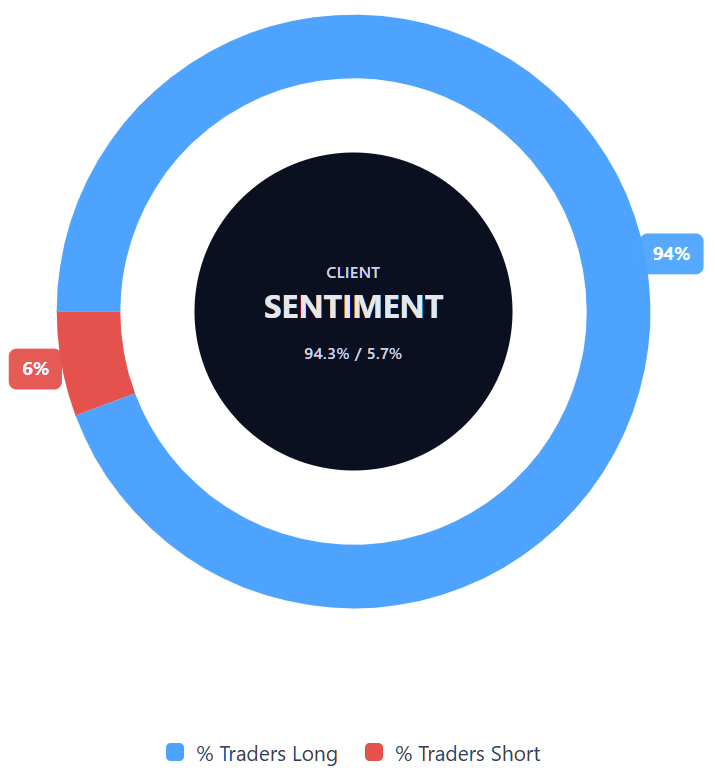
As of 2 April 2026, Capital.com client positioning in BNP Paribas CFDs shows 94.3% buyers and 5.7% sellers, putting buyers ahead by 88.6 percentage points and placing sentiment firmly in a heavy-buy, one-sided-toward-longs territory. This degree of skew is notable, as an overwhelming majority of open positions are currently on the long side. This snapshot reflects open positions on Capital.com at the time of writing and can change rapidly as market conditions shift.
Summary – BNP Paribas 2026
- As of 4:40pm UTC on 2 April 2026, BNP Paribas (BNP) was trading at €83.03, within an intraday range of €81.58–€85.25.
- TradingView oscillator data shows the 14-day RSI at 43.75, a neutral reading, with the average directional index at 30.06 indicating an established trend was in force.
- Price was trading below the 20/50/100-day SMA cluster, with the classic pivot point at €84.43 acting as the immediate overhead reference and the 200-day SMA near €79.90 as the nearest long-term support shelf.
- Key drivers include BNP's record Q4 2025 earnings beat, raised 2028 financial targets, and the ECB holding its deposit rate at 2% at its March 2026 meeting.
- Renewed US trade policy uncertainty and tariff-driven European equity sell-offs weighed on the broader banking sector through late March and into April 2026.
Past performance is not a reliable indicator of future results.
FAQ
Who owns the most BNP Paribas stock?
What is the 5 year BNP Paribas share price forecast?
Is BNP Paribas a good stock to buy?
Whether BNP Paribas is a good stock to buy depends on an individual’s objectives, risk tolerance, time horizon and view of the banking sector. Some analysts have pointed to supportive factors such as earnings performance, capital return potential and valuation, while others remain cautious because of macroeconomic risks and pressure on European banks. That means the stock may appeal to some market participants but not others. This is why it is important to treat research as information, not a recommendation.
Could BNP Paribas stock go up or down?
Should I invest in BNP Paribas stock?
Can I trade BNP Paribas CFDs on Capital.com?
Yes, you can trade BNP Paribas CFDs on Capital.com. Trading share CFDs lets you speculate on price movements without owning the underlying asset and to take long or short positions. However, contracts for difference (CFDs) are traded on margin, and leverage amplifies both profits and losses. You should ensure you understand how CFD trading works, assess your risk tolerance, and recognise that losses can occur quickly.