

Gold rallies as falling yields revive demand
Gold rebounds as falling yields and softer dollar allow the precious metal to regain some upside momentum.
Gold has regained momentum this week as US Treasury yields retreat. The recent decline in yields has been driven by a combination of softer economic data, easing geopolitical concerns and a Federal Reserve that struck a less hawkish tone than many investors had anticipated. Together, these developments have encouraged investors to dial back expectations for further policy tightening, reducing the opportunity cost of holding a non-yielding asset such as gold.
While easing tensions in the Middle East may have removed some of the safe-haven demand that supported gold earlier in the summer, the fall in real yields has more than compensated. A modest pullback in the US dollar has also provided additional support, allowing bullion to recover despite an improving tone across equity markets.
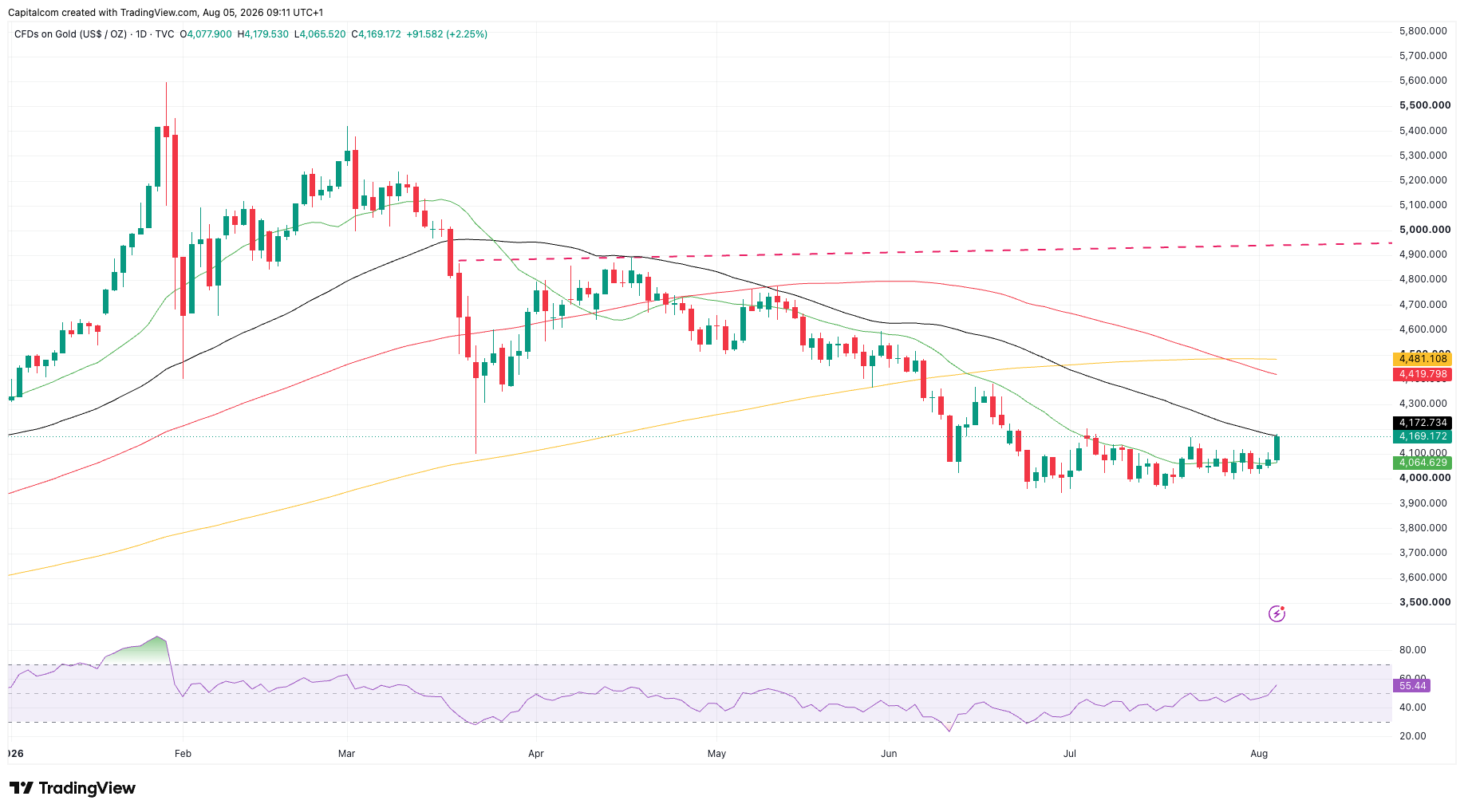
Gold (XAU/USD) daily chart
Past performance is not a reliable indicator of future results.
The technicals suggest a notable improvement in sentiment, with the RSI pushing above 50 for the first time since May. That said, as the RSI has managed to post a higher high, price is lagging as it is yet to break above the high set on July 6th at $4,200. A sustained break above this level may unlock further bullish appetite as it will also confirm a possible breakout from the sideways consolidation range that has prevailed for most of the past six weeks. The fact that support has held remarkably well around $4,000 despite several episodes of volatility in oil and yields, suggests that there is a lack of real appetite to be a seller below this level.
Gold’s long-term outlook
The longer-term outlook for gold may depend less on geopolitics and more on a structural shift taking place in global capital markets. The rapid expansion of artificial intelligence is driving one of the largest investment cycles in decades, with technology companies committing hundreds of billions of dollars to data centres, semiconductors, power infrastructure and networking equipment. At the same time, governments continue to run large fiscal deficits, creating unprecedented competition for capital.
That combination has the potential to keep long-term bond yields structurally higher. As businesses and governments compete for financing, investors may demand higher returns to provide that capital, pushing up borrowing costs even if central banks eventually begin lowering policy rates. AI-related investment could also create short-term inflationary pressures by increasing demand for labour, electricity and industrial commodities before productivity gains have time to materialise.
For gold, this presents an interesting tension. The metal typically benefits from lower real yields and a weaker dollar, but a world characterised by structurally higher borrowing costs could prove a more challenging environment. While periodic declines in yields may continue to support gold in the near term, a sustained rise in long-term real interest rates would increase the opportunity cost of holding bullion and could limit its upside over time.
Ultimately, gold's outlook may hinge on which force proves stronger: cyclical declines in yields as growth slows, or the structural upward pressure on interest rates created by the global AI investment boom. That debate is likely to become increasingly important for investors over the coming years, extending well beyond the current cycle of central bank policy.