

Ethereum Price Prediction: Third-party outlook
Ethereum is the native token of the Ethereum blockchain, with July price action shaped by spot ETF inflows and Federal Reserve policy signals. Explore third-party ETH price targets and technical analysis. Past performance is not a reliable indicator of future results.
Ethereum (ETH/USD) traded at $1,788 at 9am UTC on 13 July 2026, within Monday’s intraday range of $1,776.36–$1,827.07. Past performance is not a reliable indicator of future results.
Support has come from continued institutional demand via spot Ethereum exchange-traded funds (ETFs), which recorded net inflows including $18.4m on 10 July, led by BlackRock's ETHA fund (Cryptorank, 11 July 2026). This extended a multi-session inflow trend that broke an eight-week streak of net outflows (Phemex, 12 July 2026).
Broader crypto market sentiment has also reflected the Federal Reserve's 16–17 June policy meeting, where the Federal Open Market Committee (FOMC) held rates at 3.50%–3.75% by a 12–0 vote (Federal Reserve, 17 June 2026). Minutes released in early July showed some officials had considered a rate hike amid persistent inflation concerns (Federal Reserve, 18 June 2026).
Wider market commentary has noted Ethereum's roughly 11% rise so far in July, attributed to institutional interest and supply-demand dynamics (Phemex, 11 July 2026). Separate coverage attributed the move to institutional infrastructure development, the 'Lean Ethereum' roadmap proposal, and continued corporate treasury accumulation of ETH (KuCoin, 10 July 2026). Past performance is not a reliable indicator of future results.
Third-party Ethereum outlook: ETF flows, Fed CPI, and targets
As of 13 July 2026, third-party ETH price predictions show a range of third-party views shaped by ETF flows, moving-average positioning and prediction-market data. The following targets summarise forecasts captured during this period for the Ethereum spot market.
CoinDCX (monthly model forecast)
CoinDCX sets a July 2026 price target of $1,960, with an indicative trading range of $1,718–$1,960, as ETH looks to build momentum above its 20-day moving average. The projection links near-term upside to whether that momentum can continue through the month (CoinDCX, 12 July 2026).
Cryptorank (prediction-market and technical update)
Cryptorank cites prediction markets assigning a 57% probability to Ethereum reaching $1,900 during July 2026, against a 32% probability of reaching $2,000, as ETH tests resistance at its Supertrend line near $1,803.65. The reading reflects positioning around that technical level as of the capture date (Cryptorank, 6 July 2026).
CoinGecko (prediction-market aggregation)
CoinGecko reports a 67% probability of Ethereum reaching $1,900 by end-July 2026, with a 54% probability that $1,700 holds as downside support, based on aggregated prediction-market data. It separately cites a 77.5% probability of ETH reaching $2,000 by the end of 2026 amid what it describes as bullish overall sentiment (CoinGecko, 13 July 2026).
Binance (short-term algorithmic projection)
Binance projects Ethereum could rise around 5% to $1,812.08 over the 30 days following its 11 July 2026 update, with an October 2026 range of $1,698.86–$3,336.19 and an average near $2,517.53. The model attributes the projection to aggregated technical-indicator inputs rather than a single catalyst (Binance, 11 July 2026).
Changelly (monthly average forecast)
Changelly puts the July 2026 average trading price at $2,193.63, with a projected monthly low of $1,779.55 and a high of $2,607.71. The forecast frames the range around continued volatility, citing its own algorithmic trend analysis as of the capture date (Changelly, 11 July 2026).
Predictions and third-party forecasts are inherently uncertain, as they cannot fully account for unexpected market developments. Past performance is not a reliable indicator of future results.
Ethereum: macro and sector developments
The main near-term macro catalyst for Ethereum and broader crypto markets is US June CPI data, due 14 July 2026. It follows a hawkish shift from the Federal Reserve after its 17 June meeting, when the Federal Open Market Committee held rates at 3.50%–3.75% (Federal Reserve, 17 June 2026), removed its previous cutting bias, and raised its 2026 headline inflation forecast to 3.6% (Hex Trust, 29 June 2026).
May CPI had already reached 4.2% year on year, its highest reading in three years, while May PPI rose 6.5% (Hex Trust, 29 June 2026). These figures have reinforced market focus on the Fed's next scheduled meeting on 28–29 July 2026, which commentary has framed as a live discussion point for a potential rate hike, depending on the inflation path (Hex Trust, 29 June 2026).
Ethereum-specific developments include Vitalik Buterin's 'Lean Ethereum' roadmap, which extends through 2029 and outlines planned quantum-safety, privacy and scalability upgrades (Cryptorank, 6 July 2026). Spot Ethereum ETFs also recorded positive weekly flows of $84.42m for the week ending 11 July 2026, ending an eight-week run of net outflows after earlier weakness in ETH/BTC and broader ETF redemptions (Phemex, 12 July 2026).
Regulatory developments remain part of the wider sector backdrop. The US GENIUS Act stablecoin rules are due for finalisation in July 2026 (Dotfile, 2 January 2026), while Hong Kong's Stablecoin Ordinance is nearing its first licence approvals (South China Morning Post, 12 March 2026). Illinois has enacted a 0.2% digital-asset transfer levy from January 2027 (Forbes, 18 June 2026), and Japan's National Business Corporate Pension Fund has announced an approximate 1% crypto allocation from fiscal 2026 (Hex Trust, 29 June 2026).
ETH price: technical overview
The ETH/USD price trades near $1,788 as of 9am UTC on 13 July 2026, below its 20/50/100/200-day simple moving averages at roughly $1,697 / $1,755 / $2,010 / $2,216, per TradingView data. The 20-day exponential moving average stands near $1,742, while the 50-day exponential moving average sits near $1,799, both close to their simple counterparts.
The 14-day relative strength index reads 55.8, an upper-neutral level that leans mildly constructive without signalling stretched conditions, according to TradingView. The average directional index (14) stands at 23.9, below the 25 threshold typically associated with an established trend.
The nearest classic pivot above the last price is R1 at around $1,891. A daily close above that level would bring the classic R2 marker near $2,015 back into view, according to TradingView pivot data. Further out, the 100-day simple moving average near $2,010 and the 200-day simple moving average near $2,216 act as additional overhead references.
On the downside, the classic pivot point near $1,698 marks the first support reference. A move below that level would bring the 20-day simple moving average shelf near $1,697 into focus. Losing that shelf could put the classic S1 marker near $1,377 back in view, per TradingView data (TradingView, 13 July 2026).
This technical analysis is for informational purposes only and does not constitute financial advice or a recommendation to buy or sell any instrument.
Ethereum price history (2024–2026)
As of 13 July 2026, the most recent ETH/USD two-year cycle has been shaped by two distinct phases. From July 2024, the coin climbed steadily through the back end of the year, then accelerated through the summer of 2025, reaching a two-year high of $4,956.26 on 24 August 2025 as risk appetite for crypto broadly improved.
That peak proved short-lived. ETH moved through fresh volatility in autumn 2025, briefly touching $4,120 by late October before losing ground into year-end and closing 2025 at $2,967.68.
Weakness continued early in 2026. ETH fell from above $3,300 in mid-January to a low close of $1,824.28 on 5 February, before a choppy recovery attempt stalled through spring and summer. The coin dipped to $1,566.11 on 25 June amid a run of weaker sessions. From there, ETH moved back above $1,800 by early July, closing at $1,788.78 on 13 July 2026 – around 63.9% below its August 2025 high, but broadly in line with levels seen in April 2025.
Past performance is not a reliable indicator of future results. Prices are indicative and may differ from live market prices.
Capital.com analyst view: Ethereum
Ethereum’s price performance across the past year has been marked by pronounced volatility rather than sustained direction. The asset fell from a two-year high above $4,950 in August 2025 to trade closer to $1,800 by mid-July 2026. That decline coincided with a mix of factors, including a run of net outflows from spot Ethereum ETFs earlier in 2026 and a more hawkish tone from the Federal Reserve amid elevated inflation readings. More recently, some pressure has eased, with ETFs recording positive weekly inflows in early to mid-July and ETH recovering from lows near $1,566 in late June.
Some market participants have pointed to Ethereum’s role in decentralised finance and its planned network upgrades as longer-term supportive factors. Others note that the asset remains highly sensitive to broader risk sentiment and macro policy shifts, which could weigh on prices if conditions tighten further. The current setup reflects both renewed institutional interest and continued uncertainty, with no single narrative dominating price action.
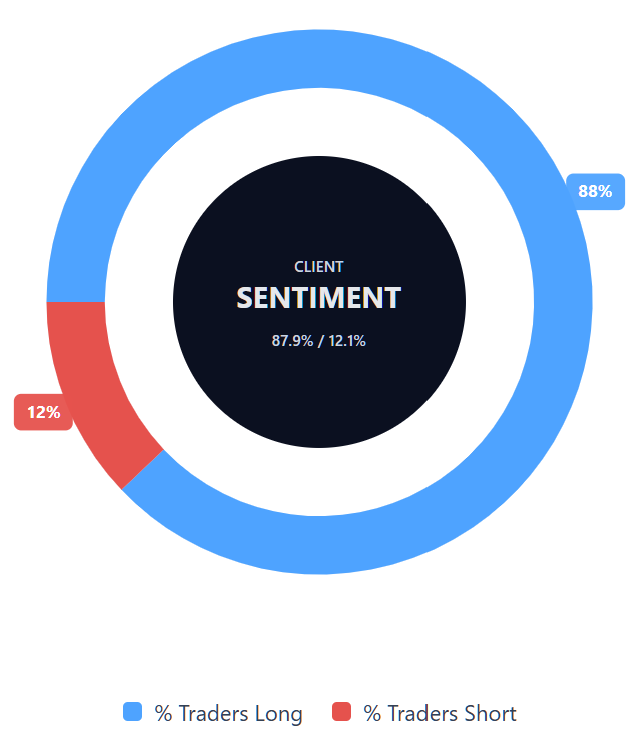
Capital.com’s client sentiment for Ethereum CFDs
As of 13 July 2026, Capital.com client positioning in Ethereum CFDs stands at 87.9% buyers versus 12.1% sellers, putting buyers ahead by 75.8 percentage points. This keeps positioning in heavy-buy, one-sided territory toward longs, with little balance between the two sides. This snapshot reflects open positions on Capital.com and can change.
Summary – Ethereum (2026)
- ETH traded near $1,788 at 9am UTC on 13 July 2026, down sharply from its August 2025 high above $4,950 but above its late-June low near $1,566.
- Technical indicators on TradingView show ETH below its 20/50/100/200-day moving averages, with RSI at 55.8 in upper-neutral territory and ADX below 25, signalling no established trend.
- Key drivers include ETF flow trends, Federal Reserve policy signals amid elevated inflation readings, and shifting institutional demand for Ethereum exposure.
- Recent news centres on renewed spot ETF inflows breaking an eight-week outflow streak, Ethereum’s ‘Lean Ethereum’ roadmap, and upcoming US CPI data due 14 July 2026.
Past performance is not a reliable indicator of future results.