

Organisational behaviour in trading: how groups can influence decisions
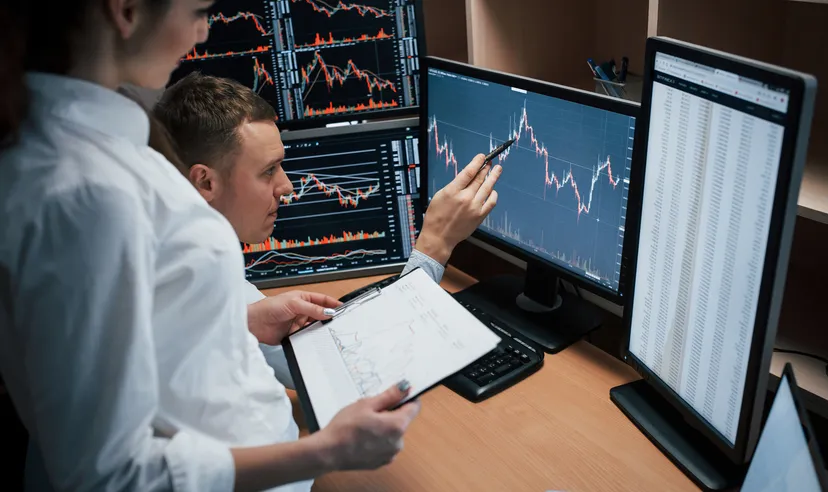
Organisational behaviour is the study of how people act within groups, teams and structured environments. It looks at how social pressure, incentives, leadership, habits and shared beliefs can affect the way people make decisions.
In trading, this matters because decisions are rarely made in a vacuum. Professional traders work within firms, desks and risk frameworks. Retail traders may trade alone, but they can still be influenced by online communities, social media, platform features and visible market sentiment. Understanding these pressures is a useful part of trading psychology, especially when markets move quickly and decisions need to be made under uncertainty.
- Organisational behaviour studies how people, groups and structures influence decision-making.
- In trading, it can help explain why traders may follow a group view rather than their own analysis.
- Groupthink can reduce independent thinking, especially when a team or community strongly agrees on a market view.
- Incentive structures may influence risk-taking, particularly when short-term gains are rewarded more than long-term discipline.
- Social influence can affect retail traders through forums, social trading features and online market commentary.
- Tools such as trading plans, checklists and trade reviews can help traders make more structured decisions.
What is organisational behaviour?
Organisational behaviour, often shortened to OB, studies how people behave in organised settings. These settings can include companies, teams, trading desks, online communities or any environment where people interact around shared goals, rules or expectations.
The field draws on psychology, sociology, economics and management studies. It asks three main questions:
- Why do people behave the way they do in groups?
- How do group dynamics affect individual decisions?
- How do structures such as hierarchy, incentives, culture and rules shape behaviour?
In financial markets, these questions have clear relevance. A trader’s decision may be affected not only by price action, data or analysis, but also by the environment around them. That environment might include a senior trader’s view, a desk consensus, a bonus structure, a popular online narrative or a platform feature showing what other traders are doing.
Origins and development of organisational behaviour
Organisational behaviour developed over the 20th century as researchers tried to understand what motivates people at work and how group settings affect performance.
Scientific management and early industrial psychology
One of the earliest approaches came from scientific management in the early 1900s, associated with Frederick Winslow Taylor. Taylor’s work treated workers mainly as rational economic actors who responded to financial incentives. This was an important starting point, but it was limited. People do not respond only to money or rules. They are also affected by recognition, status, belonging, pressure, confidence and fear of making mistakes. These wider influences later became central to organisational behaviour (Britannica, accessed 12 June 2026).
The Hawthorne studies
A major shift came from the Hawthorne studies, conducted at the Western Electric Company in the late 1920s and 1930s. These studies found that productivity was influenced not only by working conditions, but also by social factors such as attention, group identity and informal workplace norms. The Hawthorne effect describes the idea that people may change their behaviour when they know they are being observed. In trading, this can matter in environments where performance is highly visible. A trader who can see live profit and loss, rankings or peer performance may behave differently from one trading privately with less outside pressure (Simply Psychology, accessed 12 June 2026).
Motivation theory and human relations
Later research looked more closely at motivation. Abraham Maslow’s hierarchy of needs, published in 1943, suggested that people are motivated by more than basic financial reward. Frederick Herzberg’s two-factor theory, published in 1959, separated factors that prevent dissatisfaction from those that actively motivate people. In trading environments, this can help explain why money is not the only driver of behaviour. Traders may also be motivated by status, recognition, autonomy, intellectual challenge or professional identity. These factors can support discipline in some situations, but they can also contribute to overconfidence or reluctance to accept mistakes (Simply Psychology, accessed 12 June 2026).
Cognitive and social approaches
From the 1970s onwards, organisational behaviour increasingly drew on cognitive and social psychology. Herbert Simon’s concept of ‘bounded rationality’ became especially important. It describes how people make decisions with limited time, limited information and limited mental capacity. Rather than finding the perfect answer, people often settle for a workable one. In trading, this is highly relevant. Markets can move quickly, information can be incomplete, and traders may need to act before they have a full picture. Social identity theory also became influential. It showed that people often take part of their identity from the groups they belong to. In trading, that group could be a professional desk, a market community, a trading forum or a group of traders who follow the same strategy or asset class (Science Direct, accessed 12 June 2026).
Key principles of organisational behaviour
Several organisational behaviour concepts are especially useful for understanding trader decision-making.
In trading, groupthink can affect a professional desk when most people support the same market view. It can also affect retail traders in online communities, where a popular narrative may become difficult to question. For example, if many traders in a community believe that a market will move in one direction, individual traders may feel less comfortable taking the opposite view, even when their own analysis is more cautious. Groupthink does not guarantee a poor decision, but it can reduce the quality of debate before the decision is made.
These identities can support consistency, but they can also create blind spots. A trader who sees themselves as high-conviction may find it harder to exit a position when the evidence changes. A trader who values quick reactions may struggle to pause before entering a crowded trade. Role identity matters because decisions are not only analytical. They can also be tied to pride, reputation and how traders see themselves.
Organisational behaviour in financial markets
Organisational behaviour helps explain several patterns that can appear in financial markets, especially where group pressure and shared incentives are involved.
Institutional herding
- Herding occurs when many market participants make similar decisions at the same time. This may happen because they have reached similar conclusions, but it can also happen because they are watching each other.
- In institutional settings, herding can be reinforced by professional pressure. It may feel safer to be wrong with the group than wrong alone. A trader or fund manager who takes a different view may face more scrutiny if that view does not work out.
- Research on information cascades by Sushil Bikhchandani, David Hirshleifer and Ivo Welch showed how people can place more weight on others’ visible actions than on their own private information. In trading, this can help explain why market views sometimes become crowded, even when the underlying evidence is mixed.
Risk culture and tone from the top
- Risk culture refers to the shared attitudes and behaviours around risk within an organisation. ‘Tone from the top’ means the example set by senior leaders.
- If senior management rewards high returns without enough focus on how those returns were achieved, traders may receive a message that risk-taking matters more than risk discipline. If leaders encourage challenge, review mistakes openly and respect risk limits, the culture may support more measured decision-making.
- This matters because formal rules are only part of the picture. Traders also respond to what is noticed, praised, ignored or quietly accepted within the organisation.
The Hawthorne effect in performance environments
- Trading is often a highly measured activity. Professional traders may work with live profit-and-loss displays, performance dashboards and internal rankings. Retail platforms may also show performance data, popular markets, sentiment tools or other visible activity.
- Being measured can help create focus, but it can also affect behaviour. A trader who pays too much attention to visible performance may start optimising for short-term results rather than following their plan. This can lead to more reactive decisions, especially after a gain or loss.
- The point is not that performance data is bad. It is that the way information is displayed can influence behaviour.
Organisational behaviour and trader decision-making
Organisational behaviour is not only relevant to banks, funds or professional trading desks. It can also affect individual traders, including those using retail CFD platforms.
- Online communities as virtual organisations: forums, social media groups and social trading platforms can develop informal leaders, shared language and popular views.
- Group views can shape judgement: a trader may start to absorb the group’s view of a market. This can be useful when it adds new information, but risky if group confidence replaces independent analysis.
- Popularity isn’t proof: a widely shared market view may feel more reliable because many people repeat it. That doesn’t mean it’s wrong, but popularity alone doesn’t make it stronger.
- Visible performance data can act as social proof: positions, returns, win rates and portfolio allocations may influence decisions, especially when many visible traders appear to take the same view.
- Other traders may have different risk profiles: their goals, time horizons, account sizes and risk limits may not match yours, so their position may not suit your plan.
- Self-serving attribution can distort reviews: Traders may credit wins to skill, while blaming losses on luck, market noise or unexpected news.
- Reputation can increase pressure: in teams or public communities, traders may find it harder to admit poor trade management after sharing a view.
- Structured reviews can help: Balanced trade reviews can make it easier to assess decisions more objectively, rather than focusing only on the outcome.
Applying organisational behaviour to CFD trading
For retail CFD traders, organisational behaviour can offer practical ways to think about social and environmental pressure. These ideas are not trading rules, and they do not guarantee better outcomes. They are tools for making decisions more structured.
- Step 1. Treat your trading plan as a reference pointWrite down what you look for, how you assess risk, when you enter and when you exit. This gives you something concrete to compare against group views, market sentiment or community narratives.
- Step 2. Monitor how you use social trading signalsSocial signals can be useful, but they shouldn’t replace your own view. Ask what the data shows, who is included, whether their time horizon or risk tolerance matches yours, and whether you had a view before seeing it.
- Step 3. Check the influence of popular narrativesBefore acting on a widely discussed theme, ask whether the trade would still make sense without the surrounding commentary. This can help separate analysis from repetition.
- Step 4. Test the idea against your own criteriaA popular view may contain useful information, but it should still fit your trading plan, risk appetite and time horizon.
- Step 5. Use a demo account to observe behaviourA demo account can help you spot how you respond to social signals without putting real capital at risk. You may notice patterns, such as entering faster when others take the same side or abandoning your plan after reading a strong community view.
Criticisms and limitations of organisational behaviour in trading
Organisational behaviour can be useful, but it has limits. Applying it to trading requires care.
- Research often comes from non-trading settings: many studies come from workplaces, psychology experiments and decision-making groups, not financial markets. Trading is faster-moving, data-heavy and shaped by risk.
- Individual variation is large: organisational behaviour describes group patterns, not exact individual behaviour. Experience, personality, confidence, market knowledge and trading style all affect how strongly these influences apply.
- Incentives aren’t always simple: financial institutions don’t only create poor incentives. Risk limits, oversight, deferred compensation and reviews can help support longer-term risk management, though no system is perfect.
- Social influence can be positive: teams and trading communities can challenge weak analysis, support risk discipline and expose traders to useful perspectives. The issue is whether social influence supports independent thinking or replaces it.
Organisational behaviour is a framework for understanding possible influences on decision-making. It doesn’t predict individual outcomes or remove the need for independent analysis and risk management.
Common misconceptions about organisational behaviour and trading
Several misconceptions can arise when organisational behaviour is applied to trading.
Create an account Open a demo account

