
Volkswagen stock forecast: 20% cost-cutting plan by 2028
Volkswagen AG is a Germany-based carmaker listed on Xetra, currently in focus as it pursues a reported 20% cost reduction by 2028, while managing electric vehicle competition and diesel-related legal proceedings in France. Explore third-party VOW price targets and technical analysis.
Volkswagen AG (VOW) is trading around €101.91 in early European dealing on 27 February 2026, holding near the top of its intraday range between €100.09 and €101.99 as of 7:38am (UTC). The stock’s latest move leaves it consolidating just below the session high, with relatively narrow intraday price action around the €100 mark. Past performance is not a reliable indicator of future results.
The shares are moving amid renewed focus on the group’s multi-year efficiency efforts, after reports that Volkswagen plans to cut costs by around 20% across all brands by the end of 2028, with plant closures flagged as a possibility (Reuters, 16 February 2026). At the same time, broader German auto stocks remain under pressure from softer demand and intensifying competition in electric vehicles, particularly from Chinese manufacturers (Global Banking & Finance Review, 10 February 2026), alongside an ongoing legal overhang from emissions-related cases, including fresh proceedings in France linked to diesel engines (Yahoo Finance, 16 February 2026).
Volkswagen stock forecast 2026–2030: Third-party price targets
As of 27 February 2026, third-party Volkswagen stock predictions generally sit above the current spot level, although assumptions and methodologies differ across services covering the German listing and US depositary receipts. These targets reflect individual models and should not be interpreted as forecasts of actual future performance.
MarketScreener (consensus snapshot)
MarketScreener’s consensus VOW stock forecast page shows an average 12-month target of about €116.62, with individual analyst estimates spanning €92.60 to €151 and an overall tilt towards positive recommendations, such as buy and outperform, as of that date. The service says this rolling consensus incorporates multiple broker models and updates as analysts revise forecasts in response to changing assumptions on margins, cash generation and demand in core regions (MarketScreener, 25 February 2026).
Simply Wall St (valuation check)
Simply Wall St notes that Volkswagen’s Xetra-listed shares were trading around 13% below an analyst target of approximately €116.6, implying a mid-teens percentage gap to the consolidated target at that time. The article states that this valuation difference sits alongside mixed recent returns and reflects a range of analyst views on strategy execution, electric vehicle competition and profitability (Simply Wall St, 13 February 2026).
Fintel (VWAGY ADR consensus)
Fintel reports that the average one-year price target for Volkswagen’s US-listed depositary receipt, VWAGY, stands at $44.41, based on multiple analyst forecasts with a range from $35.25 to $61.37. The service explains that this US dollar consensus updates as new estimates are published and reflects differing expectations on earnings, free cash flow and capital allocation for the ADR line (Fintel, 4 February 2026).
StockScan (VWAGY ADR forecast)
StockScan’s forecast page for Volkswagen AG ADR cites an average 12-month VWAGY price target of about $4.43, with individual estimates ranging from approximately $0.91 to $9.02, according to its compiled data. The site notes that these projections imply a marked difference from the then-current share price and are model-based, with results sensitive to the inputs and scenario assumptions selected by analysts (StockScan, 25 February 2026).
Predictions and third-party forecasts are inherently uncertain, as they cannot fully account for unexpected market developments. Past performance is not a reliable indicator of future results.
VOW stock price: Technical overview
The VOW stock price is trading around €101.91 as of 7:38am (UTC) on 27 February 2026, sitting just below a dense daily moving average cluster, with the 20-, 50-, 100- and 200-day moving averages at roughly 103, 104, 100 and 98 respectively. The 14-day relative strength index (RSI), at around 47.5, sits in mid-range neutral territory, while a low average directional index (ADX) reading near 10 suggests a weakly defined trend rather than a sustained directional move at this stage.
On the topside, the nearest classic resistance level appears at R1 around 108, with R2 near 113 coming into view only if price records a convincing daily close above that initial pivot area. On pullbacks, the classic pivot near 102 may act as initial support, with the 100-day simple moving average around 100 forming the next potential level. A sustained break below that zone would place focus on the S1 region towards 97 (TradingView, 27 February 2026).
This technical analysis is provided for informational purposes only and does not constitute financial advice or a recommendation to buy or sell any instrument.
Volkswagen share price history (2024–2026)
VOW’s stock price has completed a broad round trip over the past two years, moving from the mid-€140s at the end of February 2024 down to the mid-€80s by early December 2024 before recovering. The stock then built a base in the high-€80s to low-€90s in early 2025, pushed back above €100 in March and traded largely within a €90–€110 range for the remainder of the year, finishing 2025 at €105.21 on 30 December.
In 2026 so far, VOW has remained within a comparatively tighter range than during those earlier swings. It opened the year at €107.71 on 2 January, slipped towards the high-€90s during January and then stabilised. As of 26 February 2026, the share closed at €101.91, leaving it modestly below the early January high but still above the lows recorded in late 2024.

Past performance is not a reliable indicator of future results. Share prices are indicative and may differ from live market prices.
Volkswagen (VOW): Capital.com analyst view
Volkswagen’s share price has oscillated over the past two years, reflecting shifting investor assessments of legacy carmakers operating in a changing automotive landscape. Recent headlines around a planned 20% cost-cutting programme across the group by 2028 have sharpened focus on management’s efficiency drive. Some market participants may interpret these measures as supportive for margins if executed as planned, while others may question how potential plant closures and workforce reductions could affect operations, labour relations and long-term capacity.
At the same time, renewed legal scrutiny linked to diesel emissions cases in France keeps historical issues in view. Depending on how proceedings develop, investors may factor in potential financial penalties or reputational considerations, or treat them as part of a longer-running legacy matter that evolves alongside broader sector trends.
For short-term traders and longer-term investors, these cross-currents sit within a wider backdrop of structural change in Germany’s automotive sector, including capital allocation decisions, electric vehicle competition and shifting demand patterns. In practice, Volkswagen’s share price may remain sensitive to updates on cost savings, productivity, legal developments and competitive positioning. Each new data point can influence sentiment in either direction, and there is no certainty over how these factors will translate into future price performance.
Capital.com’s client sentiment for Volkswagen CFDs
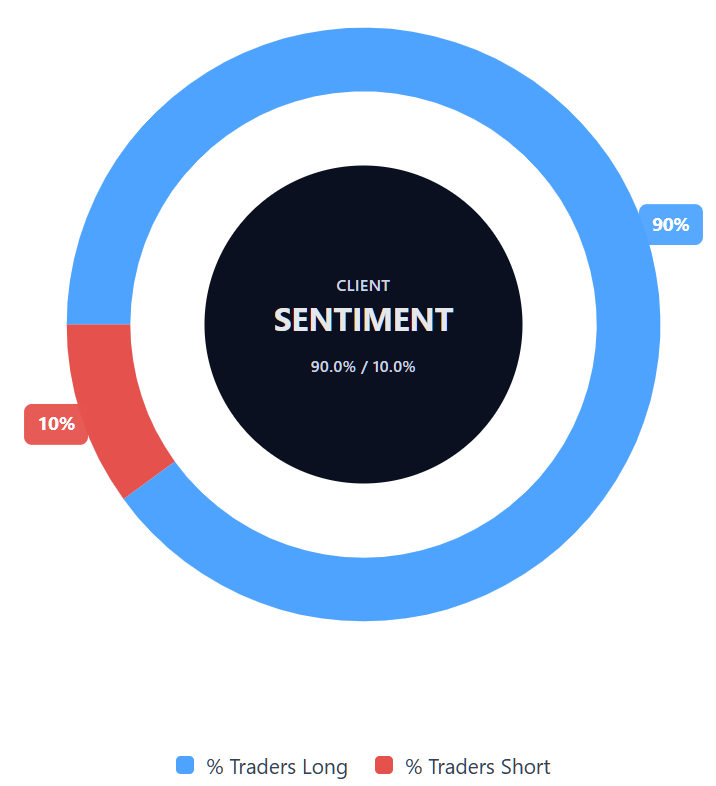
As of 27 February 2026, Capital.com client positioning in Volkswagen CFDs shows 90% buyers versus 10% sellers, a heavy-buy skew that puts buyers ahead by 80 percentage points. This positioning indicates that a majority of clients with open positions currently hold long exposure. However, client sentiment data reflects existing positions only and does not indicate future price direction. This snapshot represents open positions on the Capital.com platform and can change over time.
Summary – Volkswagen 2026
- As of 7:38am (UTC) on 27 February 2026, Volkswagen was trading near €101.91, after moving from the mid-€140s in early 2024 to the mid-€80s and back above €100.
- Technical indicators show the price sitting just below a cluster of key moving averages between €100 and €104, with the RSI in neutral territory and the ADX pointing to a relatively weak trend.
- Key themes include Volkswagen’s planned 20% group-wide cost reduction programme by 2028, ongoing legal proceedings related to diesel emissions and competitive dynamics in electric vehicles.
- Recent reporting has focused on cost-saving measures and fresh diesel-related proceedings in France, keeping both operational strategy and legal risks in focus.
Past performance is not a reliable indicator of future results.
FAQ
Who owns the most Volkswagen stock?
Volkswagen AG has a concentrated ownership structure. Porsche Automobil Holding SE remains the largest shareholder, holding a majority of the company’s ordinary shares and voting rights. The State of Lower Saxony also holds a significant stake, giving it substantial influence under German corporate governance rules. In addition, institutional investors and asset managers hold portions of both ordinary and preference shares. These ownership proportions may change over time as shareholders adjust their positions.
What is the 5-year Volkswagen share price forecast?
There is no single, reliable five-year VOW stock forecast. Most published analyst targets focus on a 12-month horizon rather than longer periods. Longer-term projections depend on a range of variables, including the group’s electric vehicle strategy, cost-efficiency initiatives, global demand trends, regulatory developments and the outcome of ongoing legal matters. Any long-term forecast should be viewed as scenario-based rather than predictive, as market conditions and company fundamentals can change over time.
Is Volkswagen a good stock to buy?
Whether Volkswagen is considered a ‘good’ stock depends on your objectives, time horizon and risk tolerance. The company operates in a cyclical, capital-intensive industry that faces structural change, including the transition towards electric vehicles and evolving regulation. While some analysts publish price targets above recent trading levels, others point to competitive pressures and legal risks. This overview is provided for informational purposes only and does not constitute investment advice.
Could Volkswagen stock go up or down?
Yes. Like all listed shares, Volkswagen’s stock price can move up or down in response to earnings results, industry trends, macroeconomic data, legal developments and broader market sentiment. Automotive stocks can be sensitive to changes in consumer demand, supply chains, input costs and policy decisions. Short-term price movements may also reflect technical factors and wider equity market conditions.
Should I invest in Volkswagen stock?
Yes, you can trade Volkswagen CFDs on Capital.com. Trading share CFDs lets you speculate on price movements without owning the underlying asset and to take long or short positions. However, contracts for difference (CFDs) are traded on margin, and leverage amplifies both profits and losses. You should ensure you understand how CFD trading works, assess your risk tolerance, and recognise that losses can occur quickly.