
Volkswagen stock forecast: Rivian venture winter testing
Volkswagen is a German carmaker whose outlook is shaped by weaker profits, 2026 margin guidance, and progress in its Rivian-linked software venture after winter testing in late March. Past performance is not a reliable indicator of future results. Explore third-party VOW price targets.
Volkswagen AG (VOW) is trading at €90.50 as of 1:03pm UTC on 1 April 2026, within an intraday range of €88.06–€90.55. Past performance is not a reliable indicator of future results.
Sentiment around VOW has been shaped by several concurrent developments: Volkswagen's joint venture with Rivian (RV Tech) successfully completed winter testing of its software-defined vehicle architecture in late March, unlocking a $1 billion investment tranche from Volkswagen into Rivian as part of a deal valued at up to $5.8 billion (Reuters, 27 March 2026); European stocks more broadly are recovering after the DAX recorded a monthly loss of approximately 10.5% in March, its sharpest since March 2020 (Trading Economics, 1 April 2026), amid US tariff uncertainty and geopolitical tensions (CNBC, 1 April 2026), while the group's full-year 2025 operating profit fell by more than half to €8.9 billion, with management guiding for a 4%–5.5% operating margin in 2026 (Volkswagen, 10 March 2026).
Volkswagen stock forecast 2026–2030: Third-party price targets
As of 1 April 2026, third-party Volkswagen stock predictions span a wide range, reflecting divergent views on the group's cost programme execution, margin recovery, and exposure to US tariffs and competitive headwinds in China. The following targets summarise the most recently available third-party broker and consensus estimates within that window.
Morgan Stanley (Equal Weight, target trimmed)
Morgan Stanley lowered its 12-month VOW stock forecast to €100 from €115, while keeping an Equal Weight rating on the shares. The revision reflects the bank's more cautious view on near-term margin recovery, amid ongoing restructuring costs and a sector-wide de-rating of European automotive names (TipRanks, 30 March 2026).
DZ Bank (Neutral, rating reiterated)
DZ Bank reiterated a Neutral rating on Volkswagen, maintaining a cautious stance in line with the broader sell-side consensus on the stock. The bank's position reflects persistent uncertainty over the pace of the group's margin recovery and the structural challenges it faces in electrification and in its Chinese operations (MarketScreener, 30 March 2026).
Bernstein (Neutral, stance unchanged)
Bernstein maintained a Neutral rating on Volkswagen, leaving its assessment broadly unchanged after reviewing the group's restructuring trajectory and FY 2026 guidance. The firm flags the group's asset disposal strategy and cost targets as the key variables to watch, with margin guidance of 4%–5.5% for 2026 appearing tight given structural headwinds (MarketScreener, 26 March 2026).
Warburg Research (Buy, target maintained)
Warburg Research analyst Fabio Holscher maintained a Buy rating on Volkswagen with a price target of €151, representing the most bullish single-broker call in the current window. The firm's constructive stance rests on its view that the stock's compressed valuation does not adequately reflect the group's medium-term earnings recovery potential, with job-cut and cost-reduction plans cited as supportive (The Globe and Mail, 20 March 2026).
RBC Capital Markets (Buy, target cut)
RBC Capital Markets analyst Tom Narayan lowered his price target on Volkswagen to €125 from €139, while retaining a Buy rating and citing asset sales as a key re-rating catalyst. The cut reflects downward revisions to earnings estimates after the group's 2025 results, as tariff exposure and China volume weakness weigh on near-term profit assumptions, with the 2026 EBIT margin guided at 4%–5.5% and including an assumed €3 billion tariff burden (MarketScreener, 16 March 2026).
Predictions and third-party forecasts are inherently uncertain, as they cannot fully account for unexpected market developments. Past performance is not a reliable indicator of future results.
VOW stock price: Technical overview
The VOW stock price trades at €90.50 as of 1:03pm UTC on 1 April 2026, sitting just below the 20-day simple moving average (SMA) at around €90, with the short-term 10-day SMA at around €89 signalling a buy on TradingView's indicator summary. The broader moving-average structure is bearish: the 30/50/100/200-day SMAs range from around €93 to around €100, all above the last price and all reading sell, indicating that the stock remains below its medium- and long-term averages.
The 14-day relative strength index (RSI) registers 43.38, a lower-neutral reading that reflects subdued momentum without signalling an oversold condition. The average directional index (ADX) at 42.10 indicates that an established trend is in place, consistent with the prevailing sell bias across longer-dated moving averages, according to TradingView data.
On the topside, the classic pivot R1 at €96.55 is the nearest reference above the last price; a daily close above that level would put R2 at around €104.65 in view. On the downside, the classic pivot (P) at €90.80 sits just above the current price and represents initial support; below that, S1 at €82.70 is the next meaningful reference, while the 100-day SMA near €99.83 and 200-day SMA near €97.90 overhead continue to act as potential resistance rather than support (TradingView, 1 April 2026).
This technical analysis is provided for informational purposes only. It does not constitute financial advice or a recommendation to buy or sell any instrument.
Volkswagen share price history (2024–2026)
VOW’s stock price opened April 2024 around €144, with the stock touching a two-year high of €152.67 on 4 April 2024 before entering a prolonged downtrend. From that peak, the stock lost ground steadily through the summer, slipping below €130 by early June and below €110 by late July as investor concerns about the group's profitability, China exposure, and EV transition costs mounted.
The sell-off deepened into the autumn of 2024, with VOW hitting a trough close of €82.59 on 27 November , roughly 46% below the April peak. A partial recovery followed into early 2025, with the stock climbing back above €100 by January and reaching €113.72 intraday on 11 March 2025, supported by broader European equity optimism. That recovery proved short-lived; a sharp reversal in April 2025 dragged the stock to an intraday low of €83.94 on 7 April amid a global tariff-driven sell-off.
VOW staged another rebound through mid-2025, recovering above €107 in May and holding broadly in the €95–€113 range through December 2025, which it closed at €105.21. The stock has drifted lower again in early 2026, shedding around 14.1% year to date to close at €90.35 on 1 April 2026 , approximately 7.0% below where it stood one year earlier.

Past performance is not a reliable indicator of future results. Share prices are indicative and may differ from live market prices.
Volkswagen (VOW): Capital.com analyst view
Volkswagen's share price has undergone a significant reset over the past two years, falling from above €150 in early 2024 to around €90 by April 2026, reflecting concerns about profitability, competitive pressure from Chinese EV manufacturers, and ongoing US tariff headwinds. The group's 2025 operating profit fell by more than half, and management has responded with an ambitious restructuring plan targeting a 20% cost reduction across all brands by 2028 and around 50,000 job cuts. If executed successfully, these measures could support a margin recovery towards the guided 4%–5.5% range for 2026; however, the scale of the programme carries execution risk, and labour relations in Germany's tightly unionised auto sector have historically complicated such efforts.
The group's tie-up with Rivian and progress on software-defined vehicle architecture offer a potential longer-term growth driver, though whether this translates into a competitive advantage against well-capitalised EV rivals remains uncertain. Macroeconomic factors, including the direction of European consumer demand, US trade policy, and the pace of growth in China's domestic EV market, could influence the stock in either direction.
Capital.com’s client sentiment for Volkswagen CFDs
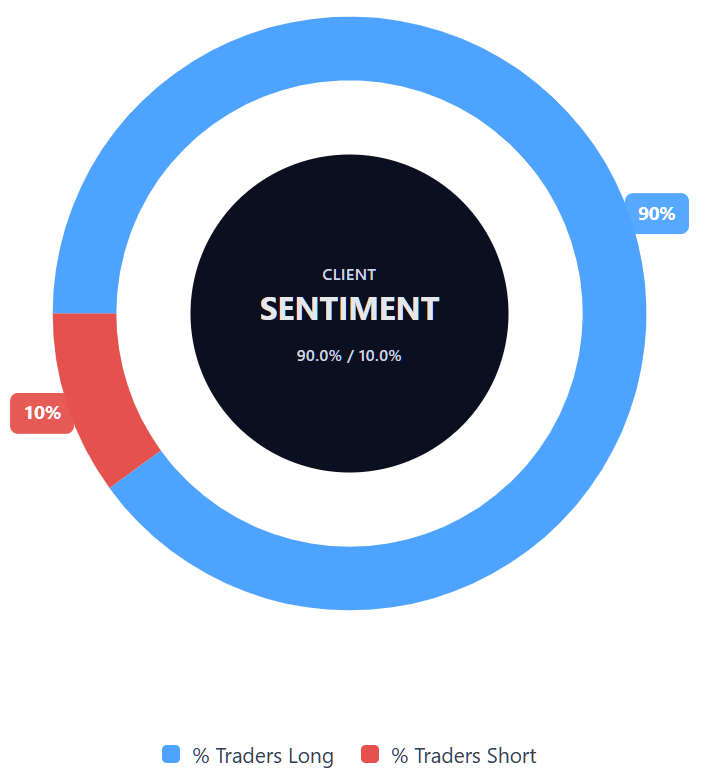
As of 1 April 2026, Capital.com client positioning in Volkswagen CFDs stands at 90% long and 10% short, putting buyers ahead by 80 percentage points and placing sentiment firmly in a heavy-buy, one-sided-toward-longs territory. This snapshot reflects open positions on Capital.com and can change.
Summary – Volkswagen 2026
- As of 1:03pm UTC on 1 April 2026, Volkswagen (VOW) was trading at €90.50, down around 37% from its April 2024 two-year high of €152.67.
- Technical indicators on TradingView show the 14-day RSI at 43.38 (lower-neutral), with the stock trading below its 20/50/100/200-day SMAs, all of which signal sell.
- Key drivers include Volkswagen's 2025 profit slump (down 53%), a 20% cost-reduction programme targeting 2028, around 50,000 planned job cuts, and persistent US tariff and China EV headwinds.
- Recent news centres on the Rivian joint venture unlocking a further $1 billion investment tranche after successful winter software testing, and on European equities rebounding on 1 April after their sharpest monthly decline since March 2020.
Past performance is not a reliable indicator of future results.
FAQ
Who owns the most Volkswagen stock?
What is the 5 year Volkswagen share price forecast?
Is Volkswagen a good stock to buy?
Whether Volkswagen is a good stock to buy depends on your objectives, risk tolerance and time horizon. Some market participants may focus on valuation, restructuring efforts and potential margin recovery, while others may focus on weaker profitability, tariff risk, competition in EVs and execution challenges. The article shows that analyst views are mixed rather than one-sided. That balance highlights an important point: a share can offer potential upside and still carry meaningful downside risks at the same time.
Could Volkswagen stock go up or down?
Should I invest in Volkswagen stock?
Can I trade Volkswagen CFDs on Capital.com?
Yes, you can trade Volkswagen CFDs on Capital.com. Trading share CFDs lets you speculate on price movements without owning the underlying asset and to take long or short positions. However, contracts for difference (CFDs) are traded on margin, and leverage amplifies both profits and losses. You should ensure you understand how CFD trading works, assess your risk tolerance, and recognise that losses can occur quickly.