
Tesla stock forecast: Q1 delivery miss, V2G approval
Tesla enters its Q1 2026 earnings release after a second consecutive delivery shortfall, while California approval for a Cybertruck vehicle-to-grid programme adds a new development to its energy business. Explore third-party TSLA price targets and technical analysis.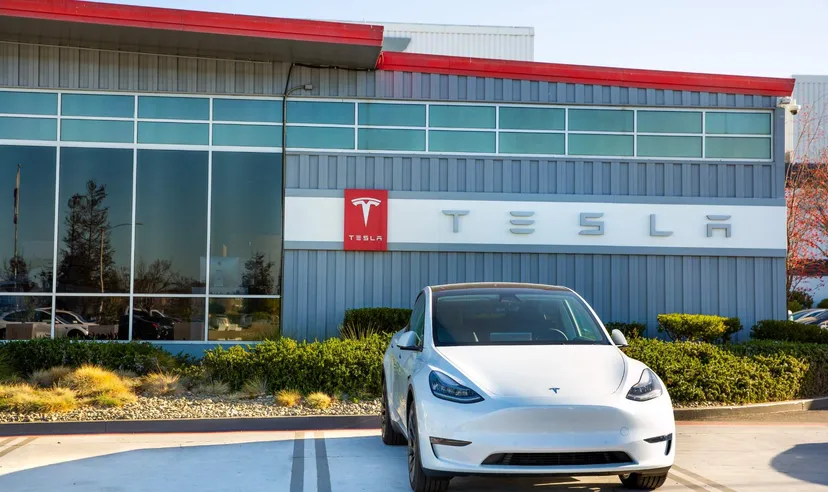
Past performance is not a reliable indicator of future results.
Tesla, Inc. (TSLA) last closed at $400.39, within an intraday range of $390.75–$404.70, as of 8:58am UTC on 21 April 2026, ahead of its scheduled Q1 2026 earnings release after market close on Wednesday, 22 April 2026. Past performance is not a reliable indicator of future results.
Sentiment ahead of earnings is shaped by several factors: Tesla reported Q1 2026 deliveries of 358,023 vehicles, missing the Wall Street consensus of approximately 365,000–372,000 units and marking a second consecutive quarterly shortfall. Reuters cited fading US EV incentives and intensifying global competition as contributing pressures (Reuters, 2 April 2026). CNBC reported that Musk's political involvement has weighed on consumer demand (CNBC, 2 April 2026). Meanwhile, on 21 April 2026, PG&E and Tesla received California regulatory approval for a Cybertruck vehicle-to-grid (V2X) programme, representing a new use case for the company's energy business (Seeking Alpha, 21 April 2026).
Tesla stock forecast 2026–2030: Third-party price targets
As of 21 April 2026, third-party Tesla stock predictions span a wide range in April 2026, as brokers weigh a Q1 delivery miss against the company's longer-term artificial intelligence and autonomous vehicle ambitions ahead of Q1 2026 earnings on 22 April 2026.
J.P. Morgan (Underweight reiteration)
J.P. Morgan reiterates an Underweight rating and a $145 price target on TSLA, implying substantial downside from current levels. Analyst Ryan Brinkman cites the Q1 2026 delivery total of 358,023 vehicles, which the firm characterises as the largest production-to-delivery gap in Tesla's history, alongside a trimmed 2026 EPS estimate of $1.80 (Quartz, 6 April 2026).
Deutsche Bank (Buy, trimmed target)
Deutsche Bank lowers its TSLA price target to $465 from $480, while retaining a Buy rating. The revision follows the Q1 2026 delivery shortfall, though the bank maintains a constructive view on Tesla's autonomous driving and energy storage businesses as medium-term growth drivers (MarketBeat, 9 April 2026).
Public.com (consensus overview)
Public.com aggregates ratings from 28 analysts and reports a consensus Hold for TSLA with an average 12-month price target of $397.35. The distribution is 29% Strong Buy, 21% Buy, 32% Hold, 11% Sell, and 7% Strong Sell, reflecting the wide dispersion in sentiment across covering analysts (Public.com, 20 April 2026).
TD Cowen (Buy, trimmed target)
TD Cowen lowers its TSLA price target to $490 from $519, while retaining a Buy rating. Analyst Itay Michaeli reduces near-term delivery and margin assumptions following the Q1 miss, but the firm keeps a positive longer-term view anchored to Tesla's autonomous vehicle rollout and AI infrastructure investment cycle (MarketScreener, 15 April 2026).
Wedbush (Outperform reiteration)
Wedbush reiterates an Outperform rating and a $600 price target, the highest target among major Wall Street firms at the time of publication. Analyst Dan Ives bases the bull case on expected full-self-driving penetration exceeding 50%, an ongoing robotaxi rollout beginning in Austin with expansion planned across multiple US cities in 2026, and a potential Tesla-SpaceX strategic scenario (Investing.com, 2 April 2026).
Predictions and third-party forecasts are inherently uncertain, as they cannot fully account for unexpected market developments. Past performance is not a reliable indicator of future results.
TSLA stock price: Technical overview
The TSLA stock price trades at $400.39 in early Tuesday European trading as of 8:58am UTC on 21 April 2026, sitting just above the 100-day simple moving average (SMA) at approximately $417 and the 200-day SMA at approximately $399, with the daily last price pressing into a congested long-term moving-average shelf. Shorter-dated averages remain constructive: the 20- and 50-day SMAs at approximately $369 and approximately $390 are both flagged as buy signals by TradingView, though the 100-day SMA at approximately $417 and the Hull moving average (9) at approximately $406 read as sell signals, indicating mixed conditions at the current price level.
Momentum is neutral to cautious: the 14-day relative strength index (RSI) stands at 56.36, in the upper-neutral zone, while the average directional index (ADX) at 24.47 sits just below the 25 threshold that would typically indicate an established trend, per TradingView.
On the topside, the classic R1 pivot at approximately $408 is the first nearby reference; a daily close above that level would put the R2 area near approximately $444 in view. On the downside, the classic pivot point at approximately $380 represents initial support, with the 200-day SMA at approximately $399 and S1 near approximately $344 as the next references if that level gives way (TradingView, 21 April 2026).
This is technical analysis for informational purposes only and does not constitute financial advice or a recommendation to buy or sell any instrument.
Tesla (TSLA): Capital.com analyst view
Tesla's price performance in 2026 has been shaped by a sharp early-year decline from an all-time high of $498.46 reached in December 2025, with TSLA recovering to trade near the $400 level by late April 2026. The stock's partial rebound reflects renewed investor attention to Tesla's autonomy roadmap, including an ongoing robotaxi expansion into Dallas and Houston ahead of the Q1 2026 earnings release scheduled for 22 April 2026. However, Q1 2026 delivered only 358,023 vehicles against a production run of 408,386, leaving a gap of more than 50,000 units that points to demand absorption pressures, while consensus estimates project Q1 revenue of $22.08 billion, down 9% year on year.
The bull case centres on Tesla's AI and energy optionality: analysts expect net cash to exceed $28 billion by year-end, even as capital expenditure is projected to surpass $19 billion in 2026, supporting investment in full self-driving and robotics. The bear case, however, notes that this elevated spending is projected to generate negative free cash flow of $1.44 billion for the quarter, while competition from BYD, which posted 310,389 battery-electric sales in Q1, continues to narrow Tesla's global volume lead.
Summary – Tesla 2026
- Tesla (TSLA) last closed at $400.39, recovering from a 2026 low after falling sharply from an all-time high of $498.46 reached in December 2025.
- Technical indicators from TradingView are mixed: shorter-dated SMAs signal a buy, while the 100-day SMA (approximately $417) and Hull moving average (approximately $406) read as sell signals.
- Key bull-case drivers include robotaxi expansion into Dallas and Houston, full self-driving progress, and an energy business supported by projected net cash exceeding $28 billion.
- Bear-case risks include projected negative free cash flow of $1.44 billion in Q1, capital expenditure forecast at more than $19 billion for 2026, and intensifying competition from BYD.
Past performance is not a reliable indicator of future results.
FAQ
Who owns the most Tesla stock?
Tesla’s largest individual shareholder is Elon Musk, who remains the company’s biggest equity holder. However, ownership is spread across founders, executives, retail investors, and large institutional asset managers. The balance can change over time as insiders sell shares, exercise options, or as funds rebalance their holdings. For traders, ownership concentration can matter because it may affect voting control, market sentiment, and how the share price responds to company-specific developments.
What is the 5 year Tesla share price forecast?
Is Tesla a good stock to buy?
Could Tesla stock go up or down?
Tesla stock could move in either direction, and that is one reason it attracts such close attention from traders and investors. Upward moves may be driven by stronger earnings, improving margins, progress in autonomy, or supportive analyst revisions. Downward moves may follow weaker deliveries, rising costs, softer demand, or broader risk-off sentiment in equity markets. Technical levels can also shape short-term price action, but they do not remove the uncertainty around future moves.
Should I invest in Tesla stock?
Can I trade Tesla CFDs on Capital.com?
Yes, you can trade Tesla CFDs on Capital.com. Trading share CFDs lets you speculate on price movements without owning the underlying asset and to take long or short positions. However, contracts for difference (CFDs) are traded on margin, and leverage amplifies both profits and losses. You should ensure you understand how CFD trading works, assess your risk tolerance, and recognise that losses can occur quickly.