
Palantir stock forecast: Tariff pressure, Pentagon AI role
Palantir Technologies is a US software company whose recent price action has reflected both broader tech market weakness and continued focus on its AI, commercial growth and defence contracts. Past performance is not a reliable indicator of future results. Explore third-party PLTR price targets.
Palantir Technologies Inc. (PLTR) is trading at $141.20 as of 1:29pm UTC on 9 April 2026, within an intraday range of $139.89–$155.83. Past performance is not a reliable indicator of future results.
Pressure on PLTR comes amid a broad tech sector sell-off driven by ongoing US tariff uncertainty, with the Nasdaq and software stocks particularly exposed to risk-off sentiment in early April 2026 (Linos.ai, 4 April 2026). Analysts continue to reference underlying company fundamentals, including Palantir's Q4 FY2025 results – in which total revenue reached $4.475 billion for the year, up 56% year on year, and US commercial revenue grew 137% year on year in Q4 – alongside the US Army enterprise agreement worth up to $10 billion over 10 years (Yahoo Finance, 2 February 2026). The Army contract, announced in July 2025, consolidated 75 existing contracts into a single enterprise arrangement with Palantir (CNBC, 1 August 2025). Reuters reported in March 2026 that the Pentagon's adoption of Palantir AI as a core US military system has been cited as a structural support for the company's government revenue base, even as macro headwinds weigh on the broader technology sector (Reuters, 20 March 2026).
Palantir stock forecast 2026–2030: Third-party price targets
As of 9 April 2026, third-party Palantir stock predictions span a wide range, reflecting divided views on whether the stock's premium valuation is warranted by its AI-driven revenue growth trajectory. The following targets summarise broker and consensus forecasts issued during that period.
Benchmark (Hold initiation)
Benchmark analyst Yi Fu Lee initiates coverage of Palantir with a Hold rating and a 12-month PLTR stock forecast of $150. Lee argues that the current valuation appears to price in near- to mid-term perfection, requiring sustained 60%–70% annual revenue growth to avoid potential downside, while acknowledging Palantir's AI-powered platform and strong fundamentals under CEO Alex Karp (Seeking Alpha, 1 April 2026).
Rosenblatt Securities (Buy, raised target)
Rosenblatt reiterates a $200 Buy target on PLTR, maintaining its view that rising geopolitical demand for integrated defence and AI battlefield software underpins a sustained re-rating. Analyst John McPeake bases the target on a price/earnings-to-growth ratio of 1.2x applied to 88 times 2027 EPS estimates, using what Rosenblatt describes as street-high projections for the company's 2027 financials (Investing.com, 3 March 2026).
Mizuho (Outperform, $195 target)
Mizuho upgrades PLTR from Neutral to Outperform with a price target of $195, citing confidence in the company's revenue growth and margin expansion after the stock's enterprise value-to-free-cash-flow multiple fell 46% in the first six weeks of 2026. The firm notes that AI demand trends and acceleration in Palantir's US commercial business support a more constructive stance, even as broader Nasdaq sentiment remains under pressure from macro headwinds (Investing.com, 18 February 2026).
Zacks (consensus overview)
Zacks aggregates 22 short-term price targets for PLTR and reports a mean of $200.41, with individual estimates ranging from a low of $90 to a high of $260. The wide standard deviation of $33.93 reflects persistent disagreement over Palantir's valuation framework, with the most optimistic analysts pricing in continued AI-driven revenue acceleration, while the more cautious end of the range highlights downside risk from the stock's elevated price-to-earnings multiple (Zacks, 5 March 2026).
MarketBeat (consensus summary, Moderate Buy)
MarketBeat records a Moderate Buy consensus for PLTR with an average 12-month price target of $197.77 across 22 analysts, alongside a note that the stock trades at a price-to-earnings ratio of approximately 223 times. The platform notes that the consensus reflects mixed fundamentals, with Palantir's Q4 FY2025 revenue growth of 70% year on year and an earnings per share beat set against ongoing valuation scrutiny and recent insider sales, leaving further gains contingent on continued strong execution (MarketBeat, 8 April 2026).
Predictions and third-party forecasts are inherently uncertain, as they cannot fully account for unexpected market developments. Past performance is not a reliable indicator of future results.
PLTR stock price: Technical overview
The PLTR stock price trades at $141.20 as of 1:29pm UTC on 9 April 2026, sitting below all major moving averages across both the simple and exponential families, according to TradingView data. The 20/50/100/200-day SMAs stand at approximately $150 / $146 / $161 / $164, placing the current price beneath the full short- and long-term stack, a configuration that TradingView's moving average summary classifies as a collective sell signal. The Hull moving average (nine-period) at $147.88 and the volume-weighted moving average (20-period) at $150.13 reinforce this picture, with price trading below both levels.
Momentum indicators are mixed. The 14-day relative strength index registers 42.62, sitting in neutral territory and indicating neither oversold conditions nor strong upside momentum. The average directional index (14) reads 19.14, below the 25 threshold commonly associated with a confirmed trend, suggesting the current directional move lacks strong conviction. The MACD level (12, 26) is negative at -1.01, consistent with the broader sell bias reflected in the moving average cluster.
On the upside, the classic R1 pivot at $160.35 represents the nearest overhead reference; a daily close above that level would bring R2 near $174.43 into view. On the downside, the classic pivot (P) at $148.33 sits immediately above the current price and may act as a near-term reference level, with S1 at $134.25 the next notable level if the pivot fails to hold (TradingView, 9 April 2026).
This is technical analysis for informational purposes only and does not constitute financial advice or a recommendation to buy or sell any instrument.
Palantir share price history (2024–2026)
PLTR’s stock price was trading around $22 in April 2024, a relatively subdued level that belied the rally to come. The stock climbed steadily through the second half of 2024, closing at $41.78 on 31 October 2024, before a sharp post-election surge in early November took it past $60 and then above $67 by month-end.
The momentum carried into 2025. PLTR hit an intraday high of $222.05 on 3 November 2025, its highest point in the dataset, before pulling back into the mid-$160s heading into year-end. The stock closed 2025 at $177.60.
In 2026, PLTR reached $182.55 intraday on 12 January before rolling over. A sharp sell-off accelerated through March and into April, with the stock dropping as low as $65.59 intraday on 7 April 2026 during broader tariff-driven market turbulence before recovering. By early April 2026, that recovery had faded, and PLTR was trading at $141.20 on 9 April 2026 – approximately 20.5% down year to date, but roughly 55.1% higher year on year versus the close of $91.05 on 9 April 2025.

Past performance is not a reliable indicator of future results.
Palantir (PLTR): Capital.com analyst view
Palantir's price trajectory over the past two years reflects the tension between an exceptional fundamental story and a valuation that has left little room for error. The company's Q4 FY2025 results – which showed revenue growth of 70% year on year and US commercial revenue up 137% – alongside the Pentagon's adoption of its AI platform as a core military system, provide tangible support for the more optimistic case. However, the stock's price-to-earnings ratio of roughly 223 times, as noted by MarketBeat, means that any macro headwind or growth disappointment can quickly translate into outsized price swings, as the April 2026 sell-off illustrates.
The broader context adds further complexity. Palantir's deep ties to US government defence spending could prove supportive if geopolitical tensions persist, but the same concentration creates vulnerability should defence budgets face revision or contract timelines shift. On the macro side, ongoing tariff uncertainty and risk-off sentiment in the Nasdaq are weighing on near-term price action, while a potential easing of that uncertainty could provide a catalyst for recovery. Both scenarios carry meaningful uncertainty.
Capital.com’s client sentiment for Palantir CFDs
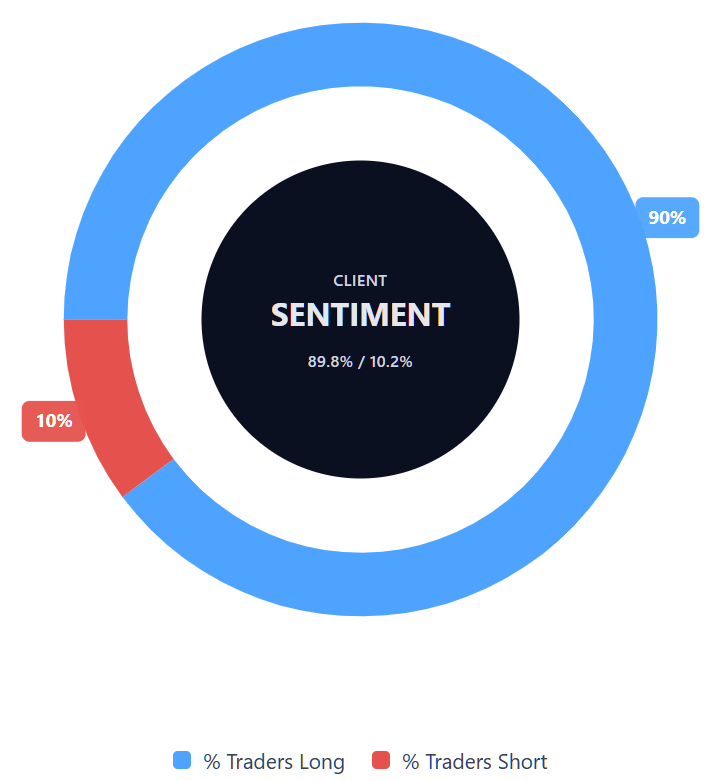
As of 9 April 2026, Capital.com client positioning in Palantir CFDs shows 89.8% of clients hold buy positions versus 10.2% short, putting buyers ahead by 79.6 percentage points and placing sentiment firmly in heavy-buy, one-sided-towards-longs territory. This snapshot reflects open positions on Capital.com at the time of writing and can change rapidly as market conditions evolve.
Summary – Palantir 2026
- As of 1:29pm UTC on 9 April 2026, PLTR trades at $141.20, down roughly 20.5% year to date but around 55.1% higher year on year.
- Key drivers include Palantir's strong Q4 FY2025 revenue growth of 70% year on year and the Pentagon's adoption of its AI platform as a core US military system.
- Ongoing US tariff uncertainty and broad Nasdaq risk-off sentiment are weighing on near-term price action, with software stocks particularly exposed to the current macro environment.
Past performance is not a reliable indicator of future results.
FAQ
Who owns the most Palantir stock?
What is the 5 year Palantir share price forecast?
Is Palantir a good stock to buy?
Could Palantir stock go up or down?
Should I invest in Palantir stock?
Can I trade Palantir CFDs on Capital.com?
Yes, you can trade Palantir CFDs on Capital.com. Trading share CFDs lets you speculate on price movements without owning the underlying asset and to take long or short positions. However, contracts for difference (CFDs) are traded on margin, and leverage amplifies both profits and losses. You should ensure you understand how CFD trading works, assess your risk tolerance, and recognise that losses can occur quickly.