
Rheinmetall stock forecast: Enforce Tac & Italy missile approval
Rheinmetall AG is a German defence contractor listed in Frankfurt, recently showcasing new military systems at Enforce Tac 2026 and receiving Italian approval to begin missile production in Sardinia. Explore third-party RHM price targets and technical analysis.
Rheinmetall AG (RHM) is trading around €1,701.28 in early European dealings on 25 February 2026, near the lower end of its intraday range of €1,700.78-€1,726.76, as quoted on Capital.com at 9:53am (UTC). Past performance is not a reliable indicator of future results.
The stock trades amid a steady flow of defence-sector developments. Rheinmetall is showcasing new systems, including the Fuchs JAGM missile tank destroyer, modular body armour and combat helmets, at the Enforce Tac 2026 trade fair in Nuremberg from 23-25 February 2026 (Army Technology. 24 February 2026). At the same time, the company has received Italian government approval to begin production at its explosives and missiles plant in Domusnovas, Sardinia. It states that the facility will supply several EU, NATO and allied countries, expanding its industrial footprint alongside Italian partner Leonardo in armoured vehicle manufacturing (MarketScreener, 18 February 2026).
Rheinmetall stock forecast 2026–2030: Third-party price targets
Third-party Rheinmetall stock predictions remain above the Capital.com last price of €1,701.28 as of 9:53am (UTC) on 25 February 2026. Brokers and data providers reference defence-budget trends, sizeable order pipelines and execution considerations following recent guidance updates. The summaries below outline six recent 12-month targets and consensus snapshots, focusing on stated price levels, ratings and key assumptions at the time of publication.
Jefferies (target revision)
Jefferies lowers its Rheinmetall price target from €2,170 to €2,060, while maintaining a buy rating. The broker notes that initial indications for the 2025 financial year and early sales expectations for 2026 came in below prior consensus on revenue and margins. However, it continues to reference elevated defence spending as a structural support (MarketScreener, 4 February 2026).
Berenberg (rating confirmation)
Berenberg maintains a buy rating and sets a €2,100 price target. The analyst bases this valuation on expectations of continued defence-related revenue growth and order conversion, while acknowledging uncertainty around guidance and the execution of capacity expansion plans (The Globe and Mail, 6 February 2026).
UBS (house view update)
UBS reaffirms its buy rating and sets a €2,200 price target. The bank cites Rheinmetall’s positioning within the European defence cycle and expectations for sustained order growth and capacity expansion. It also flags macroeconomic factors, public budget decisions and programme execution as potential risks to its framework (The Globe and Mail, 25 February 2026).
MarketScreener (consensus overview)
MarketScreener reports an average 12-month RHM stock forecast of €2,127.25, with individual analyst targets ranging from €1,700 to €2,500. The spread reflects differing assumptions about the pace at which large defence contracts convert into revenue and earnings, and the durability of margins following what some analysts describe as cautious initial 2026 guidance (MarketScreener, 25 February 2026).
Fintel (ADR consensus snapshot)
Fintel shows an average one-year price target of $2,506.86 for Rheinmetall’s RNMBF ADR, with forecasts ranging from $1,982.09 to $3,030.28. The aggregation reflects multiple analyst models that incorporate expectations for order intake, revenue development and profitability across defence segments within the current global security backdrop (Fintel, 2 February 2026).
Predictions and third-party forecasts are inherently uncertain, as they cannot fully account for unexpected market developments. Past performance is not a reliable indicator of future results.
RHM stock price: Technical overview
The RHM stock price trades around €1,701.28 as of 9:53am (UTC) on 25 February 2026, below the Classic pivot near 1,768, while technical indicators present mixed signals. On the daily chart, the simple moving average cluster stands near the 20/50/100/200-day averages at approximately 1,676 / 1,711 / 1,707 / 1,741. The 10-day SMA near 1,673 provides an additional short-term reference. The 14-day RSI around 50 indicates mid-range momentum, while an ADX reading near 20 suggests a modestly developed trend rather than a strong directional phase.
On the upside, the nearest classic resistance appears at R1 around 1,979, with R2 near 2,176 coming into focus only if RHM closes decisively above the first level. On pullbacks, the classic pivot around 1,769 marks initial support, followed by the 100-day SMA near 1,707 as a technical reference. A sustained move below that level could expose the S1 zone near 1,572 based on standard pivot calculations (TradingView, 25 February 2026).
This technical analysis is provided for informational purposes only and does not constitute financial advice or a recommendation to buy or sell any instrument.
Rheinmetall share price history (2024–2026)
Over the past two years, RHM’s stock price has risen from below €1,000 in early 2025 to trading largely within the €1,700-€1,900 range in early 2026. The stock closed at €954.16 on 25 February 2025, moved above €1,000 later that year, and reached highs above €2,000 in late September and early October 2025 before consolidating into the €1,700s.
Through late 2025 and into 2026, price action remained volatile but elevated. Rheinmetall closed 2025 at €1,555.07 on 30 December, then reached intraday highs near €1,935-€1,970 in January 2026 before easing. As of 25 February 2026, the stock closed at €1,731.74, placing it well above year-earlier levels but below its recent January highs, reflecting a market that has repriced materially over the two-year period.

Past performance is not a reliable indicator of future results. Share prices are indicative and may differ from live market prices.
Rheinmetall (RHM): Capital.com analyst view
Rheinmetall’s share price has undergone a substantial re-rating over the past two years, moving from sub-€1,000 levels in early 2025 to the mid-€1,700s-€1,900s in parts of early 2026. The move has coincided with increased defence spending, order momentum and extended contract visibility. However, the path has included periods of consolidation as investors respond to updated guidance, macroeconomic developments and evolving margin expectations.
Looking ahead, multiple factors could influence price development. Continued defence-budget allocations, new programme awards and evidence of effective capacity expansion may support revenue visibility. Conversely, slower order conversion, political or fiscal adjustments, project delays or broader risk-off conditions could weigh on valuations after a significant advance.
Capital.com’s client sentiment for Rheinmetall CFDs
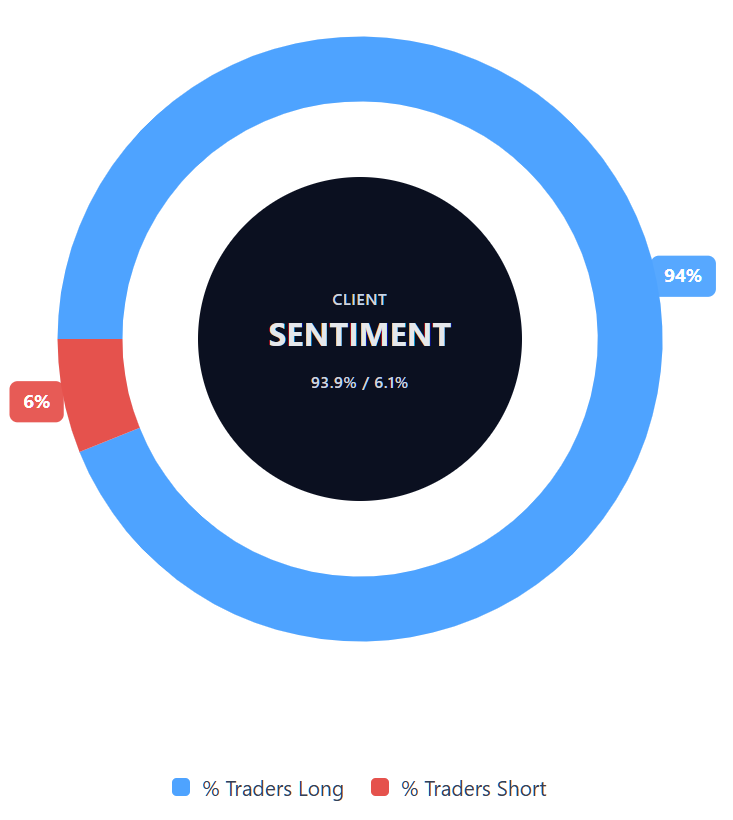
As of 25 February 2026, Capital.com client positioning for Rheinmetall CFDs shows a pronounced long bias, with 93.9% of accounts holding net long positions compared with 6.1% net short. Buyers therefore outnumber sellers by approximately 87.8 percentage points. This snapshot reflects open positions on Capital.com at the time referenced and may change as market conditions evolve.
Summary – Rheinmetall 2026
- As of 9:53am (UTC) on 25 February 2026, Rheinmetall trades near €1,701.28, significantly above sub-€1,000 levels seen in early 2025 but below recent January highs.
- Daily technical indicators show price moving around key averages, with RSI near mid-range and ADX indicating a modest trend structure.
- Key drivers include European defence spending trajectories, multi-year order pipelines, guidance and margin expectations, and broader geopolitical and fiscal developments.
- Recent coverage highlights moderated 2026 guidance, broker targets clustered in the low-€2,000s, and ongoing defence-sector contract activity.
Past performance is not a reliable indicator of future results.
FAQ
Who owns the most Rheinmetall stock?
Rheinmetall’s shareholder base generally comprises a mix of institutional investors, asset managers and private shareholders. Large global investment firms and pension funds often hold material positions through diversified portfolios, while retail participation can fluctuate with market conditions. Ownership levels change over time as funds rebalance and investors adjust exposure. For the most up-to-date breakdown, investors can consult Rheinmetall’s official shareholder disclosures and regulatory filings.
What is the 5-year Rheinmetall share price forecast?
There is no single, agreed five-year RHM stock forecast. Most published analyst estimates focus on 12-month price targets rather than multi-year projections. Longer-term expectations depend on factors such as defence spending trends, contract execution, geopolitical developments and margin sustainability. Because these variables can evolve over time, long-term forecasts involve a higher degree of uncertainty. Investors typically review a range of analyst views and scenario assumptions rather than relying on a single projection.
Is Rheinmetall a good stock to buy?
Whether Rheinmetall is considered a ‘good’ stock depends on an investor’s objectives, risk tolerance and time horizon. The company operates in the defence sector, where revenues may benefit from multi-year government contracts, but earnings can fluctuate depending on order timing and project execution. Share prices may also respond to political and macroeconomic developments. Investors often assess fundamentals, valuation metrics and risk factors before making a decision. This information is provided for general educational purposes and does not constitute investment advice.
Could Rheinmetall stock go up or down?
Rheinmetall’s share price can move in either direction depending on market conditions and company-specific developments. Contract announcements, changes in defence budgets or earnings results may influence price action. Conversely, delays, guidance revisions, budget adjustments or broader risk-off sentiment could weigh on the stock. As with all listed equities, volatility is possible, and past performance does not guarantee future results.
Should I invest in Rheinmetall stock?
Only you can decide whether investing in Rheinmetall aligns with your financial goals and risk profile. Shares provide exposure to the defence sector, but they also carry market risk and company-specific uncertainties. Investors typically consider diversification, investment horizon and personal circumstances before allocating capital. This information is for general purposes only and does not constitute investment advice.
Can I trade Rheinmetall CFDs on Capital.com?
Yes, you can trade Rheinmetall CFDs on Capital.com. Trading share CFDs lets you speculate on price movements without owning the underlying asset and to take long or short positions. However, contracts for difference (CFDs) are traded on margin, and leverage amplifies both profits and losses. You should ensure you understand how CFD trading works, assess your risk tolerance, and recognise that losses can occur quickly.