
Palantir stock forecast: Q4 revenue up 70%
Palantir is a US-listed data analytics company whose Q4 2025 results reported 70% year-on-year revenue growth to $1.41bn, alongside guidance for $7.2bn in 2026 sales and a potential $10bn US Army contract. Explore third-party PLTR price targets and technical analysis.
Palantir Technologies Inc. (PLTR) is trading around $133.45 on 25 February 2026, holding near the top of its session range between $127.59 and $133.82 as of 3:38pm UTC. Past performance is not a reliable indicator of future results.
Price action reflects upbeat fundamental data as well as ongoing debate about valuation. Palantir’s Q4 2025 update showed revenue growth of about 70% year on year to roughly $1.41bn, with U.S. commercial revenue rising more than 130% year on year. Management also guided for around $7.2bn in 2026 sales (Yahoo Finance, 2 February 2026). At the same time, headlines referenced a previously announced U.S. Army enterprise agreement with a potential value of up to $10bn over 10 years, as well as recent insider selling by a company officer in February 2026 (Investing.com, 25 February 2026).
Palantir stock forecast 2026–2030: Third-party price targets
As of 25 February 2026, third-party Palantir stock predictions span a wide range. While most sit above the current spot price, analysts differ on how much of a premium the company’s AI-focused growth profile justifies. The following summaries reflect third-party targets and consensus data.
Fintel (multi‑analyst screen)
Fintel’s Palantir screen shows that the average one-year price target compiled from covering analysts stands near $191 per share, with individual forecasts spanning from about $70.70 at the low end to roughly $273 at the high. The service notes that this distribution reflects a mix of bullish and cautious views, with some analysts emphasising Palantir’s AI-driven growth trajectory and others highlighting valuation and execution uncertainties (Fintel, 25 February 2026).
Investing.com (consensus overview)
Investing.com’s PLTR stock forecast consensus page shows that 27 analysts collectively assign a Buy-leaning consensus, with an average 12-month price target of around $185.87 and individual forecasts ranging from roughly $70 to about $260. The overview states that this average draws on a mix of Buy, Hold and Sell ratings. Analysts who take a more constructive view point to rapid AI-related revenue growth, while more cautious commentators focus on valuation levels, competitive pressures and the sustainability of recent earnings momentum (Investing.com, 25 February 2026).
TipRanks (Wall Street sample)
TipRanks reports that 19 Wall Street analysts assign a Moderate Buy consensus, with an average 12-month price target of about $191.25 per share and individual forecasts ranging from approximately $70 to $260. The breakdown of five Buy, ten Hold and two Sell ratings illustrates the divergence in analyst opinion, particularly around how far Palantir’s AI and data analytics positioning can justify a premium multiple as growth moderates or stabilises (TipRanks, 18 January 2026).
Predictions and third-party forecasts are inherently uncertain, as they cannot fully account for unexpected market developments. Past performance is not a reliable indicator of future results.
PLTR stock price: Technical overview
On the daily chart, the PLTR stock price is trading below a declining cluster of moving averages. The 20-, 50-, 100- and 200-day simple moving averages sit around 139, 163, 171 and 161 respectively as of 25 February 2026 at 3:38pm UTC. This configuration indicates that price remains below key medium- and long-term trend measures, consistent with a corrective phase following prior gains. The 20-day exponential moving average near 140 also remains above spot, reinforcing near-term overhead resistance.
Momentum indicators show a mixed but not extreme backdrop. The 14-day relative strength index (RSI) stands around 38.7, in lower-neutral territory rather than oversold conditions. The average directional index (ADX) near 30 suggests an established trend environment rather than range-bound trading.
On the upside, the nearest classic resistance level appears around 174 (R1). A sustained daily close above this area would be required before 202 (R2) becomes technically relevant. On pullbacks, initial support aligns with the classic pivot near 160, followed by the 100-day SMA around 171 as a potential moving-average reference point. A break below S1 near 132 could expose the lower boundary of the recent range (TradingView, 25 February 2026).
This technical analysis is provided for informational purposes only and does not constitute financial advice or a recommendation to buy or sell any instrument.
Palantir share price history (2024–2026)
PLTR’s stock price has undergone a significant re-rating over the past two years, rising from below $30 in early 2024 to triple-digit levels by early 2026. In the first half of 2024, PLTR traded largely between about $21 and $27, with brief moves above $26–$27 in March and May before easing back towards the low-$20s and high-teens over the summer. By November 2024, the stock had reached around $41 before rebounding, closing the year near $75 following a strong recovery into December.
Momentum accelerated during 2025. PLTR moved above $100 in February and trended higher through much of the year. Between September and early November, it traded from the mid-$170s to just above $200. On 3 November 2025, it recorded an intraday high above $220 before consolidating into the high-$170s and $180s towards year-end.
In 2026 to date, price action has turned more volatile. PLTR declined from roughly $178 at the start of January to about $133.87 at the close on 25 February 2026. While this leaves the stock well below late-2025 highs, it remains substantially above levels seen a year earlier.

Past performance is not a reliable indicator of future results. Share prices are indicative and may differ from live market prices.
Palantir (PLTR): Capital.com analyst view
Palantir’s share price has moved sharply over the past two years, rising from sub-$30 levels in early 2024 to above $200 at points in late 2025, before easing back towards the $133–134 area by 25 February 2026. Strong reported growth in U.S. commercial revenue and total sales, alongside its positioning in AI-driven data analytics, has supported this re-rating. However, the subsequent pullback and ongoing valuation and governance discussions illustrate how quickly market expectations can shift.
Looking ahead, several factors may influence PLTR in either direction. These include the company’s ability to deliver earnings in line with elevated growth assumptions, broader risk appetite towards higher-multiple technology stocks, and developments in large commercial or government contracts. Macroeconomic variables, such as interest-rate expectations and overall equity market volatility, may also affect sentiment. Stronger-than-expected results or contract wins could underpin the share price, while weaker performance, policy headwinds or renewed focus on valuation metrics could place it under pressure.
Capital.com’s client sentiment for Palantir CFDs
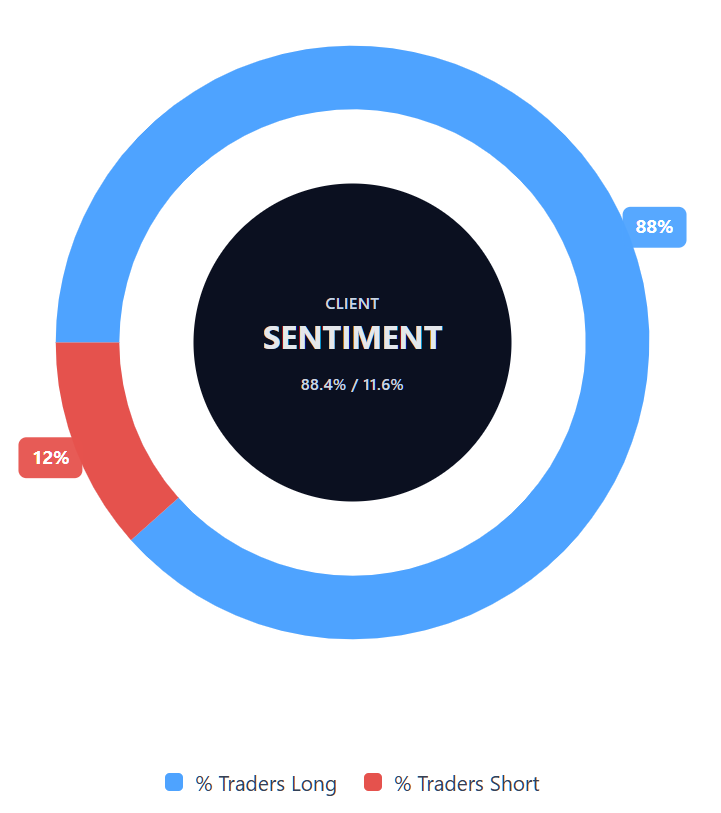
As of 25 February 2026, Capital.com client positioning in Palantir CFDs is currently skewed towards long positions, with 88.4% buyers versus 11.6% sellers. This places buyers ahead by approximately 77 percentage points and indicates that positioning is concentrated on the long side rather than evenly balanced.
This data reflects open positions on the Capital.com platform at the time of writing and can change.
Summary – Palantir 2026
- As of 3:38pm UTC on 25 February 2026, Palantir traded around $133.45, below its late-2025 highs above $220 but significantly above early-2024 levels.
- Technically, the price trades beneath a declining 20-, 50-, 100- and 200-day SMA cluster near 139, 163, 171 and 161 respectively, while the RSI sits around 38 in lower-neutral territory and the ADX signals a trending backdrop.
- Key influences include AI-driven revenue growth, sensitivity to sentiment around higher-valuation technology stocks, commercial and government contract developments, and broader equity and interest-rate conditions.
- Recent updates highlight strong Q4 2025 revenue and U.S. commercial growth, alongside valuation, governance and volatility considerations following the retreat from record highs.
Past performance is not a reliable indicator of future results.
FAQ
Who owns the most Palantir stock?
Palantir’s largest shareholders typically include its co-founders, senior executives and major institutional investors such as asset managers and investment funds. Over time, insider holdings have tended to decline as more shares entered the public market, while institutional ownership has increased. The exact breakdown may change as funds rebalance portfolios or executives sell shares under pre-arranged trading plans. Investors can review the latest filings with the US Securities and Exchange Commission (SEC) for current ownership information.
What is the five-year Palantir share price forecast?
There is no single agreed five-year PLTR stock forecast. Most publicly available analyst targets focus on a 12-month horizon rather than longer-term projections. Over a five-year period, outcomes would likely depend on revenue growth, profitability, competitive positioning in AI and data analytics, and broader market conditions. Longer-term forecasts are inherently uncertain and sensitive to macroeconomic factors, sector valuations and company execution. Investors should treat extended projections as illustrative scenarios rather than firm predictions.
Is Palantir a good stock to buy?
Whether Palantir is considered ‘good’ depends on an individual investor’s objectives, time horizon and risk tolerance. The company has reported strong revenue growth, particularly in its U.S. commercial segment, but analysts continue to debate valuation levels and the sustainability of current growth rates. The share price has also shown significant volatility. As with any equity, potential returns need to be weighed against risks, including shifts in market sentiment, execution challenges and broader technology-sector trends. This information is provided for educational purposes and does not constitute investment advice.
Could Palantir stock go up or down?
Palantir’s share price can move in either direction depending on company-specific and macroeconomic developments. Earnings results, contract announcements and changes in growth expectations may influence market sentiment. Broader drivers, such as interest-rate expectations, risk appetite for higher-valuation technology shares and overall equity market volatility, can also affect price action. Historical performance shows that the stock has experienced both sharp rallies and notable pullbacks over relatively short periods. Past performance is not a reliable indicator of future results.
Should I invest in Palantir stock?
Deciding whether to invest in Palantir requires careful consideration of your financial goals, experience and tolerance for risk. The stock has delivered strong multi-year gains at times, but it has also experienced periods of heightened volatility and valuation debate. Shares and CFDs carry risk, and losses can exceed initial expectations depending on the product used. It may be appropriate to assess your personal circumstances and, where necessary, seek independent financial advice before making any investment decisions.
Can I trade Palantir CFDs on Capital.com?
Yes, you can trade Palantir CFDs on Capital.com. Trading share CFDs lets you speculate on price movements without owning the underlying asset and to take long or short positions. However, contracts for difference (CFDs) are traded on margin, and leverage amplifies both profits and losses. You should ensure you understand how CFD trading works, assess your risk tolerance, and recognise that losses can occur quickly.