
Orange stock forecast: Globecast sale talks
Orange is a French telecoms group that in February 2026 set a target to grow organic cash flow at a 12% compound annual rate through 2028. Past performance is not a reliable indicator of future results. Explore third-party ORA price targets and technical analysis.
Orange SA (ORA) was trading at €18.11 as of 11:49am UTC on 7 April 2026, near the top of its intraday range of €17.67–€18.13, according to Capital.com's quote feed. Past performance is not a reliable indicator of future results.
Sentiment around ORA has been supported by a string of corporate developments, including Orange's announcement in February 2026 of a target to grow organic cash flow at a 12% compound annual rate, reaching approximately €5.2bn by 2028, underpinned by the full consolidation of its MasOrange Spanish joint venture and a cybersecurity division targeted to generate €2bn in revenue by 2030 (Reuters, 19 February 2026). More recently, on 25 March 2026, Orange confirmed it had entered into exclusive negotiations with investment fund Verdoso over a possible divestment of its Globecast broadcasting unit, with completion expected by the end of 2026 (Orange.com, 25 March 2026). Broader European equity markets faced pressure through late March and into early April, with the pan-European STOXX 600 falling 8% over the course of March 2026 amid ongoing Middle East conflict, disrupted shipping routes, and uncertainty over ceasefire prospects (Devdiscourse, 31 March 2026).
Orange stock forecast 2026–2030: Third-party price targets
As of 7 April 2026, third-party Orange stock predictions following the company's February 2026 full-year results and investor day were updated into late March and early-April 2026, as brokers calibrate price targets against the stock's sharp re-rating since late-2025. The briefs below draw on published broker actions and consensus data captured between 25 March and 7 April 2026, ordered from lower to higher central estimate.
Zacks Research (rating upgrade)
Zacks Research upgrades Orange from a strong-sell rating to a hold rating, reflecting a revised assessment of near-term downside risk following the stock's recovery from its 2025 lows. The upgrade does not carry a specific numerical price target in the publicly available summary, but it does mark a material shift from the firm's prior negative stance, with the stock trading near a one-year high at the time of the revision (Zacks, 16 March 2026).
MarketScreener (consensus snapshot)
MarketScreener records an average analyst price target of €17.98 for Orange, drawn from 18 covering analysts, with a high estimate of €21 and a low of €13. The consensus rating stands at 'Outperform', with the spread between the average target and the last close price of €17.89 sitting at approximately +0.52%, indicating that the analyst community's central estimate sits marginally above prevailing market levels (MarketScreener, 5 April 2026).
Investing.com UK (consensus rating)
Investing.com UK aggregates coverage from 18 analysts and assigns Orange a consensus rating of 'Buy' as of early April 2026, with 13 analysts recommending a buy, five recommending hold, and one recommending sell. The average 12-month ORA stock forecast across this panel stands at €17.98, with a high estimate of €21, reflecting broadly positive sentiment anchored in Orange's medium-term cash flow targets and ongoing portfolio restructuring, including the proposed Globecast divestiture announced in March 2026 (Investing.com, 7 April 2026).
MarketBeat (consensus rating summary)
MarketBeat assigns Orange a consensus of 'Moderate Buy', based on eight covering firms comprising five hold ratings, two buy ratings, and one strong-buy rating. The most recent broker actions include Zacks upgrading to hold on 16 March 2026 and New Street Research downgrading from strong-buy to hold on 12 March 2026, with the stock's 50-day simple moving average standing at approximately $19.85 and its 200-day simple moving average at $17.53 at the time of publication (MarketBeat, 1 April 2026).
Yahoo Finance (analyst target range)
Yahoo Finance reflects an analyst consensus 12-month price target of €17.98 for Orange, with the range of individual estimates spanning €13 at the low end to €21 at the high, across 18 analysts. The dispersion across the range reflects differing assumptions on the pace of earnings recovery in France, capital expenditure trajectories under Orange's Totem and fibre rollout programmes, and the financial contribution of announced portfolio disposals (Yahoo Finance, 7 April 2026).
Predictions and third-party forecasts are inherently uncertain, as they cannot fully account for unexpected market developments. Past performance is not a reliable indicator of future results.
ORA stock price: Technical overview
The Orange stock price trades at €18.11 as of 11:49am UTC on 7 April 2026, sitting near the top of its intraday range of €17.67–€18.13, per Capital.com's quote feed. All 12 simple and exponential moving averages tracked by TradingView register buy signals, with the daily 20/50/100/200-SMAs stacked at approximately €17.39 / €17.14 / €15.64 / €14.65, a 20-over-50 alignment that reflects a sustained upward trend structure across timeframes.
Momentum indicators present a broadly constructive but mixed picture, according to TradingView data. The 14-day relative strength index (RSI) reads 67.3, placing it in the upper-neutral range below the conventional 70 overbought threshold. The moving average convergence/divergence (MACD) and momentum (10) oscillators both register buy signals, while the Williams percent range (%R) at −1.5 registers a sell signal, consistent with the stock trading close to the upper end of its recent range. The Hull moving average (9) at €18.01 sits just below the last price, broadly in line with current levels.
On the topside, the classic R1 pivot at €18.33 represents the nearest reference above the last price; a daily close above that level would put the R2 area near €18.99 in view. To the downside, the classic pivot (P) at €17.56 provides an initial reference, with the 50-day SMA near €17.14 as the next meaningful moving-average shelf; a sustained move beneath that level would bring S1 at €16.90 into consideration (TradingView, 7 April 2026).
This is technical analysis for informational purposes only and does not constitute financial advice or a recommendation to buy or sell any instrument.
Orange share price history (2024–2026)
Orange’s stock price traded around €10.65 in early April 2024, and the stock spent much of the following months drifting lower, touching a two-year closing low of €9.35 on 28 June 2024. A gradual recovery followed through the second half of 2024, though the stock closed the year at €9.63 on 31 December 2024, still below where it started the period.
By contrast, 2025 told a very different story. ORA climbed steadily through the year, helped by improving sentiment around European telecoms and a string of constructive corporate updates. The stock closed 2025 at €14.22 on 31 December 2025 – a gain of approximately 47.7% over the calendar year.
The momentum continued into 2026. ORA hit an intraday high of €18.25 on 19 February 2026, its strongest level in 16 years, according to Reuters, after Orange reported full-year earnings ahead of estimates and set out new medium-term cash flow targets. The stock has broadly held those gains since. ORA closed at €18.115 on 7 April 2026, approximately 27.3% up year to date and 51.5% up year on year.

Past performance is not a reliable indicator of future results. Share prices are indicative and may differ from live market prices.
Orange (ORA): Capital.com analyst view
Orange's sharp re-rating since late 2024 reflects a notable shift in market perception, with investors responding positively to the company's improved earnings trajectory, its revised medium-term cash flow targets announced in February 2026, and strategic portfolio moves, including the proposed Globecast divestiture. The stock's 16-year high of €18.25, reached on 19 February 2026, suggests that confidence in Orange's restructuring story has grown considerably. That said, the pace of the move – a gain of over 50% in roughly 12 months – raises the question of how much of the good news is already reflected in the current price, particularly given that two brokers trimmed their strong-buy ratings in March 2026.
Broader risks remain in view. Orange still generates a significant share of revenue from a mature French domestic market, where competitive pressure and capital expenditure requirements for ongoing fibre rollout could weigh on free cash flow conversion. Macro headwinds, including any renewed strength in European borrowing costs or a deterioration in emerging-market conditions across Africa and the Middle East, could also temper the growth narrative that has underpinned the rally.
Capital.com’s client sentiment for Orange CFDs
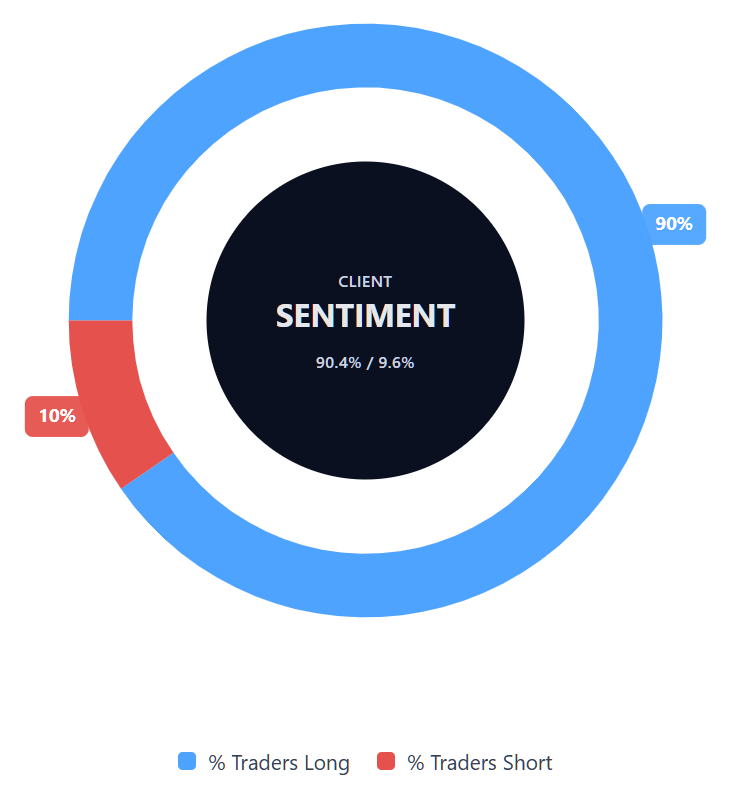
As of 7 April 2026, Capital.com client positioning in Orange CFDs shows 90.4% buyers and 9.6% sellers, putting buyers ahead by 80.8 percentage points, which places sentiment firmly in heavy-buy territory and leaves positioning one-sided toward longs. This snapshot reflects open positions on Capital.com and can change.
Summary – Orange 2026
- Orange (ORA) trades at €18.11 as of 11:49am UTC on 7 April 2026, up approximately 27.3% year to date and 51.5% year on year, after hitting a 16-year high of €18.25 in February 2026.
- Key upside drivers include Orange's revised medium-term cash flow targets, the MasOrange joint venture in Spain, and an expanding cybersecurity division; risks include competitive pressure in France and exposure to emerging markets.
- Orange entered exclusive negotiations to divest its Globecast broadcasting unit to Verdoso in March 2026, continuing a broader portfolio restructuring that has supported investor sentiment.
- All 12 moving averages tracked by TradingView register buy signals, with the 14-day RSI at 67.3 sitting in the upper-neutral range; the classic R1 pivot at €18.33 is the nearest topside reference.
Past performance is not a reliable indicator of future results.
FAQ
Who owns the most Orange stock?
What is the 5 year Orange share price forecast?
Is Orange a good stock to buy?
Could Orange stock go up or down?
Should I invest in Orange stock?
Can I trade Orange CFDs on Capital.com?
Yes, you can trade Orange CFDs on Capital.com. Trading share CFDs lets you speculate on price movements without owning the underlying asset and to take long or short positions. However, contracts for difference (CFDs) are traded on margin, and leverage amplifies both profits and losses. You should ensure you understand how CFD trading works, assess your risk tolerance, and recognise that losses can occur quickly.