
NVIDIA stock forecast: OpenAI partnership, AI spend
NVIDIA is a US semiconductor company whose recent share-price move has coincided with strong AI spending expectations and continued focus on its OpenAI partnership. Explore third-party NVDA price targets and technical analysis. Past performance is not a reliable indicator of future results.
NVIDIA Corporation (NVDA) is trading at $210.19 as of 2:36pm UTC on 27 April 2026, within an intraday range of $198.75–$211.81. Past performance is not a reliable indicator of future results.
Momentum has been underpinned by a sector-wide rally in semiconductors, with the iShares Semiconductor ETF rising 40.4% through 24 April, driven by easing geopolitical tensions, continued growth in AI infrastructure spending, and strong earnings from peer Intel, which surged 23.65% on 25 April after a first-quarter profit beat (IndexBox, 25 April 2026). The broader AI demand narrative has remained central to the move, with the four largest hyperscalers projected to spend approximately $700 billion on capital expenditure in 2026, a significant portion of which is expected to go towards chip procurement (Yahoo Finance, 16 March 2026). NVIDIA's previously announced strategic partnership with OpenAI, targeting deployment of at least 10 gigawatts of NVIDIA systems via the Vera Rubin platform in the second half of 2026, also continues to feature in investor commentary (NVIDIA Newsroom, 22 September 2025).
NVIDIA outlook: OpenAI deal and AI spend in focus
As of 27 April 2026, third-party NVIDIA stock predictions reflect broadly bullish positioning across Wall Street, shaped by AI infrastructure demand, Blackwell GPU deployment, and the pace of hyperscaler capital expenditure. The following mini-briefs summarise five estimates and consensus reads from that window, ordered from lower to higher target.
BTIG Research (initiation, Buy)
BTIG Research initiates coverage of NVDA with a Buy rating on 15 April 2026, without publishing a specific numerical price target at launch. The firm entered coverage amid renewed sector momentum, with the Philadelphia Semiconductor Index (SOXX) recording a record 17-day winning streak, as AI hardware demand visibility and Nasdaq leadership underpinned the constructive stance (MarketBeat, 24 April 2026).
public.com (consensus overview)
public.com aggregates ratings from 38 analysts as of 23 April 2026, producing a consensus Buy rating, with 55% of analysts recommending a Strong Buy and 39% recommending Buy. The aggregate Wall Street price target stands at $267.55, as analyst conviction centres on NVIDIA's data-centre revenue trajectory and expanding AI model deployment (public.com, 23 April 2026).
MarketBeat (Wall Street consensus)
MarketBeat aggregates 54 analyst ratings as of 18 April 2026, producing a consensus Buy rating comprising 48 Buy, 4 Strong Buy, and 2 Hold calls. The average 12-month price target sits at $275.25, with several firms having recently raised targets into the $250–$300 range amid AI and data-centre demand catalysts, as Q4 fiscal 2026 earnings of $1.62 EPS beat the $1.54 consensus estimate (MarketBeat, 18 April 2026).
Watcher.Guru (analyst survey, April)
Watcher.Guru reports, as of 17 April 2026, that a Wall Street median 12-month price target of $265 derives from a pool of 70 analysts tracked by The Wall Street Journal, with individual estimates spanning a wide range; Tigress Financial's Ivan Feinseth carries the high-water mark at $360, set in early March. The survey notes that KeyBanc's John Vinh maintains an Overweight rating with a $275 target and that Cantor Fitzgerald's C.J. Muse holds a $300 target, while the 39-analyst average across the sample stands at $264.54, amid continued conviction in AI infrastructure demand (Watcher.Guru, 17 April 2026).
Predictions and third-party forecasts are inherently uncertain, as they cannot fully account for unexpected market developments. Past performance is not a reliable indicator of future results.
NVDA stock price: Technical overview
The NVDA stock price trades at $210.19 as of 2:36pm UTC on 27 April 2026, holding above its key moving-average cluster, with the 20/50/100/200-day SMAs stacked at approximately $188 / $185 / $185 / $183 respectively, per TradingView data. The 20-over-50 alignment remains intact across both the simple and exponential families, keeping the near-term trend constructive. The Hull moving average (9) at $203.65 provides a closer dynamic floor just beneath the current price.
Momentum readings are stretched: the 14-day RSI sits at 71.50, a level TradingView's oscillator suite characterises as above the conventional overbought threshold of 70, while the average directional index (14) reads 23.61, just below the 25 level that would signal an established trend.
On the topside, the classic R1 pivot at $187.43 has already been cleared; the R2 level at $200.46 is also behind the current price, leaving the R3 area near $225.07 as the next reference on the classic pivot map.
To the downside, the classic pivot point (P) at $175.85 represents initial support, with the 100/200-day SMA shelf at $184.63 / $182.85 forming a denser cluster ahead of it. A retreat through that band would bring the S1 level near $162.82 into view as the next reference (TradingView, 27 April 2026).
This is technical analysis for informational purposes only and does not constitute financial advice or a recommendation to buy or sell any instrument.
NVIDIA share price history (2024–2026)
NVDA’s stock price opened April 2024 near $88, already riding early AI enthusiasm, before pulling back to around $84 by the end of the month amid broader tech rotation. A sustained recovery gathered pace through May and June 2024, with the stock pushing towards $130 by mid-June as hyperscaler capital expenditure commitments reinforced demand for NVIDIA's Blackwell and Hopper GPU families. Momentum faded through late July and August 2024, when NVDA slid back towards $97 on 7 August, coinciding with a broader market sell-off, before recovering into year-end and closing 2024 at approximately $134.
The stock picked up where it left off in January 2025, briefly touching $153 on 7 January before a sharp reset on 27 January to around $121, as news around DeepSeek's low-cost AI model rattled AI hardware sentiment across the sector. NVDA gradually rebuilt through February 2025, peaking near $141 before another leg lower carried it into the $86–$94 range by late April 2025, coinciding with escalating US tariff announcements and broader risk-off positioning.
A powerful recovery from May 2025 onward carried NVDA from approximately $113 in early May to around $207 by late October 2025, as hyperscaler AI spending commitments reasserted themselves. The stock consolidated broadly in the $175–$200 range through Q4 2025 and into early 2026, before a sharp dip towards $163 in mid-March 2026, then a strong April rebound that carried it to $211.60 on 27 April 2026. That leaves it approximately 58% above its 12-month low of around $94 recorded on 8 April 2025.

Past performance is not a reliable indicator of future results. Share prices are indicative and may differ from live market prices.
NVIDIA (NVDA): Capital.com analyst view
NVIDIA's price trajectory over the past two years reflects an asset that has moved in close step with the broader AI infrastructure narrative. The stock has demonstrated strong upside potential during periods of positive AI spending signals, climbing from the $80s in early 2024 to above $200 by April 2026, but has also shown that sentiment can reverse sharply. The April 2025 dip towards $94 and the January 2025 reset following DeepSeek headlines both illustrated how quickly enthusiasm can unwind when competing narratives emerge around cost efficiency or geopolitical constraints such as export controls on China-bound chips. Those tracking NVDA will note that the same factors driving upside – concentrated AI capital expenditure by a small number of hyperscalers – also represent a source of vulnerability if those spending commitments are revised.
Into April 2026, NVDA has recovered decisively, with the stock adding approximately 19% month to date as semiconductor sector momentum broadened and peer earnings supported the AI demand case. That said, the 14-day RSI above 70 points to technically stretched conditions in the near term, and the gap between the current price and the analyst consensus target of approximately $275 suggests some institutional caution remains despite the rally. The upcoming NVIDIA earnings cycle and any shift in hyperscaler guidance represent the next significant tests for the stock's direction either way.
Capital.com’s client sentiment for NVIDIA CFDs
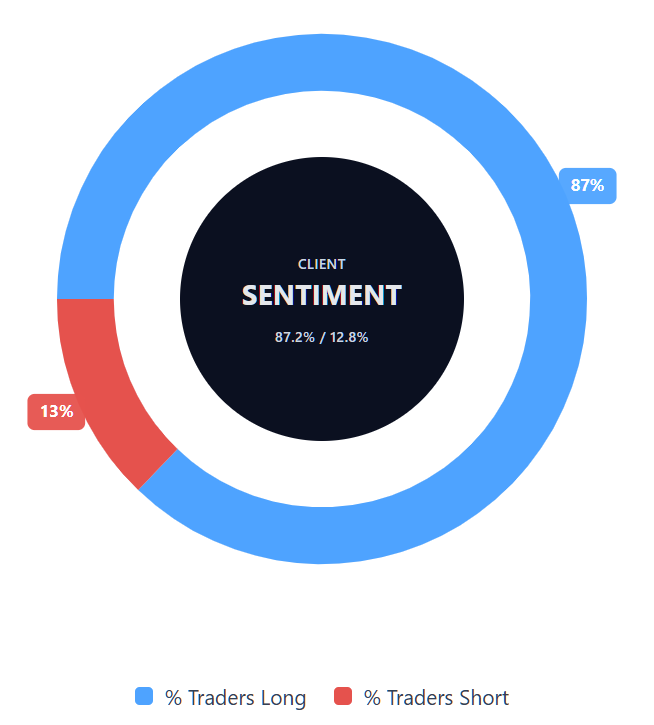
As of 27 April 2026, Capital.com client positioning in NVIDIA CFDs shows 87.2% of open positions are held by buyers versus 12.8% by sellers, putting buyers ahead by 74.4 percentage points and placing sentiment firmly in heavy-buy, one-sided-towards-longs territory. This snapshot reflects open positions on Capital.com at the time of capture and can change rapidly as market conditions evolve.
Summary – NVIDIA 2026
- NVDA trades at $210.19 as of 2:36pm UTC on 27 April 2026, up roughly 58% from its 12-month low of approximately $94 recorded on 8 April 2025.
- Key price drivers include sustained hyperscaler AI capital expenditure commitments, NVIDIA's Blackwell GPU deployment cycle, and the upcoming earnings season, which may influence near-term direction.
- China export control restrictions on NVIDIA chips and potential hyperscaler spending revisions represent the principal downside risks cited across analyst commentary and recent news coverage.
Past performance is not a reliable indicator of future results.
FAQ
Who owns the most NVIDIA stock?
What is the 5 year NVIDIA share price forecast?
There is no single reliable five-year NVDA stock forecast, as long-term projections depend on factors that can shift materially over time. These include AI infrastructure demand, competition in advanced chips, data-centre spending, regulation, and wider equity-market conditions. Third-party forecasts are also more commonly published on a 12-month basis than over five years. For that reason, longer-term estimates should be treated as scenario-based views rather than firm expectations or guarantees.
Is NVIDIA a good stock to buy?
Could NVIDIA stock go up or down?
Should I invest in NVIDIA stock?
Can I trade NVIDIA CFDs on Capital.com?
Yes, you can trade NVIDIA CFDs on Capital.com. Trading share CFDs lets you speculate on price movements without owning the underlying asset and to take long or short positions. However, contracts for difference (CFDs) are traded on margin, and leverage amplifies both profits and losses. You should ensure you understand how CFD trading works, assess your risk tolerance, and recognise that losses can occur quickly.