
Leonardo stock forecast: Ukraine drone expansion plans
Leonardo is an Italian aerospace and defence group. In September 2026, it said it was exploring drone-related partnerships and potential acquisitions in Ukraine. Explore third-party LDO price targets and technical analysis. Past performance is not a reliable indicator of future results.
Leonardo S.p.A. (LDO) traded near €49.17 as of 1:38pm UTC on 9 September 2026, within an intraday range of €49.06–€50.54. Past performance is not a reliable indicator of future results.
Recent company news includes plans to expand Leonardo's activity in Ukraine through collaboration and potential acquisitions focused on drone technology and connected systems (MarketScreener, 8 September 2026), alongside its first production contract for Centauro II armoured vehicles with the Brazilian army (Leonardo IR, 1 September 2026). These developments come as parts of the European defence sector have moved lower, with UK defence spending and EU SAFE funding allocations also in focus (MarketScreener, 3 September 2026).
Third-party Leonardo outlook: Ukraine expansion and Brazil order
As of 9 September 2026, third-party Leonardo stock predictions show a range of analyst views, reflecting different assumptions around orders, defence spending, execution and valuation.
MarketBeat
MarketBeat records a consensus buy rating based on nine analyst ratings: two strong buy, five buy and two hold. The panel includes Deutsche Bank, Royal Bank of Canada, DZ Bank, Jefferies and Barclays (MarketBeat, 4 September 2026).
Yahoo Finance
As earnings context rather than a share-price target, Yahoo Finance reports that 17 analysts expect average full-year 2026 revenue of €22.33bn, rising to €24.74bn in 2027. Current-year estimates range from €21.90bn–€22.94bn, reflecting different assumptions around Leonardo's order backlog and delivery profile (Yahoo Finance, 4 August 2026).
MarketScreener
MarketScreener's Borsa Italiana consensus places Leonardo's average target at €69.31, with estimates ranging from €60–€82. The average sits around 37% above the €50.46 closing price referenced by the platform, although targets do not indicate where the shares will necessarily trade (MarketScreener, 8 September 2026).
A parallel MarketScreener view for Leonardo's Tradegate-listed shares shows the same €69.31 average and €60–€82 range, reflecting differing analyst assumptions following the group's first-half results (MarketScreener, 7 September 2026).
Leonardo IR
Leonardo's equity coverage page lists an average target of €68.28 across 20 tracked brokerages. Morgan Stanley's €82 target is the highest, while targets from Banca Akros, UBS and Oxcap range from €60–€63. Ratings are predominantly buy or equivalent (Leonardo IR, 9 September 2026).
Predictions and third-party forecasts are inherently uncertain, as they cannot fully account for unexpected market developments. Past performance is not a reliable indicator of future results.
Leonardo (LDO) upcoming and latest earnings
Leonardo's Board of Directors approved first-half 2026 results on 30 July. New orders rose 45% year on year to €16bn, while revenue increased 12% to €10bn and EBITA rose 34% to €780m. Return on sales increased to 7.8% from 6.5%.
Free operating cash flow stood at negative €249m, a 39% improvement from the prior-year period, while adjusted net profit rose 74% to €476m.
Leonardo also raised several elements of its full-year guidance. Its new-order target increased to around €28.2bn from €26.2bn, while EBITA guidance rose to approximately €2.21bn from €2.15bn. Free operating cash flow guidance increased to around €1.37bn from €1.32bn, while net debt guidance fell to approximately €2.2bn from €2.3bn. Revenue guidance remained around €22.1bn (Leonardo IR, 30 July 2026).
Leonardo's next scheduled results cover the third quarter, with reporting aggregators indicating 5 November 2026 (Quartr, 28 August 2026). The company's financial calendar should confirm the date closer to publication.
LDO stock price: technical overview
As of 1:38pm UTC on 9 September 2026 the LDO stock price trades below its 20-, 50-, 100- and 200-day simple moving averages at roughly €54, €54, €53 and €54 respectively, according to TradingView. The 20-day EMA also sits near €53, placing several moving-average references above the latest price.
The 14-day relative strength index (RSI) stands near 29, within oversold territory by conventional thresholds. ADX near 30 indicates a more established trend but does not indicate its future direction.
The closest lower technical reference sits around €49. Above the latest price, the moving-average cluster around €53–€54 and classic pivot near €55 provide further reference points, followed by R1 near €58 and R2 around €64.
A rise could bring the moving-average cluster and higher pivots into focus, while a move below €49 could shift attention lower (TradingView, 9 September 2026).
This is technical analysis for informational purposes only and does not constitute investment advice or a recommendation to buy or sell any instrument.
Leonardo share price history (2024–2026)
LDO’s stock price rose from €20.39 on 10 September 2024 to €49.22 at the close on 9 September 2026, during a period of increased European defence spending and sector activity.
The stock spent much of late 2024 in the low €20s before rising through 2025. A wider market sell-off in April 2025, linked to US tariff announcements, saw the shares fall to €33.83 intraday on 7 April before recovering.
Leonardo reached a two-year high of €66.37 on 12 March 2026 around its FY2025 results and updated guidance. The shares subsequently moved lower, closing at €49.22 on 9 September, down around 4.4% year to date but up roughly 3.9% year on year.
Past performance is not a reliable indicator of future results. Share prices are indicative and may differ from live market prices.
Leonardo (LDO): Capital.com analyst view
Leonardo's share-price performance has coincided with higher European defence spending and a series of company order announcements, including recent activity in Brazil and Ukraine. The shares reached €66.37 in March 2026 before returning to around €49–€50 by early September.
Higher orders and upgraded guidance may support sentiment if Leonardo meets delivery and cash-flow expectations. Stronger European defence spending could also provide support. In contrast, delays to major contracts, currency movements or changes in government procurement and defence budgets could weigh on the shares.
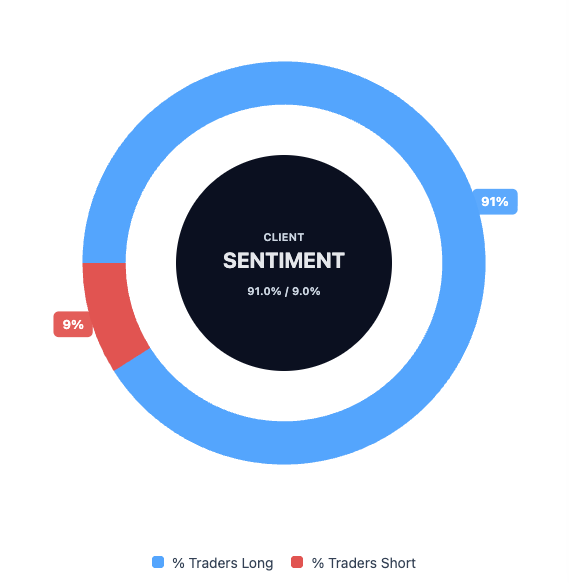
Capital.com’s client sentiment for Leonardo CFDs
As of 9 September 2026, Capital.com client positioning in Leonardo CFDs is weighted towards long positions, with 98.9% long and 1.1% short. This reflects open positions on Capital.com at the time of measurement rather than future price direction and can change.
Summary – Leonardo 2026
- As of 1:38pm UTC on 9 September 2026, Leonardo traded near €49.17, within an intraday range of €49.06–€50.54.
- According to TradingView data, the shares traded below their main moving averages, with RSI near 29 and ADX near 30.
- Key factors include defence orders, planned activity in Ukraine, the Brazilian Centauro II contract and wider European defence spending.
- Higher orders, stronger execution or increased defence spending could support sentiment, while delivery risks or changing procurement priorities could weigh on the shares.
- Recent company news includes upgraded 2026 guidance following higher first-half orders and planned expansion in Ukraine.
Past performance is not a reliable indicator of future results.