
Enel stock forecast: Strategic plan and share buyback
Enel is an Italian utility group listed on the Borsa Italiana, with current market focus on its 2026–2028 Strategic Plan, share buyback activity and full-year 2025 results. Past performance is not a reliable indicator of future results. Explore third-party ENEL price targets and technical analysis.
Enel S.p.A. (ENEL) is trading at €9.47 as of 10:59am UTC on 19 March 2026, within an intraday range of €9.41–€9.87. Past performance is not a reliable indicator of future results.
Price action comes as investors assess Enel's 2026–2028 Strategic Plan, which targets total gross investments of €53 billion and adjusted EBITDA of €23.1–€23.6 billion for the current year (Enel, 23 February 2026), while the company's ongoing on-market share buyback programme – which saw 13,270,419 treasury shares purchased between 9 and 13 March 2026 at a volume-weighted average price of €9.3459 – continues to provide a technical reference point (Enel, 17 March 2026).
The broader European equity backdrop remains cautious, with the STOXX Europe 600 down 0.75% at 597.93 as of the close on 18 March 2026 (Investing.com, 19 March 2026), while elevated energy price volatility tied to Middle East tensions and reports of Brent crude above $100 a barrel creates a mixed signal for integrated utilities such as Enel (Reuters, 13 March 2026), which face potential margin compression from Italy's Energy Decree alongside structural tailwinds from electrification demand (DLA Piper, 9 March 2026).
Enel stock forecast 2026–2030: Third-party price targets
As of 17 March 2026, third-party Enel stock predictions reflect a broad spectrum of views, shaped by the company's 2026–2028 Strategic Plan, its preliminary 2025 EBITDA result, Italy's regulatory backdrop, and wider European utility sector dynamics. The following summaries draw on broker notes and consensus data published during that window.
Deutsche Bank (target raised to €10, Hold)
Deutsche Bank analyst James Brand raised his 12-month ENEL stock forecast to €10 from €8.50, while maintaining a Hold rating, as the bank reassessed the stock's valuation following the Capital Markets Day commitments and updated earnings trajectory. The revision marks a significant step up from the prior target, though Brand's unchanged neutral stance signals a preference to observe execution before moving to a more constructive view (The Globe and Mail, 13 March 2026).
Enel Investor Relations (broker consensus)
Enel's own investor relations page reports a median 12-month price target of €9.90 across contributing brokers, with individual targets spanning a wide range from sub-consensus caution to Goldman Sachs at the high end. The data reflects input from 23 analysts and a broadly Outperform skew on aggregate recommendations, with the spread between individual estimates reflecting differing assumptions on earnings delivery, leverage and regulatory risk (Enel Group, 12 March 2026).
Morgan Stanley (upgraded to Equal-weight, target €10)
Morgan Stanley upgraded Enel to Equal-weight from Underweight and raised its price target to €10, citing an improved assessment of the stock's risk/reward profile after a period of underperformance relative to European utility peers. The upgrade, published on 6 March 2026, reflects the bank's updated view on Enel's earnings base and capital allocation framework following the strategic plan update, with the new target sitting in line with the emerging broker consensus (MarketScreener, 6 March 2026).
Goldman Sachs (Buy, target raised to €12)
Goldman Sachs analyst Alberto Gandolfi reiterated a Buy rating on Enel and maintained a 12-month price target of €12, the highest on record among publicly disclosed individual broker targets, with the note reflecting the bank's continued positive view on the stock's valuation and earnings trajectory. The target sits approximately 26.7% above the last price of €9.47, amid Enel's scheduled release of its full-year 2025 annual financial report on the same day (The Globe and Mail, 18 March 2026).
Predictions and third-party forecasts are inherently uncertain, as they cannot fully account for unexpected market developments. Past performance is not a reliable indicator of future results.
ENEL stock price: Technical overview
The ENEL stock price trades at €9.47 as of 10:59am UTC on 19 March 2026, sitting below its short- and medium-term moving-average cluster – the 20/50/100/200-day SMAs at approximately €9.66 / €9.43 / €9.14 / €8.57 – with price currently wedged between the 20-day SMA above and the 50-day SMA just below. The 20-under-50 configuration on the short-term SMAs reflects near-term softness, while the longer-dated 100- and 200-day SMAs continue to provide a broader upward structural reference well beneath current levels. The Hull moving average (9) at €9.72 and the volume-weighted moving average (20) at €9.68 both sit above the last price, reinforcing that short-term momentum has faded.
The 14-day relative strength index reads 48.5 – squarely neutral and carrying no directional bias in isolation. The average directional index (14) at 13.1 flags a weak-trend environment, suggesting the current price range lacks a clearly established directional impulse.
On the topside, the classic pivot (R1) at €10.73 is the nearest meaningful resistance reference; a convincing daily close through that level would put R2 near €11.27 back in view. The €10 figure also sits within this corridor as a nearby round-number reference that may attract attention ahead of any test of R1.
On pullbacks, the classic pivot (P) at €9.77 offers initial support, sitting just above the last price; the 20-day SMA at approximately €9.66 is the next reference below. Losing the 50-day SMA shelf near €9.43 would blunt the short-term structure and could open the way for a move toward S1 at €9.23, with the 100-day SMA near €9.14 as the broader support layer beyond that (TradingView, 17 March 2026).
This is technical analysis for informational purposes only and does not constitute financial advice or a recommendation to buy or sell any instrument.
Enel share price history (2024–2026)
ENEL’s stock price has traded in a broadly rising channel over the past two years, climbing from the mid-€6 range in early 2024 to test €10 for the first time in early 2026.
The stock opened 2024 near €6.12 in March, then dipped to a two-year low of €5.72 on 11 April 2024 as European utility stocks faced pressure from elevated interest rates and Italian regulatory uncertainty. A steady recovery followed through the summer, with ENEL pushing to a 2024 high of €7.35 on 21 October before closing the year at €6.90 – a gain of roughly 12.7% from the March 2024 open.
2025 brought a more decisive trend. ENEL opened the year at €7.03, pulled back to €6.67 on 6 March amid broader European equity weakness, then turned sharply higher through the second half. The stock crossed €8 in July, cleared €9 in November – touching a 2025 high of €9.11 on 17 November – and closed 2025 at €8.88, up approximately 26.3% on the year.
The rally extended into 2026, with ENEL reaching a year-to-date peak of €10.25 on 27 February, buoyed by the company's 2026–2028 Strategic Plan unveiled that week. A pullback has since brought the price back to €9.50 on 19 March 2026, leaving ENEL up approximately 7.0% year to date and around 32.5% year on year.

Past performance is not a reliable indicator of future results. Share prices are indicative and may differ from live market prices.
Enel (ENEL): Capital.com analyst view
Enel's price trajectory over the past two years reflects a company in transition, with the stock climbing from multi-year lows near €5.72 in April 2024 to briefly test €10.25 in late February 2026 following its 2026–2028 Strategic Plan. The €53 billion investment programme, centred on renewables and grid infrastructure, has reinforced the case for Enel as a beneficiary of Europe's electrification push, though the same capital commitments raise legitimate questions around leverage and execution risk, particularly if Italian regulatory conditions or borrowing costs shift unfavourably.
The subsequent pullback to around €9.50 illustrates that enthusiasm has limits. Broker views remain split, ranging from Goldman Sachs' Buy at €12 to Hold-rated caution from Deutsche Bank, with the divide largely reflecting differing assumptions on earnings delivery and balance-sheet management. Enel's ongoing treasury share buyback provides a technical floor of sorts, yet macro headwinds – including volatile European energy prices and broader equity market uncertainty – could weigh on sentiment as readily as they could support it.
Capital.com’s client sentiment for Enel CFDs
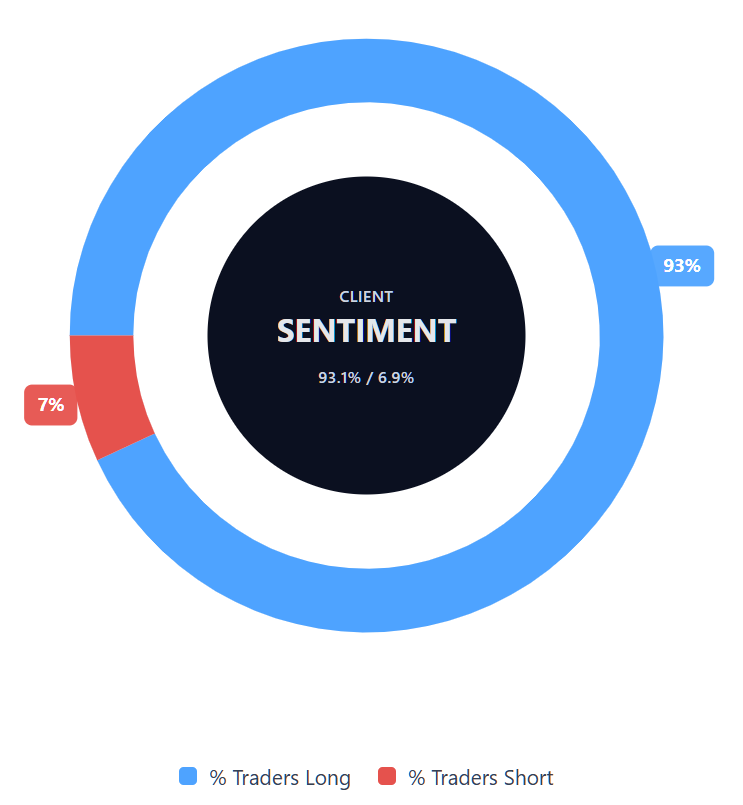
As of 17 March 2026, Capital.com client positioning in Enel CFDs is skewed: 93.1% long vs 6.9% short, putting buyers ahead by 86.2 percentage points and placing sentiment firmly in heavy-buy, one-sided-towards-longs territory. This snapshot reflects open positions on Capital.com and can change.
Summary – Enel 2026
- As of 10:59am UTC on 19 March 2026, Enel (ENEL) trades at €9.47, within an intraday range of €9.41–€9.87.
- Technical indicators are mixed: short-term moving averages sit above price, the 14-day RSI reads 48.5 (neutral), and the average directional index flags a weak-trend environment.
- The classic pivot point at €9.77 acts as immediate support, with resistance at the R1 level of €10.73; a daily close above that level would bring R2 near €11.27 into view.
- Key price drivers include Enel's €53 billion 2026–2028 Strategic Plan, an ongoing share buyback programme, Italy's Energy Decree, and volatile European energy prices.
- Today, 19 March 2026, Enel is scheduled to release its full-year 2025 annual financial report, which could act as a near-term catalyst in either direction.
Past performance is not a reliable indicator of future results.
FAQ
Who owns the most Enel stock?
What is the 5 year Enel share price forecast?
Is Enel a good stock to buy?
Whether Enel is a good stock to buy depends on an individual’s objectives, time horizon and risk tolerance, so the article does not take a buy-or-sell view. It outlines both supportive and limiting factors: the company’s strategic investment plan, buyback activity and exposure to electrification demand on one side, and leverage, regulatory risk and energy price volatility on the other. That balance matters, because a stock can appear attractive under some assumptions while still carrying material downside risks.
Could Enel stock go up or down?
Should I invest in Enel stock?
Can I trade Enel CFDs on Capital.com?
Yes, you can trade Enel CFDs on Capital.com. Trading share CFDs lets you speculate on price movements without owning the underlying asset and to take long or short positions. However, contracts for difference (CFDs) are traded on margin, and leverage amplifies both profits and losses. You should ensure you understand how CFD trading works, assess your risk tolerance, and recognise that losses can occur quickly.