
DroneShield stock forecast: FY2025 revenue up 276% YoY
DroneShield is an Australian defence technology company that reported FY2025 revenue of $216.5m AUD, a return to profitability and $100m AUD in locked-in 2026 revenue following new $22m AUD military contracts. Explore third-party DRO price targets and technical analysis.
DroneShield Limited (DRO) is trading around $3.69 AUD in Thursday’s session, with prices fluctuating between an intraday low of $2.93 AUD and a high of $3.75 AUD as of 3:14pm UTC on 26 February 2026. The move extends recent upside momentum after a sharp re-rating in February, with the stock holding near the top of today’s range amid elevated interest in defence and counter-drone names. Past performance is not a reliable indicator of future results.
The share price action follows DroneShield’s report of full-year 2025 revenue of about $216.5m AUD, up more than 270% year on year (Investing.com, 25 February 2026), alongside a return to profitability and strong growth in SaaS revenues (TipRanks, 24 February 2026). The company also announced new military business, including a $22m AUD package of contracts for dismounted counter-drone systems (MarketScreener, 26 February 2026).
DroneShield stock forecast 2026–2030: Third-party price targets
As of 26 February 2026, third-party DroneShield stock predictions sit above the current spot price, with recent broker updates and data vendors outlining 12-month views in a relatively narrow band. The following summaries outline specific one-year price objectives and their stated assumptions as of February 2026.
Fintel (analyst target average)
Fintel indicates an average 12-month analyst price target of about $5.10 AUD, based on the small group of brokers formally covering the stock, with a low of $5.05 and a high of $5.25. The service notes that this average sits above prevailing prices at the time and reflects expectations for continued revenue growth and earnings leverage in 2026 (Fintel, 12 February 2026).
Motley Fool Australia (broker recap)
Motley Fool Australia reports that the consensus analyst DRO stock forecast stands at approximately $5 AUD over the coming 12 months, implying a premium to the pre-announcement share price level. The article attributes this outlook to FY25 profit dynamics, a growing contract pipeline and the company’s positioning in global counter-drone defence markets (Motley Fool Australia, 26 February 2026).
Simply Wall St (fair value estimate)
Simply Wall St states that DroneShield’s ‘fair value’ is estimated at $8.57 AUD per share, compared with a closing price of $3.39 AUD at the time. The report presents this figure as an intrinsic value estimate derived from discounted cash flow modelling, based on growth assumptions during what it describes as a structural global defence expansion cycle. It also flags valuation risk if growth expectations moderate or fail to materialise, highlighting the sensitivity of long-term models to underlying assumptions (Simply Wall St, 25 February 2026).
GROWTH Investing (analyst average)
GROWTH Investing shows that two analysts covering DroneShield have an average 12-month price target of $4.70 AUD, with individual estimates ranging from $4.40 AUD to $5 AUD. The service notes that the company’s average target has risen over the past five quarters, as analysts respond to stronger reported results and a larger order backlog. At the same time, consensus estimates remain subject to revision as new financial data, contract announcements or sector developments emerge (GROWTH Investing, 21 January 2026).
Predictions and third-party forecasts are inherently uncertain, as they cannot fully account for unexpected market developments. Past performance is not a reliable indicator of future results.
DRO stock price: Technical overview
The DRO stock price trades near $3.69 AUD as of 3:14pm UTC on 26 February 2026, holding above its 20-, 50-, 100- and 200-day moving averages clustered around 3.26, 3.48, 3.50 and 3.20 respectively. Price action above this band keeps the broader daily trend tilted higher in technical terms. The 14-day RSI, at around 56.6, sits in the upper-neutral zone, while momentum and MACD readings remain in buy territory, with the 10- and 20-day moving averages tracking below spot.
On the topside, traders may monitor the classic R1 pivot near 4.40, with R2 around 5.49 coming into focus only if price records a sustained daily close above that initial resistance zone. On pullbacks, the classic pivot at 3.73 marks initial support just below the current price, while the 100-day SMA near 3.50 forms a key underlying shelf. A sustained move below this area could open the way towards the S1 zone around 2.64.
This technical analysis is for informational purposes only and does not constitute financial advice or a recommendation to buy or sell any instrument.
DroneShield share price history (2024–2026)
DRO’s stock price has undergone a sharp re-rating over the past two years, moving from sub-$2 AUD levels in late 2025 to trade near the mid-$3s by February 2026. After fluctuating around $1.90–$2.10 AUD through early December 2025, the stock began to climb, closing the year at about $3.07 AUD on 31 December 2025. It later pushed above $4 AUD in January 2026 and briefly traded above $6.50 AUD during an earlier surge in October 2025.
So far in 2026, DroneShield has remained volatile but trades well above its late-2025 lows. A series of price movements around $3.50–$4.50 AUD in January gave way to a pullback from $4.49 AUD on 23 January to below $3 AUD by 6 February. Since then, the price has rebounded from around $2.92 AUD on 6 February to $3.69 AUD on 26 February 2026, leaving the stock higher year to date relative to the end of 2025.

Past performance is not a reliable indicator of future results. Share prices are indicative and may differ from live market prices.
DroneShield (DRO): Capital.com analyst view
DroneShield’s share price over the past two years shows sharp swings, with periods of rapid repricing followed by pullbacks as the market digests contract wins, earnings updates and shifts in defence-sector sentiment. Strong revenue growth and higher visibility on future orders may attract interest as participants respond to changing fundamentals and developments in the counter-drone segment. However, sensitivity to news flow can also amplify downside moves if expectations shift or contract timing changes.
The recovery from late-2025 lows into early 2026 illustrates how quickly sentiment can adjust when risk appetite changes, while elevated volatility and past drawdowns highlight the potential for abrupt reversals. Increased defence spending and technological adoption may act as supportive factors, yet changes in government budgets, competitive pressures or execution risks on large projects could weigh on performance.
Capital.com’s client sentiment for DroneShield CFDs
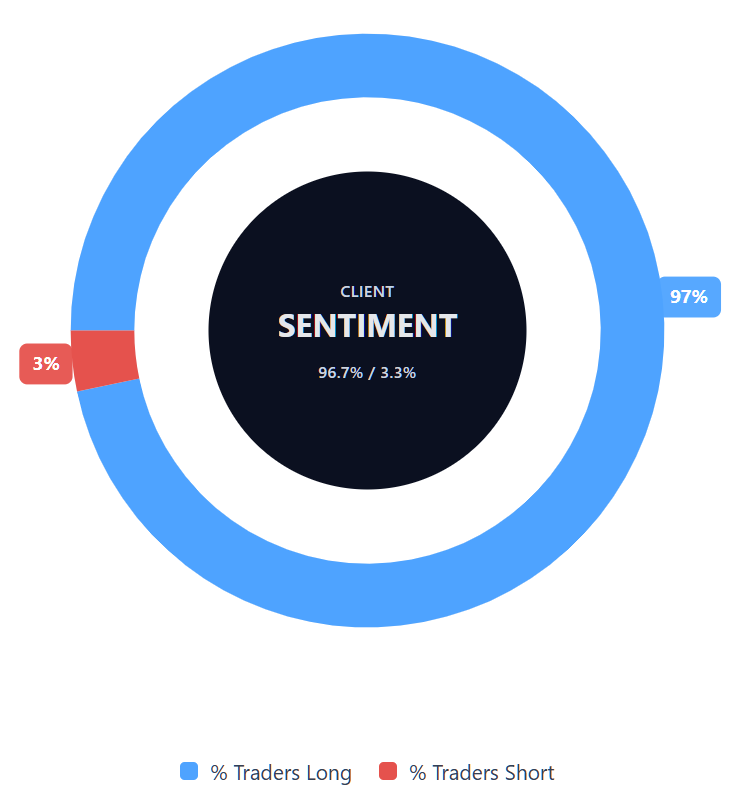
As of 26 February 2026, Capital.com client positioning in DroneShield CFDs is currently skewed towards long positions, with around 96.7% buyers versus 3.3% sellers, leaving buyers ahead by roughly 93.5 percentage points. This snapshot reflects open positions on the Capital.com platform and can change over time.
Summary – DroneShield 2026
- As of 3:14pm UTC on 26 February 2026, DroneShield trades near $3.69 AUD, above late-2025 levels following significant price swings.
- Technical indicators show price holding above clustered 20-, 50-, 100- and 200-day moving averages, with RSI in upper-neutral territory and nearby support around the $3.50–$3.70 AUD area.
- Recent price action has coincided with reported FY25 revenue and profit growth, increased attention on defence and counter-drone spending, and market responses to contract announcements and earnings updates.
- Latest coverage focuses on FY25 results, revenue and profit growth, new defence contract packages, and commentary around the company’s sales pipeline and demand outlook.
Past performance is not a reliable indicator of future results.
FAQ
Who owns the most DroneShield stock?
Public disclosures indicate that DroneShield’s share register includes a mix of institutional investors, company insiders and retail shareholders. The largest individual holdings are typically disclosed in substantial shareholder notices and annual reports, which outline stakes above the relevant regulatory reporting threshold. Ownership levels may change over time as funds rebalance portfolios or insiders adjust positions, so investors often review the latest filings to obtain an up-to-date breakdown of major shareholders.
What is the five-year DroneShield share price forecast?
There is currently no widely published, consolidated five-year DRO stock forecast. Most third-party research providers focus on 12-month price targets rather than multi-year projections. Longer-term performance would depend on factors such as defence spending trends, contract execution, revenue growth, margins and broader market conditions. Any longer-term outlook involves significant uncertainty, and published estimates should be viewed as indicative rather than predictive.
Is DroneShield a good stock to buy?
Whether DroneShield is considered suitable will depend on an individual’s objectives, risk tolerance and time horizon. The company has reported strong revenue growth and a return to profitability, but its share price has also shown notable volatility. Defence-sector exposure and contract announcements can influence performance in both directions. Investors typically assess fundamentals, valuation, competitive positioning and risk factors before making a decision. This content is for informational purposes only and does not constitute investment advice.
Could DroneShield stock go up or down?
DroneShield’s share price can move in either direction, sometimes sharply. Potential upside drivers include new contract wins, revenue growth and positive earnings developments. Conversely, delays in project delivery, shifts in government budgets, competitive pressures or broader equity market weakness could weigh on the stock. As with many small- to mid-cap companies, liquidity and market sentiment may also amplify price swings over shorter time frames.
Should I invest in DroneShield stock?
Deciding whether to invest in DroneShield requires careful consideration of your financial situation, investment goals and tolerance for risk. Shares can provide exposure to company performance but also carry the risk of capital loss. Reviewing financial statements, analyst research and sector dynamics may help inform your assessment. If appropriate, you may wish to seek independent financial advice. This content is for informational purposes only and does not constitute a recommendation.
Can I trade DroneShield CFDs on Capital.com?
Yes, you can trade DroneShield CFDs on Capital.com. Trading share CFDs lets you speculate on price movements without owning the underlying asset and to take long or short positions. However, contracts for difference (CFDs) are traded on margin, and leverage amplifies both profits and losses. You should ensure you understand how CFD trading works, assess your risk tolerance, and recognise that losses can occur quickly.