
Advanced Micro Devices stock forecast: AMD Backs $300m Loan Facility
Advanced Micro Devices (AMD) is a US-listed semiconductor manufacturer that develops processors and graphics chips for data centres, personal computers and artificial intelligence applications. Explore third-party AMD price targets and technical analysis.
Advanced Micro Devices Inc (AMD) is trading around $201.56 in US hours on 20 February 2026, within an intraday range of $198.37–$204.28 as of 3:02pm UTC. Past performance is not a reliable indicator of future results.
The stock is moving against a backdrop of softer US equities. The S&P 500 closed 0.2% lower at 6,861.89 and the Nasdaq Composite fell 0.3% to 22,682.73 on Thursday, amid concerns over private credit markets and US–Iran tensions (Nasdaq, 20 February 2026). At the company level, recent newsflow highlights expanding AI and data centre activity, including a February partnership with Tata Consultancy Services on ‘Helios’ rack-scale AI infrastructure (AMD, 16 February 2026) and reports that AMD is backing a $300m loan facility for Crusoe to finance AI chip purchases (Yahoo Finance, 19 February 2026).
Advanced Micro Devices stock forecast 2026–2030: Third-party price targets
As of 20 February 2026, third-party Advanced Micro Devices stock predictions show a wide spread of 12-month targets, reflecting different assumptions on valuation, AI demand and cyclical semiconductor risks. The summaries below outline selected published targets, associated ratings and the context cited by each source.
Public.com (analyst consensus overview)
Public.com indicates an average 12-month AMD stock forecast of about $263.56, within a range defined by lower and higher individual estimates and an overall ‘Buy’-leaning consensus rating. According to the platform, these projections reflect expectations that AMD could benefit from sustained AI and cloud-related demand, while competition and broader technology-sector conditions remain relevant considerations (Public.com, 19 February 2026).
Benzinga (broker rating round-up)
Benzinga highlights several recent broker updates, including from DA Davidson, Morgan Stanley and Wedbush, which imply an average 12-month AMD price target $272.53, ranging between $150 and $345, alongside a cluster of ‘Buy’ and ‘Neutral’ or ‘Equal-weight’ recommendations. The outlet notes that these revisions follow AMD’s latest earnings and guidance, as analysts weigh AI-related growth prospects against valuation metrics and the cyclical nature of the semiconductor industry (Benzinga, 13 February 2026).
Morgan Stanley (single-broker target adjustment)
Morgan Stanley trimmed its AMD 12-month price target to $255 from $260 and maintained an ‘Equal-weight’ rating on the shares. The bank said the revision followed AMD’s quarterly results and updated outlook, as it balanced AI and data centre momentum with guidance trends, valuation considerations and competition across high-performance computing (Yahoo Finance, 4 February 2026).
Predictions and third-party forecasts are inherently uncertain, as they cannot fully account for unexpected market developments. Past performance is not a reliable indicator of future results.
AMD stock price: Technical overview
On the daily chart, AMD’s stock price is trading around $201.56 as of 3:02pm UTC on 20 February 2026, holding below its short- and medium-term moving average cluster. The 20-, 50-, 100- and 200-day simple moving averages (SMAs) stand near 223, 220, 223 and 184 respectively. The corresponding exponential moving averages (EMAs) broadly mirror this structure. The 200-day EMA runs just above the longer-term SMA zone near 192, while shorter-term EMAs around 215–218 remain above the current price and act as near-term resistance.
The 14-day relative strength index (RSI) sits near 41, placing it in a lower-neutral zone. This reading aligns with an average directional index (ADX) near 22, which suggests a trend is present but not strongly established.
On the upside, the first level to monitor is the classic R1 pivot around 269. A sustained move above this area could bring the 302 region near R2 into focus as a subsequent resistance zone. On pullbacks, initial support lies near the classic pivot at 235. The 200-day SMA around 184 represents a key longer-term reference point. A break below S1 near 202 could expose lower support layers in the 170s–180s region (TradingView, 20 February 2026).
This technical analysis is for informational purposes only and does not constitute financial advice or a recommendation to buy or sell any instrument.
Advanced Micro Devices share price history (2024–2026)
The AMD stock price spent much of 2024 trading within a broad $130–$190 range, before closing the year at $120.59 on 31 December 2024 after several swings between the mid-$130s and low-$180s.
In early 2025, the trend shifted. AMD fell below $90 in April 2025, then rebounded into triple-digit territory by late spring and moved into the $160–$180 range over the summer.
Momentum accelerated into autumn 2025. The share price rose from around $160 in September to above $250 by late October, with volatility increasing and daily ranges widening. After reaching that region, the stock eased into year-end and early 2026, retracing towards the low-$200s. By 20 February 2026, AMD traded near $202.05, well above its early-2025 levels but below its late-2025 highs.

Past performance is not a reliable indicator of future results. Share prices are indicative and may differ from live market prices.
Advanced Micro Devices (AMD): Capital.com analyst view
Advanced Micro Devices’ share price has undergone a pronounced re-rating over the past two years, rising from double-digit levels in early 2025 to the low-$200s by February 2026. This move coincided with stronger investor focus on AI and data centre demand, alongside periods of elevated volatility marked by sharp advances and subsequent pullbacks as expectations adjusted.
The recent retracement from late-2025 highs into early 2026 illustrates how valuations can respond to shifts in earnings guidance, competitive developments and broader market risk appetite.
Looking ahead, continued product development in high-performance and AI-focused chips, as well as potential design wins with cloud and enterprise customers, may influence AMD’s share price. At the same time, factors such as US dollar strength, tighter financial conditions, changing equity-market sentiment or slower-than-expected AI and data centre spending could weigh on valuations. As with all equities, past performance is not a reliable indicator of future results.
Capital.com’s client sentiment for Advanced Micro Devices CFDs
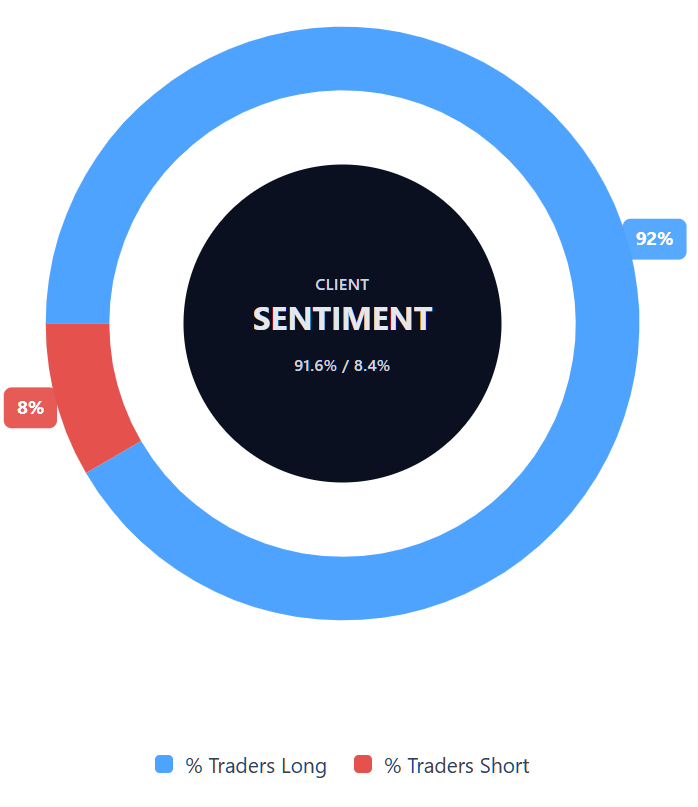
As of 20 February 2026, Capital.com client positioning in Advanced Micro Devices CFDs shows buyers at 91.6% and sellers at 8.4%, leaving buyers ahead by approximately 83.2 percentage points. This distribution indicates a strong skew towards long positions among clients, though it reflects only the current balance of open trades on the platform and can change over time.
Client sentiment data is provided for informational purposes only and does not indicate future price direction.
Summary – Advanced Micro Devices 2026
- As of 3:02pm UTC on 20 February 2026, Advanced Micro Devices trades around $201.56, near the lower end of its $198.37–$204.28 intraday range.
- Technical indicators show the price below several short- and medium-term moving averages, with momentum gauges in neutral territory and no firmly established trend.
- Analyst price targets for the next 12 months vary widely but generally fall within the $250–$290 range, reflecting different assumptions about AI demand, competition and valuation.
- Macro conditions, equity-market sentiment and company-specific developments remain key variables that can influence AMD’s share price in either direction.
Past performance is not a reliable indicator of future results.
FAQ
Who owns the most Advanced Micro Devices stock?
Advanced Micro Devices is a publicly listed company. Its largest shareholders typically include major institutional investors, such as global asset managers and index fund providers, which hold shares on behalf of clients through mutual funds and exchange-traded funds. These positions can shift as institutions rebalance portfolios or adjust their exposure. For the most current information on significant shareholders, investors can refer to official company filings and regulatory disclosures.
What is the 5-year Advanced Micro Devices share price forecast?
There is no single agreed five-year AMD stock forecast. Long-term projections depend on assumptions about AI demand, semiconductor cycles, competition and global economic conditions. Most published analyst targets focus on a 12-month horizon rather than multi-year estimates. Over longer periods, outcomes can vary due to changes in technology trends, capital expenditure, regulation and investor sentiment. As a result, long-term forecasts should be viewed as scenario-based rather than precise predictions.
Is Advanced Micro Devices a good stock to buy?
Whether Advanced Micro Devices is considered ‘good’ depends on an investor’s objectives, risk tolerance and time horizon. Analysts often highlight AMD’s exposure to AI and data centre markets, while also noting valuation considerations and the cyclical nature of the semiconductor industry. Share prices can be volatile, particularly around earnings releases and updates to forward guidance. Any decision requires consideration of both potential returns and the risk of capital loss.
Could Advanced Micro Devices stock go up or down?
Advanced Micro Devices’ share price can move in either direction. Earnings results, product developments, competitive dynamics and broader market conditions can all influence performance. Expectations around AI and data centre demand remain important drivers, while macroeconomic variables such as interest rates, currency movements and overall equity-market sentiment may also affect valuations. As with all equities, price movements are uncertain and may accelerate during periods of higher volatility.
Should I invest in Advanced Micro Devices stock?
Only you can determine whether investing in Advanced Micro Devices aligns with your financial circumstances and goals. Shares can provide exposure to themes such as AI and high-performance computing, but they also carry company-specific and market-wide risks. You may wish to seek independent financial advice if you are unsure. This content is for informational purposes only and does not constitute investment advice.
Can I trade Advanced Micro Devices CFDs on Capital.com?
Yes, you can trade Advanced Micro Devices CFDs on Capital.com. Trading share CFDs lets you speculate on price movements without owning the underlying asset and to take long or short positions. However, contracts for difference (CFDs) are traded on margin, and leverage amplifies both profits and losses. You should ensure you understand how CFD trading works, assess your risk tolerance, and recognise that losses can occur quickly.