
Indra Sistemas stock forecast: Third-party price targets
Indra Sistemas is a Spain-based technology and defence company listed in Madrid, with activities spanning defence systems, digital services, transport solutions, and public-sector projects. Explore third-party IDR price targets and technical analysis.
Indra Sistemas, S.A. (IDR) is trading around €53.84 in intraday European dealing, within a €52.94–€55.04 session range as of 3:49pm UTC on 22 January 2026. Past performance is not a reliable indicator of future results.
Price action comes amid continued focus on Indra’s nine-month 2025 results, where management reported around 6% revenue growth, a 10% increase in EBITDA, and a 58% year-on-year rise in net profit to about €291 million. This performance was supported by backlog growth of roughly 35% and the consolidation of TESS Defence (Investing.com, 30 October 2025). The broader Spanish equity backdrop was positive on the day, with Spain’s main stock market benchmark trading higher versus the prior session (Trading Economics, 22 January 2026), while company-specific news highlighted ongoing expansion in mobility and transportation solutions through new international offices (MarketScreener, 22 January 2026).
Indra Sistemas stock forecast 2026–2030: Third-party price targets
As of 22 January 2026, third-party Indra Sistemas stock predictions reflect varying assumptions around valuation, growth prospects and sector positioning. The following summaries draw on third-party equity research and data providers; all figures and dates are those stated by the respective sources. Third-party forecasts are inherently uncertain and may not account for unexpected market or company-specific developments.
Yahoo Finance (street consensus range)
Yahoo Finance’s analyst page for Indra Sistemas shows a price-target range with a low around €33, an average close to €53.38 and a high near €66.90. This spread underscores differing views on how Indra’s defence and technology exposure, order backlog and profitability trends might translate into medium-term valuation (Yahoo Finance, 21 January 2026).
Investing.com (consensus snapshot)
Investing.com’s consensus page shows an average 12-month price target for Indra Sistemas of about €54.31, with a high estimate of €75 and a low estimate of €33, based on 17 covering analysts. The site notes that this range reflects differing expectations for earnings growth and valuation as analysts updated their models over the preceding three months (Investing.com, 22 January 2025).
ValueInvesting.io (target distribution)
ValueInvesting.io’s estimates page reports an average 12-month IDR stock forecast of around €53.17, with individual forecasts ranging from €33.33 to €63. The platform attributes this dispersion to 22 analyst models incorporating different assumptions around revenue growth, margin resilience and potential upside or downside relative to the then-prevailing share price (ValueInvesting.io, 22 January 2025).
TipRanks (broker survey)
TipRanks data indicates a one-year price target of €54.83 for Indra Sistemas, implying a modest downside from the contemporaneous market price, with coverage from six analysts. The service characterises the rating consensus as Moderate Buy, reflecting a balance between Indra’s exposure to defence and digital projects and valuation considerations (TipRanks, 22 January 2025).
Predictions and third-party forecasts are inherently uncertain, as they cannot fully account for unexpected market developments. Past performance is not a reliable indicator of future results.
IDR stock price: Technical overview
The IDR stock price is holding near €53.84 as of 3:49pm UTC on 22 January 2026, sitting slightly above the Ichimoku base line around €53.48 and within an intraday band capped by nearby short-term moving averages. On the daily timeframe, the simple 20-, 50-, 100- and 200-day moving averages cluster around €54, €50, €45 and €40, respectively. The 20-day average remains above the 50-day, which keeps the broader trend constructive, despite price trading just below the 20-day line. The 14-day RSI, at around 50.5, sits in neutral territory, while an ADX near 30 points to an established trend rather than a range-bound market.
On the topside, the nearest classic pivot resistance is R1 near €51.37, with R2 around €54.21 coming into view if the price secures a daily close above the first level. On pullbacks, the classic pivot at roughly €47.27 provides initial support, followed by the 100-day SMA near €45.39. A deeper move could bring S1 near €44.43 into focus if those levels were breached on a closing basis (TradingView, 22 January 2026).
This technical analysis is provided for informational purposes only and does not constitute financial advice or a recommendation to buy or sell any instrument.
Indra Sistemas share price history (2024–2026)
IDR’s stock price has undergone a significant re-rating over the past two years, moving from the high-teens to the mid-€50s. The stock closed at about €16 on 24 January 2024 and spent much of the first half of that year trending higher in relatively modest daily moves, finishing June 2024 near €19.34. By year-end, it had retreated to the high-€16s, closing 31 December 2024 at roughly €17.08, before opening 2025 at €17.20 on 2 January.
Momentum built through 2025 as the price began trending higher from late February, rising from around €21.07 on 28 February to roughly €37.32 by 2 June, before advancing into the low-€40s by October. The rally accelerated into year-end, with the stock closing 2025 at about €48.77 on 31 December and extending gains into early 2026. During January, prices traded between roughly €49.79 and €58.96. As of 22 January 2026, Indra Sistemas finished the session at €54.01, meaning the share price has more than tripled from its late-January 2024 levels over this two-year period.

Past performance is not a reliable indicator of future results. Share prices are indicative and may differ from live market prices.
Indra Sistemas (IDR): Capital.com analyst view
Indra Sistemas’ share price has moved sharply higher over the past two years, with the stock trading around the mid-€50s in January 2026 after spending early 2024 below €20. This move has coincided with reported improvements in revenues, operating margins and order backlog, which some market participants view as supportive of the company’s medium-term profile. At the same time, the pace and scale of the re-rating mean that any disappointment around earnings, contract execution or sector-specific developments could increase downside volatility, particularly if broader equity sentiment deteriorates.
From a macro and sector perspective, Indra remains closely linked to European defence and technology spending. Recent years have seen higher budgets, new programme launches and financing support from institutions such as the European Investment Bank. While this environment can improve revenue visibility and investment capacity, it also brings exposure to political priorities, regulatory oversight and the cyclical nature of public expenditure, all of which may influence results in either direction. Past performance is not a reliable indicator of future results.
Capital.com’s client sentiment for Indra Sistemas CFDs
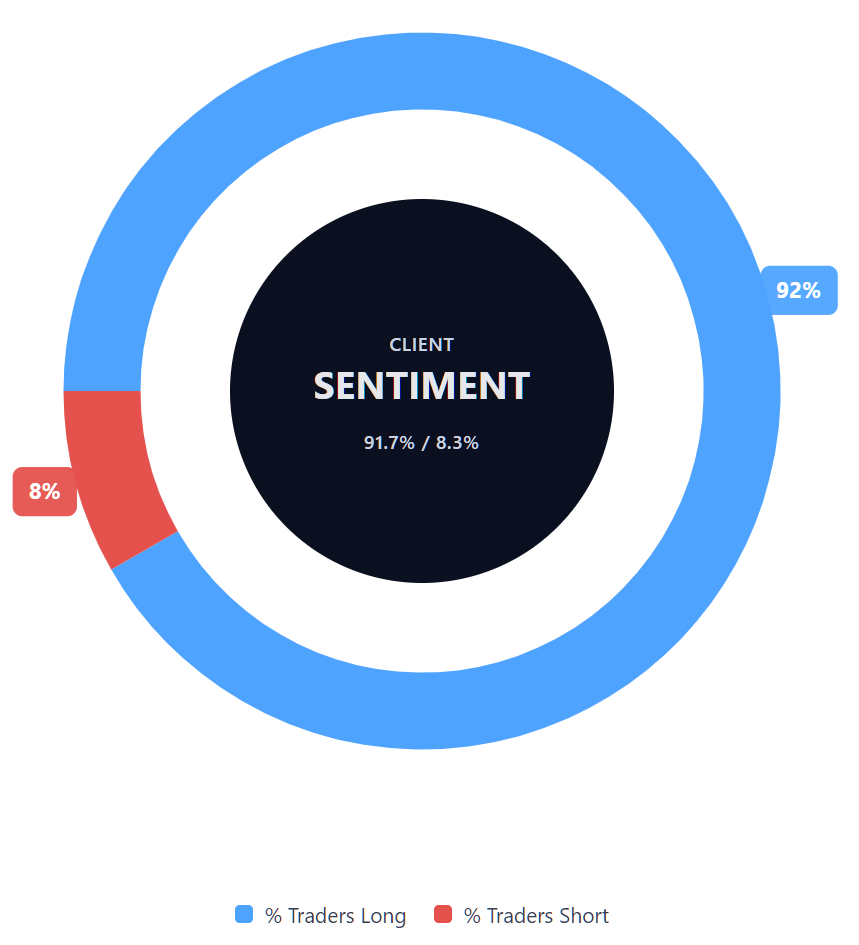
As of 22 January 2026, Capital.com client positioning in Indra Sistemas CFDs shows 91.7% buyers versus 8.3% sellers, indicating a heavily skewed long bias, with buyers ahead by 83.3 percentage points. This places sentiment firmly in heavy-buy territory rather than a balanced two-way profile. The data reflects open positions on Capital.com only and may change over time as traders reassess their views.
Summary – Indra Sistemas 2026
- Indra Sistemas traded around €54–€58 in January 2026 after closing 2025 near €48.77, marking a sharp re-rating from sub-€20 levels in early 2024.
- Over the past two years, the share price has more than tripled, with a particularly strong advance from around €21 in February 2025 to the high-€40s by the end of that year.
- Technical indicators show the price holding above medium- and long-term moving averages clustered near €50, €45 and €40, while momentum indicators remain broadly neutral and trend measures point to an established move.
- Reported results for 2025 to date indicate rising revenues, improving margins and a record order backlog, supported by defence and technology-related activity.
- Indra’s outlook remains closely tied to European defence and digitalisation spending, which may provide support but also introduces policy, budgetary and execution risks that could contribute to price volatility in either direction.
Past performance is not a reliable indicator of future results.
FAQ
Who owns the most Indra Sistemas stock?
Indra Sistemas has a mixed shareholder structure that includes institutional investors, public-sector interests and free-float holdings. One of the most significant shareholders has historically been the Spanish state, through SEPI, alongside domestic and international institutional investors. Ownership levels can change over time as funds rebalance portfolios or as strategic stakes are adjusted. For the most up-to-date ownership breakdown, market participants typically refer to regulatory filings or company disclosures.
What is the five-year Indra Sistemas share price forecast?
There is no single agreed five-year IDR stock forecast. Most published analyst targets focus on 12-month horizons, and longer-term projections tend to vary widely, depending on assumptions around defence spending, technology demand, execution risk and valuation multiples. Longer-dated forecasts are inherently uncertain, as they cannot fully account for changes in macroeconomic conditions, political priorities or company-specific developments over several years.
Is Indra Sistemas a good stock to buy?
Whether Indra Sistemas is considered attractive depends on individual objectives, risk tolerance and market outlook. The company has reported improving revenues, margins and backlog growth in recent periods, which some analysts interpret as supportive factors. However, the stock has already undergone a significant re-rating, and future performance remains subject to earnings delivery, contract execution and broader market conditions. This information is provided for general market context only and does not constitute investment advice.
Could Indra Sistemas stock go up or down?
Like all listed shares, Indra Sistemas’ stock price can move both higher and lower. Factors influencing future price movements may include financial results, order intake, defence and technology spending trends, regulatory developments and overall market sentiment. External events, such as changes in government policy or macroeconomic conditions, can also affect volatility. Past price performance is not a reliable indicator of future outcomes, and price movements can be unpredictable.
Should I invest in Indra Sistemas stock?
Deciding whether to invest in Indra Sistemas requires an assessment of your own financial situation, investment goals and risk appetite. While analysts publish forecasts and price targets, these represent third-party views and may be revised or withdrawn over time. Shares can be volatile, and losses as well as gains are possible. You may wish to carry out independent research or seek professional advice before making any investment decisions.
Can I trade Indra Sistemas CFDs on Capital.com?
Yes, you can trade Indra Sistemas CFDs on Capital.com. Trading share CFDs lets you speculate on price movements without owning the underlying asset and to take long or short positions. However, contracts for difference (CFDs) are traded on margin, and leverage amplifies both profits and losses. You should ensure you understand how CFD trading works, assess your risk tolerance, and recognise that losses can occur quickly.