

USD/JPY nears 160 as markets await Japan’s inflation data
USDJPY hovers near 160 as traders focus on the lates inflation data from Japan
Japan’s inflation data will be closely watched this week as markets assess whether domestic price pressures are strong enough to support further Bank of Japan tightening, and, by extension, whether the yen can build a more sustainable recovery after recent intervention. The backdrop is becoming increasingly interesting, with core CPI slowing to 1.8% year-on-year in July, in line with expectations and below the BoJ’s 2% target, which reduces some of the urgency for additional tightening, particularly after the BoJ raised rates earlier this year.
For the yen, it will be important to gauge whether the data change expectations for the next BoJ move. USD/JPY remains elevated despite the sharp decline triggered by coordinated US-Japan intervention in late July. Much of that intervention-driven yen strength has subsequently faded, reinforcing the view that official action can slow depreciation but struggles to reverse it while US-Japanese interest-rate differentials remain wide. That makes the upcoming inflation figures potentially important. A stronger-than-expected reading—particularly if underlying services and non-energy inflation show renewed persistence—could revive expectations that the BoJ will need to tighten again. Higher Japanese rate expectations would narrow the yield differential with the US, potentially providing the yen with the fundamental support that intervention alone has struggled to deliver.
Conversely, if price pressures continue cooling, the BoJ has little reason to accelerate tightening, leaving the yen dependent on developments elsewhere, most importantly the Federal Reserve and US Treasury yields. In that scenario, USD/JPY could remain supported even with the threat of further intervention hanging over the market.
USD/JPY: intervention creates a ceiling, but rates still drive the trend
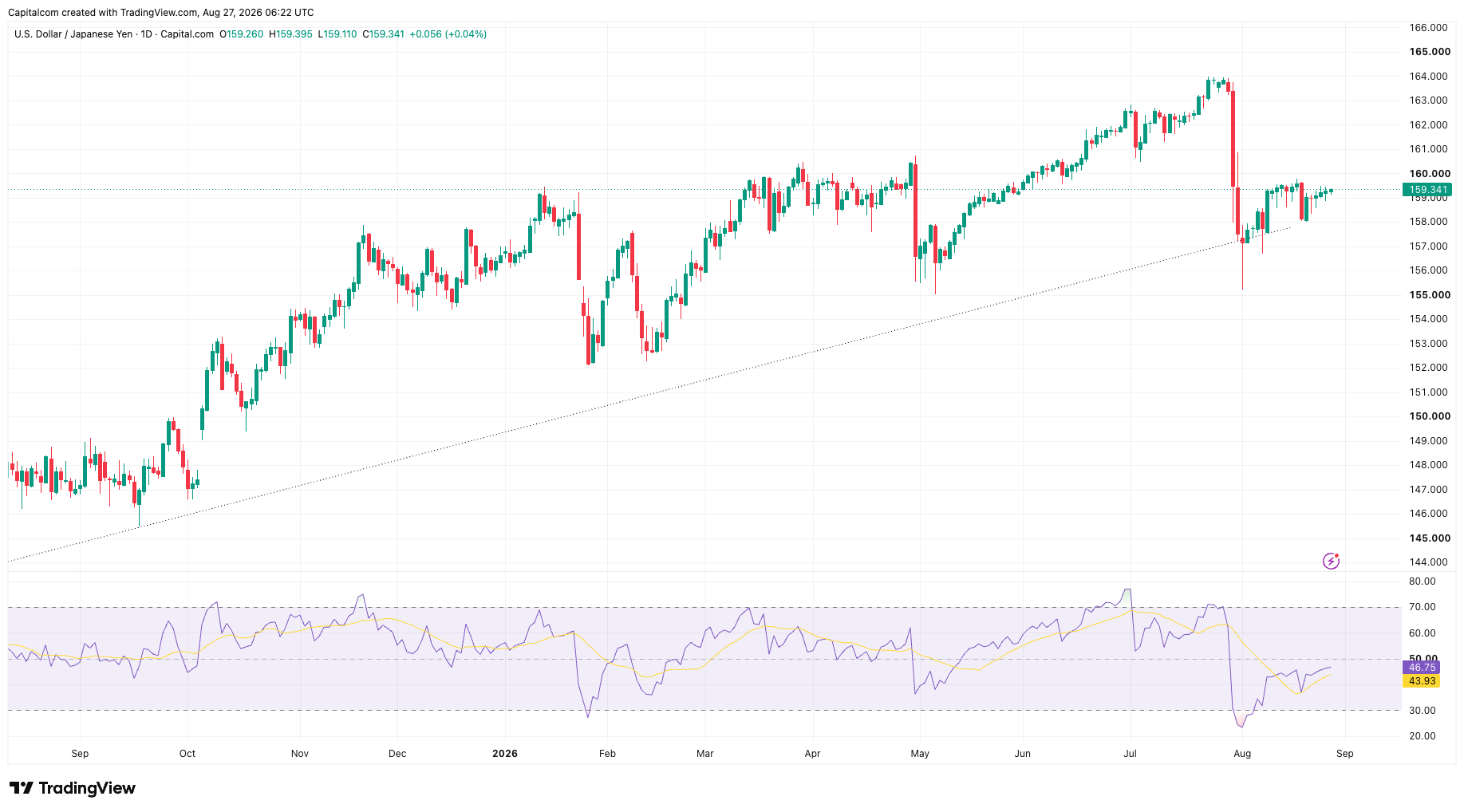
The recent price action illustrates the problem facing Japanese policymakers. Intervention produced a strong appreciation in the yen, but USD/JPY has since recovered gradually towards 160. The slower pace of that recovery suggests traders remain wary of provoking another round of official action, effectively creating a speed limit on yen depreciation rather than fundamentally changing its direction.
USD/JPY daily chart
Past performance is not a reliable indicator of future results.
The inflation report could therefore determine whether that ceiling becomes more meaningful. A hotter print accompanied by stronger expectations for another BoJ hike could make it harder for USD/JPY to reclaim 160 and potentially put 157–158 back into focus. Softer inflation, by contrast, could encourage another test of 160, although moves above that level would likely bring intervention risk straight back into the conversation.
Ultimately, the yen needs more than intervention to produce a lasting recovery. A narrowing of the US-Japan rate differential remains the missing ingredient. This week’s inflation data could help provide that if it strengthens the case for further BoJ tightening; if not, the yen may remain caught between structurally unfavourable rate differentials and the increasingly credible threat of authorities stepping in whenever depreciation becomes too rapid.