

Meta Platforms stock forecast: Q2 growth, margin pressure
Meta Platforms launched its Muse AI agent on 8 September 2026, adding a new consumer AI product designed to complete tasks such as sending emails and booking travel. Explore third-party META price targets. Past performance is not a reliable indicator of future results.
Meta Platforms, Inc. (META) traded at $639.95 as of 11:19am UTC on 9 September 2026, within an intraday range of $608.45–$644.38 and near the upper end. Past performance is not a reliable indicator of future results.
The move followed Meta's 8 September rollout of its Muse AI agent, internally known as Hatch, which is designed to perform tasks such as sending emails and booking travel for users (Reuters, 8 September 2026). The launch followed the 2 September release of Muse Spark 1.3 for coding and agentic tasks (Yahoo Finance, 4 September 2026), while privacy and safety scrutiny remains around AI agents accessing personal information (CNBC, 8 September 2026).
Third-party Meta outlook: Muse AI launch and privacy scrutiny
As of 9 September 2026, third-party Meta Platforms stock predictions show a range of 12-month estimates, reflecting different assumptions around AI investment, advertising growth, legal developments and capital expenditure.
Wedbush
Wedbush sets a 12-month target of $595 and maintains a neutral rating. The firm points to elevated AI infrastructure spending and its potential effect on near-term earnings (MarketBeat, 1 September 2026).
Truist Securities
Truist Securities sets a 12-month target of $763, down from $770, while maintaining a buy rating. Analyst Youssef Squali links the reduction to revised assumptions around AI spending (Intellectia.ai, 27 August 2026).
Rosenblatt Securities
Rosenblatt Securities raised its 12-month target to $886 from $883 while maintaining a buy rating. Analyst Barton Crockett cites Meta's resolution of an $18bn multistate legal settlement and a revised valuation framework (Investing.com, 27 August 2026).
MarketBeat
MarketBeat shows an average 12-month target of $785.22 from 47 Wall Street analysts, with a consensus moderate-buy rating and estimates ranging from $595–$1,000. The spread reflects different expectations around AI growth and capital expenditure (MarketBeat, 28 August 2026).
Ticker Nerd
Ticker Nerd reports a median 12-month target of $750 from 62 Wall Street analysts, with estimates ranging from $580–$1,000. The forecasts reflect expectations around Meta's advertising business and AI-product strategy (Ticker Nerd, 4 September 2026).
Predictions and third-party forecasts are inherently uncertain, as they cannot fully account for unexpected market developments. Past performance is not a reliable indicator of future results.
Meta Platforms latest and upcoming earnings
Meta Platforms reported quarterly results on 29 July 2026 for the period ended 30 June. Revenue rose 28% year on year to $60.80bn, while net income reached $15.85bn and diluted earnings per share fell to $6.18 from $7.14.
Operating margin narrowed to 31% from 43%, which Meta attributed to $2.40bn in legal-proceeding charges and $1.18bn in severance costs following a May headcount reduction.
For the third quarter, Meta guided revenue to $61bn–$64bn and reaffirmed plans for continued capital expenditure on AI infrastructure. Higher revenue could support earnings expectations, while continued spending may put pressure on margins (Meta Platforms, 29 July 2026).
Meta's next quarterly results are estimated for 28 October, according to Yahoo Finance. As of 9 September, Meta had not confirmed the date on its investor relations site (Yahoo Finance, 8 September 2026).
META stock price: technical overview
As of 11:19am UTC on 9 September 2026, the META stock price trades above its 20-, 50-, 100- and 200-day simple moving averages at roughly $578, $597, $605 and $622 respectively, according to TradingView. However, the 20-day average remains below the 50-day, so the shorter-term averages do not provide a clear directional signal.
The 14-day relative strength index (RSI) stands near 61, within upper-neutral territory, while the average directional index (ADX) near 13 indicates relatively limited trend strength.
Above the latest price, the next classic pivot sits near $649.17. Lower references include the 200-day moving average near $622, R1 at $610.76 and the 100- and 50-day averages near $605 and $597 respectively.
A rise could bring $649.17 into focus, while a move lower could shift attention towards the moving-average cluster (TradingView, 9 September 2026).
This is technical analysis for informational purposes only and does not constitute investment advice or a recommendation to buy or sell any instrument.
Meta Platforms share price history (2024–2026)
META’s stock price closed at $504.80 on 10 September 2024 before falling to a two-year low of $486.55 on 21 April 2025 amid broader market volatility. The stock later recovered, reaching $754.55 on 28 October 2025 before falling to $650.50 by the end of the month.
In 2026, META reached $732.04 on 29 January around fourth-quarter results before moving lower into the summer. Shares fell to $542.57 on 29 July following second-quarter earnings, then recovered through August and into September, trading around $639.95 on 9 September.

Past performance is not a reliable indicator of future results. Share prices are indicative and may differ from live market prices.
Meta Platforms (META): Capital.com analyst view
Meta Platforms shares have moved substantially in both directions as expectations around AI investment, advertising growth and profitability have changed.
Higher AI investment could support new products and future revenue if adoption develops as expected, while elevated spending may weigh on margins or earnings if returns take longer to emerge. Similarly, stronger advertising growth or successful AI products could support sentiment, while execution, privacy or regulatory concerns could put pressure on the shares.
These are potential price influences rather than a forecast of future direction. Past or simulated performance is not a reliable indicator of future results, and this commentary does not constitute investment advice or a personal recommendation.
Capital.com’s client sentiment for Meta Platforms CFDs
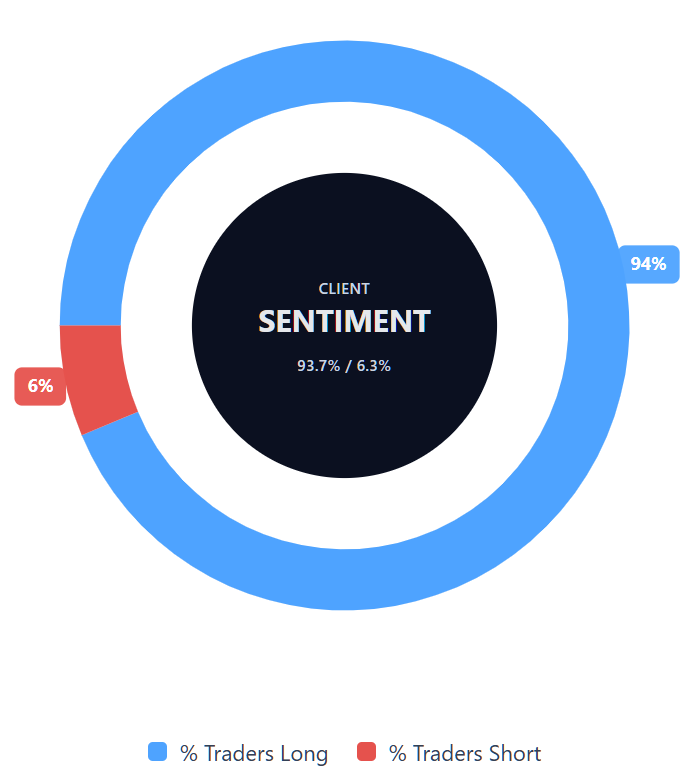
As of 9 September 2026, Capital.com client positioning in Meta Platforms CFDs is weighted towards long positions, with 93.7% long and 6.3% short. This reflects open positions on Capital.com at the time of measurement rather than future price direction and can change.
Summary – Meta Platforms 2026
- As of 11:19am UTC on 9 September 2026, META traded near $639.95, within an intraday range of $608.45–$644.38.
- According to TradingView data, the share price was above its 20-, 50-, 100- and 200-day moving averages, with RSI near 61 and ADX near 13.
- Key influences include AI investment, advertising growth, legal developments and capital expenditure.
- Stronger AI adoption or advertising growth could support the shares, while higher costs, execution issues or regulatory pressure could weigh on them.
- Recent attention centres on the Muse AI agent launch and privacy and safety scrutiny around AI agents.
Past performance is not a reliable indicator of future results.
FAQ
Who owns the most Meta stock?
This article does not identify Meta Platforms' largest shareholder or provide a breakdown of its ownership structure. Instead, it focuses on recent share-price performance, earnings, AI investment, regulatory developments and third-party analyst forecasts. Ownership can change as institutional and other investors adjust their holdings, so current shareholder disclosures would need to be checked separately when assessing which investor holds the largest stake in Meta Platforms.
What is the five-year Meta share price forecast?
The article does not provide a five-year META stock forecast. The third-party estimates covered here focus mainly on 12-month targets, with cited individual forecasts ranging from $595–$886 and consensus estimates around $750–$785.22. Longer-term forecasts carry greater uncertainty because advertising growth, AI adoption, capital expenditure, regulation and profitability can change materially over several years. These estimates should therefore be treated as scenarios rather than reliable long-term predictions.
Is Meta a good stock to buy?
This article does not classify Meta as a good or bad stock to buy. Stronger advertising growth, successful AI products and improving returns on investment could support sentiment, while elevated capital expenditure, execution issues, privacy concerns or regulatory pressure could weigh on the shares. Analyst targets also vary considerably. These factors provide context for assessing Meta's outlook, but they do not amount to an investment recommendation or indicate how the stock will perform.
Could Meta stock go up or down?
Yes. Meta shares can move in either direction as company-specific and wider market conditions change. Stronger advertising revenue, successful AI adoption or better-than-expected earnings could support the stock, while higher costs, weaker returns on AI spending, regulatory action or execution issues could put pressure on it. Technical levels may also influence short-term trading activity, but they are reference points rather than reliable predictions of future price movements.
Should I invest in Meta stock?
Whether Meta shares are suitable for you depends on your circumstances, objectives and tolerance for risk, and this article does not provide investment advice or a personal recommendation. Factors to consider include advertising growth, AI-related capital expenditure, profitability, regulatory developments and product execution. Each could influence the share price positively or negatively, while unexpected market or company developments may change the outlook. Past performance is not a reliable indicator of future results.
Can I trade Meta CFDs on Capital.com?
Yes, you can trade Meta Platforms CFDs on Capital.com. Trading share CFDs lets you speculate on price movements without owning the underlying asset and to take long or short positions. However, contracts for difference (CFDs) are traded on margin, and leverage amplifies both profits and losses. You should ensure you understand how CFD trading works, assess your risk tolerance, and recognise that losses can occur quickly.