

Boeing stock forecast: FAA investigates Miami freighter crash
Boeing is a US aerospace manufacturer whose shares remain in focus after a 767-300 freighter crash in Miami prompted an FAA investigation. Explore third-party BA price targets and technical analysis. Past performance is not a reliable indicator of future results.
The Boeing Company (BA) is trading at $211.97 as of 10:25am UTC on 8 September 2026, within an intraday range of $209.25–$212.14. Past performance is not a reliable indicator of future results.
Safety scrutiny remains in focus after a Boeing 767-300 freighter operated by 21 Air for Amazon Prime Air was involved in an incident at Miami International Airport on 6 September 2026, prompting a Federal Aviation Administration (FAA) investigation (Reuters, 6 September 2026). Boeing also paid a $3.1m FAA fine in January over production-quality violations linked to the 2024 Alaska Airlines MAX 9 door-plug incident (Reuters, 2 September 2026). Labour risk remains in focus, with Boeing and the union representing roughly 17,000 engineering and technical staff due to resume contract talks on 8 September after workers authorised a potential strike (Reuters, 31 August 2026).
Third-party Boeing outlook: FAA scrutiny and union talks
As of 8 September 2026, third-party Boeing stock predictions show a range of 12-month projections, shaped by expectations around production recovery, labour negotiations and the 777X certification timeline.
Argus (house view)
Argus sets a 12-month price target of $265 after upgrading Boeing to buy from hold. The target was around 24.85% above the reference price at the time. The firm cites production-rate progress and an improving cash flow outlook (Investing.com, 11 August 2026).
Bernstein SocGen Group (house view)
Bernstein sets a 12-month target of $298 and reiterates an outperform rating. The target was around 40.4% above the reference price at the time. The firm cites free cash flow expectations while flagging uncertainty around the engineers' union dispute as a risk (Investing.com, 24 August 2026).
MarketWatch (consensus overview)
MarketWatch's compiled analyst data show an average 12-month price target of $274.94 from 32 ratings, with estimates ranging from $230–$305. The consensus recommendation is overweight (MarketWatch, 4 September 2026).
Investing.com (consensus overview)
Investing.com puts Boeing's average 12-month target at $274.85, based on estimates from 26 analysts ranging from $246–$305. The average target was around 29.49% above the reference price used in the calculation (Investing.com, 4 September 2026).
Public.com (consensus overview)
Public.com lists a 12-month target of $277, based on ratings from 14 analysts, most of whom assign strong buy or buy recommendations. The same analyst pool gives Boeing a consensus buy rating (Public.com, 7 September 2026).
Predictions and third-party forecasts are inherently uncertain, as they cannot fully account for unexpected market developments. Past performance is not a reliable indicator of future results.
Boeing latest and upcoming earnings
Boeing reported second-quarter 2026 revenue of $24.6bn on 28 July, up 8% year on year, alongside 171 commercial deliveries. The company posted a GAAP loss of $0.67 per share and a core, non-GAAP loss of $0.76 per share. Operating cash flow reached $1.4bn, while non-GAAP free cash flow was $0.6bn. Total backlog rose to a record $715bn, including more than 6,200 commercial aircraft (Boeing, 28 July 2026).
The $0.76 core loss per share compared with an average analyst estimate for a $0.34 loss per share, according to compiled consensus data (MarketBeat, 28 July 2026).
Boeing has not confirmed its next earnings date. Third-party calendars estimate that third-quarter 2026 results could arrive between 28 October–4 November, based on its previous reporting cadence (MarketScreener, 26 August 2026).
BA stock price: technical overview
As of 10:25am UTC on 8 September 2026, the BA stock price trades at $211.97, below its 20-, 50-, 100- and 200-day simple moving averages (SMAs), at roughly $218, $219, $222 and $220, respectively, according to TradingView. The 20-day SMA also sits below the 50-day average.
The relative strength index (RSI) (14) reads 44.12, placing momentum in neutral territory. The average directional index (ADX) (14) stands at 26.97, indicating trend strength but not direction.
TradingView's classic pivot data put the central pivot at $218.38, R1 at $230.49, R2 at $253.20 and S1 at $205.08. With Boeing below the central pivot, S1 is the nearest listed downside pivot, while R1 sits above the current price. These are reference levels rather than directional signals.
The Hull moving average (9) stands at $209.49, just below the current price, while the Ichimoku base line (9, 26, 52, 26) sits higher at $223.29 (TradingView, 8 September 2026).
This is technical analysis for informational purposes only and does not constitute financial advice or a recommendation to buy or sell any instrument.
Boeing share price history (2024–2026)
BA’s stock price closed at $141.05 on 7 April 2025, a two-year low reached during tariff-driven volatility across global equities. The stock later moved above $200 in June and reached a two-year intraday high of $260.05 on 27 January 2026, during a period of improving deliveries and a record order backlog.
Shares then fell to $190.72 by 30 March before recovering to $248.05 on 14 May. Another pullback took BA to $205.59 on 21 July, followed by a move to $240.40 by 5 August after second-quarter results showed higher year-on-year revenue.
At $211.80 on 8 September 2026, Boeing shares were around 8.4% lower year on year and roughly 2.9% below their $218.10 close at the end of 2025.

Past performance is not a reliable indicator of future results. Share prices are indicative and may differ from live market prices.
Boeing (BA): Capital.com analyst view
Boeing's share price has moved through a wide range, from $141.05 in April 2025 to $260.05 in January 2026, before returning to around $212 by early September. Improving deliveries and a record order backlog have sat alongside regulatory scrutiny, production-quality issues and labour negotiations. Boeing reported a record $715 billion total backlog as of the second quarter of 2026, including more than 6,200 commercial airplanes (Boeing Investor Relations, 28 July 2026).
Boeing's commercial backlog and defence contracts could support revenue if deliveries progress, while 777X certification delays, production issues or labour disruption could weigh on operations and sentiment. The 777-9 remains in certification flight testing, with the programme more than halfway through and an entry into service still expected in 2027 (Simple Flying, 30 August 2026). Recent analyst targets of $265–$305 also show differing expectations around the pace of Boeing's recovery.
Safety findings, certification updates and contract announcements could move the shares higher or lower. Their longer-term effect may depend on whether they change Boeing's production, cash flow or earnings outlook. Past performance is not a reliable indicator of future results.
Capital.com’s client sentiment for Boeing CFDs
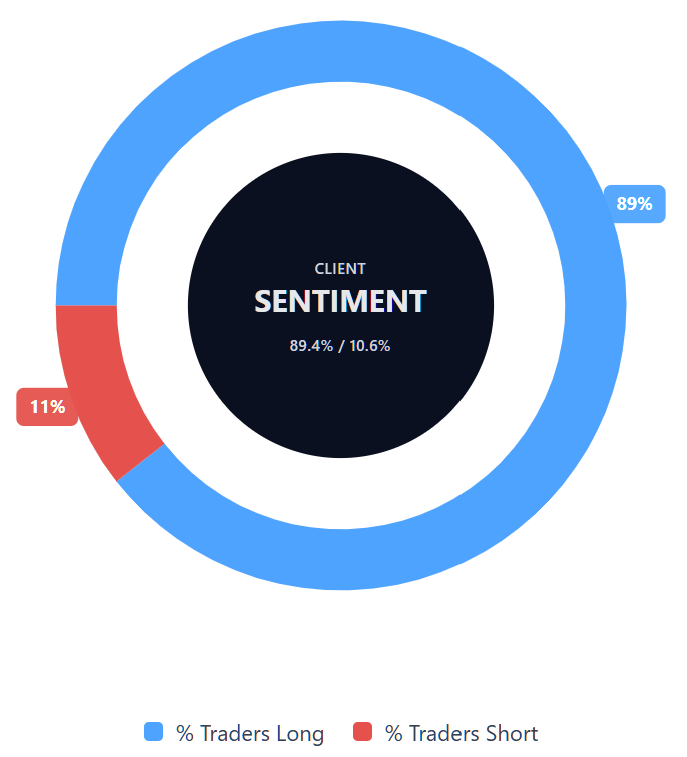
As of 8 September 2026, Capital.com client positioning in Boeing CFDs is 89.4% long and 10.6% short, a difference of 78.8 percentage points. This snapshot reflects open positions on Capital.com and can change.
Summary – Boeing 2026
- Current price: Boeing traded near $211.97 at 10:25am UTC on 8 September 2026, within an intraday range of $209.25–$212.14.
- Technical picture: the price was below its 20-, 50-, 100- and 200-day SMAs, while RSI remained neutral and ADX indicated trend strength but not direction.
- Key influences: safety scrutiny, labour negotiations, production recovery and 777X certification could affect the shares in either direction.
- Recent developments: an FAA fine linked to previous production-quality violations, a fatal cargo-aircraft accident under investigation and resumed union contract talks remain in focus.
Past performance is not a reliable indicator of future results.
FAQ
Who owns the most Boeing stock?
The article does not cover Boeing’s largest shareholders or current ownership structure, so it does not identify who owns the most Boeing stock. Ownership can also change as institutional and other investors adjust their holdings. For the latest breakdown, readers would need to check Boeing’s regulatory filings, annual report or other official shareholder disclosures rather than relying on the price, earnings and analyst forecast data covered in this article.
What is the five-year Boeing share price forecast?
The forecasts covered here do not extend to five years. Recent third-party estimates focus on a 12-month horizon, with targets ranging from $265–$305 and consensus figures around $275–$277. A five-year forecast would carry substantially more uncertainty because production, certification, labour conditions, cash flow and demand can change over time. Third-party forecasts can be inaccurate and should not be treated as reliable indicators of future performance.
Is Boeing a good stock to buy?
Whether Boeing is suitable to buy depends on individual circumstances, objectives and risk tolerance, so this article does not make a recommendation. Supportive factors include improving deliveries, a large order backlog and potential cash flow recovery. However, production issues, regulatory scrutiny, labour disputes and delays to 777X certification could weigh on the shares. Analyst targets also vary, showing that expectations for Boeing’s recovery are not uniform.
Could Boeing stock go up or down?
Yes. Boeing shares could move higher or lower as investors respond to production progress, aircraft deliveries, certification updates, labour negotiations, safety findings and earnings. Improving deliveries, stronger cash flow or positive contract developments could support the price. Conversely, production disruption, weaker results, regulatory action or delays to major programmes could weigh on it. These factors can interact, so no single development determines how the stock will perform.
Should I invest in Boeing stock?
This article cannot determine whether you should invest in Boeing, as that would depend on your financial circumstances, objectives and tolerance for risk. It provides context on recent price performance, earnings, analyst targets and technical indicators rather than a recommendation. Boeing’s outlook includes both potential support from deliveries and backlog, and risks from production, certification, regulation and labour. Past performance and analyst forecasts do not guarantee future results.
Can I trade Boeing CFDs on Capital.com?
Yes, you can trade Boeing CFDs on Capital.com. Trading share CFDs lets you speculate on price movements without owning the underlying asset and to take long or short positions. However, contracts for difference (CFDs) are traded on margin, and leverage amplifies both profits and losses. You should ensure you understand how CFD trading works, assess your risk tolerance, and recognise that losses can occur quickly.