

US midterm elections 2026: Can gridlock lift the peso and rand?
On 3 November, Americans vote for a new Congress. Mexico and South Africa get no ballot, yet their currencies will live with the result.
On 3 November, Americans vote for a new Congress. Mexico and South Africa get no ballot, yet their currencies will live with the result. The peso and rand sit downstream of two forces Washington controls: US interest rates, which set the price of dollar funding, and trade policy, which, together with global risk appetite, steers capital in and out of emerging markets (EM). Mexico is bound to the US by trade and people; South Africa by commodities and global risk. Same vote, different stakes.
The hope is simple. A divided Washington spends less, pressure on yields eases and the dollar softens. The catch is that gridlock only binds Congress. The White House keeps its powers over tariffs, immigration and sanctions, and those are the levers that matter most to Mexico and South Africa. So can lower dollar pressure outweigh trade risk that no election can remove? The answer depends on conditions that sit outside Congress, and those conditions are the story.
What gridlock can and cannot stop
Let’s start with the arithmetic. Republicans hold both chambers. The House has 218 Republicans, 214 Democrats, one independent who caucuses with the Republicans and two vacancies; the Senate has 53 Republicans, 45 Democrats and two independents who caucus with the Democrats. All 435 House seats and 35 Senate seats are up for election. Even a Democratic sweep would leave Donald Trump in the White House with his veto, and the new Congress would not sit until 3 January 2027.
Forecasters currently see Democratic control of both chambers as the most likely outcome, with a split Congress the main alternative. That makes the outcome fewest people expect, Republicans holding on, the one with the most power to move currencies.
If Democrats do win, the first casualty would be deficit-financed tax and spending plans. That would take some upward pressure off yields, which is the closest thing to good news the peso and rand can get from Washington. Even that relief has a hazard on the way: government funding expires on 11 December, weeks before the new Congress arrives, and a funding fight could rattle risk appetite in the meantime.
Trade is another matter. The United States–Mexico–Canada Agreement (USMCA) was not extended at the July review. It remains in force, but now faces annual reviews and a 2036 sunset unless extended. The African Growth and Opportunity Act (AGOA) runs to December 2028, yet South Africa’s eligibility and additional tariffs remain separate risks. A new Congress could legislate and scrutinise, but much of the power here sits with the executive, subject only to legal limits.
The same gap appears elsewhere. Congress can cut immigration funding, but it cannot simply reverse enforcement or the existing 1% tax on qualifying cash-funded remittances. Sanctions mix congressional mandates with executive designations, and measures already reaching Mexican companies show how payment risks can survive gridlock. Washington’s spending can be restrained; its trade weapons cannot.
The starting point: a dollar with momentum
Any relief would also start from a difficult position, because the dollar enters the vote with support. The Federal Reserve (Fed) raised its rate range to 3.75%–4.00% in September. The US Dollar Index (DXY) reached 101.78 on 21 October, up 2.4% since end-August, and the US 10-year Treasury yield hit 5.12% the day before. Fear has faded a little: the Chicago Board Options Exchange Volatility Index (VIX) eased to 16.68 on 21 October from 19.99 five days earlier. But with further Fed tightening still possible, so for the peso or rand to rally, inflation, yields and risk appetite all need to cooperate.
Against a dollar with this much support, local policy can do only so much. Banco de México (Banxico) held at 6.50% in September, and the South African Reserve Bank (SARB) raised its rate to 7.25%. Both stand well above US rates, yet both currencies remain at the mercy of what Washington and global markets do next.
At home, each country carries its own weak spot. Mexico’s nearshoring promise still needs the investment to arrive: net foreign direct investment fell 11.7% in the first half, despite a second-quarter current-account surplus of US$8.9 billion, and August remittances fell 3.6% to US$5.45 billion. South Africa’s current account swung from a surplus of 2.3% of gross domestic product (GDP) to a 2.6% deficit in the second quarter, and its Government of National Unity (GNU) faces a cohesion test in November’s municipal elections. Gold and platinum exports help; an oil shock would hurt. Whatever Washington delivers, these vulnerabilities limit how far either currency can run.
What past midterms tell us
If history offered a reliable midterm rally, the case would be easy. It doesn’t. Across the four full post-election windows since 2010, the peso weakened every time; the rand strengthened only twice. Four elections show what can happen, not a seasonal rule.
Table 1 Percentage changes in window order: T−30 to T / T to T+5 / T to T+30. Positive = stronger dollar.
| Election | USD/MXN | USD/ZAR | USD/EM proxy |
|---|---|---|---|
| 2010 | -3.68 / -0.70 / +1.21 | -2.85 / -1.15 / -1.11 | -2.06 / -0.40 / +0.76 |
| 2014 | +2.52 / -0.24 / +7.10 | -1.05 / +1.16 / +4.66 | +1.51 / +0.31 / +3.96 |
| 2018 | +5.30 / +2.52 / +0.36 | -0.54 / +1.36 / +2.08 | +1.53 / +0.94 / +0.15 |
| 2022 | -4.46 / -0.77 / +0.66 | -2.38 / -2.32 / -2.89 | -0.96 / -1.41 / -2.20 |
Source: FRED (DEXMXUS, DEXSFUS, DTWEXEMEGS), retrieved 22 October 2026. T = election-day H.10 fixing, before results. Calculations reflect spot movements only, omitting interest rate spreads. USD/EM is the Fed’s trade-weighted EM dollar index, an inverse proxy, not investable. FRED Past performance is not a reliable indicator of future results.
Chart 1 Each election window took a different path
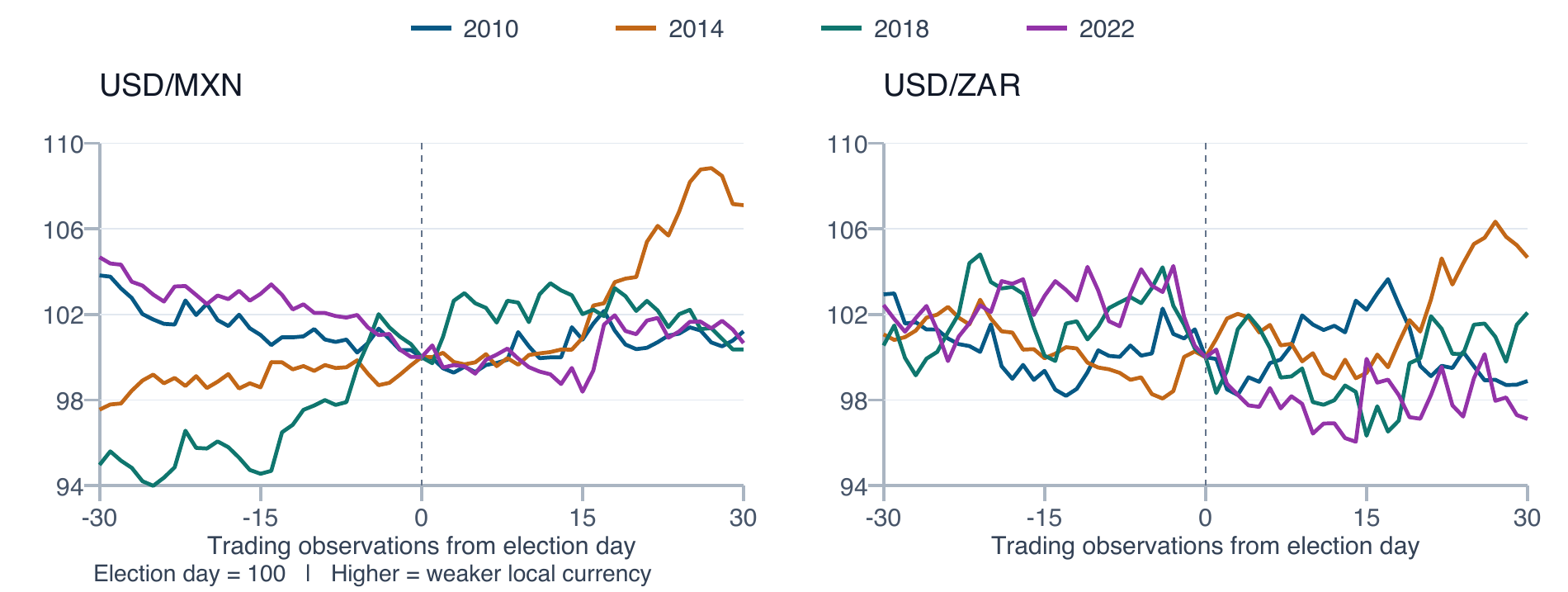
Election days: 2 Nov 2010, 4 Nov 2014, 6 Nov 2018, 8 Nov 2022. Source: Table 1 series.
The reason is that elections never happen alone. The Fed’s second round of quantitative easing followed the 2010 vote. Oil plunged in 2014. Mexico cancelled its airport project before the 2018 vote. And the November 2022 consumer price index showed US inflation slowing to 7.7%. Each time, a bigger macro shock drowned out the ballot. Beneath the noise, though, the data show how differently the two currencies respond to global forces.
Chart 2 The rand is more sensitive to the dollar and risk
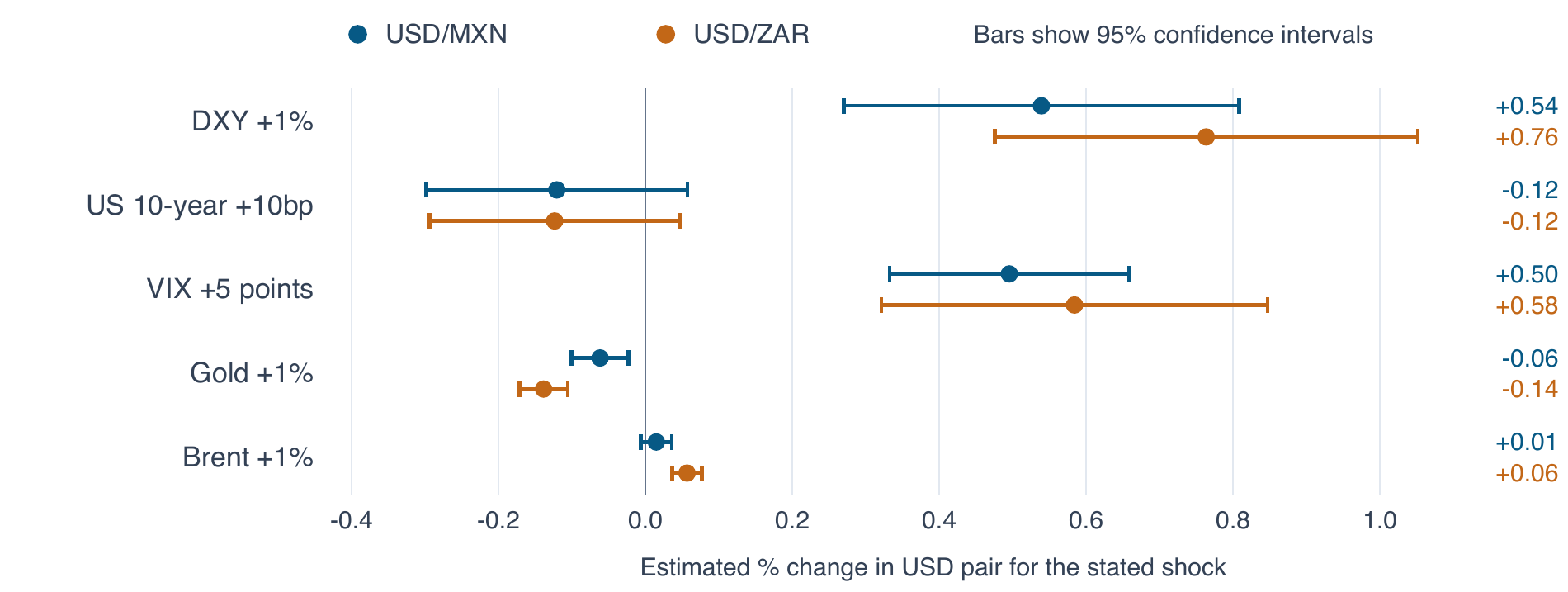
OLS, 252 daily observations, 7 October 2025–16 October 2026, all five factors estimated together. Bars show Newey–West 95% confidence intervals. Explained variance: MXN 39%, ZAR 62%. FRED
The rand shows larger estimated sensitivity to the dollar and gold, and a positive sensitivity to oil. Yield effects are indistinguishable from zero, and the two currencies’ confidence intervals overlap. These are associations, not causes. Still, they suggest the rand will take its cue less from the vote itself than from what the vote does to global risk.
Three outcomes, three sets of conditions
Put the pieces together and each outcome reaches the peso and rand through a different mix of channels. A Democratic sweep would constrain fresh fiscal stimulus, and Polymarket priced it at 67% on 22 October. Republicans holding both chambers, priced at 8%, would widen the scope for tax and spending measures. Table 2 sets out the policy implications of each scenario.
Table 2 Election scenarios and policy implications.
| Outcome | Policy implications | Mexico: main channel | South Africa: main channel |
|---|---|---|---|
| Democratic sweep 67% | Less scope for fiscal expansion; stronger oversight. Tariffs, immigration enforcement and sanctions remain live. | Lower US yield pressure vs ongoing USMCA and remittance risk | Lower US yield pressure vs AGOA eligibility and tariff risk |
| Split Congress 25% | Main case: Democratic House, Republican Senate. Fiscal bargaining; executive trade pressure could offset lower yields. | Trade policy outweighs fiscal restraint. | Global risk appetite outweighs fiscal restraint |
| Republican retention 8% | More scope for tax and spending measures; yield upside and trade restrictions could outweigh better equity sentiment. | Higher US yield pressure plus trade restrictions | Higher US yield pressure plus commodity and risk sensitivity |
Probabilities are Polymarket market-implied odds on 22 October 2026, not polling forecasts. Split Congress includes the 1% probability of a Republican House and Democratic Senate. Source: Polymarket.
The outcomes matter less than what follows them. Republican fiscal expansion might lift equities before higher yields take over, while a Democratic sweep could still disappoint if tariffs escalate. In Mexico, unresolved USMCA access could delay investment, immigration enforcement could cut remittances and Banxico easing would narrow the rate differential. In South Africa, GNU instability or weaker commodity receipts could swamp any dollar relief. Russian metals sanctions might boost demand for South African supply as a substitute, though diplomatic and risk-aversion effects could offset that. These are risks, not assumed policies.
What the market will be watching
Whatever the outcome, the coming weeks are unlikely to be calm. Annualised realised volatility over 21 observations was 12.0% for USD/MXN and 10.7% for USD/ZAR through 16 October, against 8.8% and 10.5% over 63 observations. That implies typical one-month moves of about 3.5% and 3.1%, with the peso’s volatility rising most sharply as the vote approaches. Calculations use H.10 log-return sample standard deviations × √252. FRED
History suggests those swings rarely end on election night. In 2014, the dollar gained more than 7% against the peso in the month after the vote as oil prices plunged. In 2018, the damage came first: Mexico’s airport cancellation helped push USD/MXN up more than 5% before Americans went to the polls. The ballot sets the stage; what follows decides the direction.
So the peso and rand will show whether the window has opened. Relief that lasts would look like steady strength in the weeks after the vote, backed by calmer yields and steadier risk appetite. Relief that fades within days would suggest the window was never really open.
The first signs will come quickly, because this year the events crowd together. The Fed meets on 28 October, with third-quarter US GDP and September personal consumption expenditures (PCE) the next day. Then four days in a row: the midterms on 3 November, South Africa’s municipal elections and public holiday on 4 November, Banxico on 5 November and US payrolls on 6 November. SARB follows on 19 November, the Fed returns on 9 December and US funding expires on 11 December. Close races could delay calls on who controls Congress, stretching the wait further.
Mexico and South Africa cannot cast a vote on 3 November, but the result may still open a window for their currencies, provided gridlock restrains US fiscal pressure without provoking a bigger trade shock. History promises nothing. Energy disruption, hotter US inflation, a dollar liquidity squeeze or political stress at home could shut that window fast. The election can open it; only fundamentals can keep it open.