

USD/JPY Under Pressure: dollar weakness meets yen intervention fears
Dollar weakness and intervention fears in Japan drive USD/JPY lower as key US data is to be released.
USD/JPY has come under renewed downside pressure as two powerful forces converge: a softer US dollar driven by the “sell America” trade and a strengthening Japanese yen supported by rising fears of FX intervention. The pair’s recent decline is not being driven by a single catalyst, but rather by a shift in cross-asset sentiment and policy perception on both sides of the equation
“Sell America” trade gathers momentum
The US dollar has been weakening as investors reassess US exceptionalism and trim exposure to US assets. The so-called “sell America” trade reflects concerns around stretched equity valuations, fiscal sustainability, and political uncertainty. Capital flows have begun rotating away from US assets, particularly as Treasury yields have stabilised or edged lower, compressing the dollar’s rate advantage.
Importantly, recent US data has not been strong enough to reignite the “higher-for-longer” narrative. Growth remains resilient, but not overheating, and inflation has moderated enough to keep the Fed in a patient stance. With rate differentials no longer widening decisively in favour of the US, the structural support that underpinned USD strength through much of the previous cycle has weakened. In that context, USD rallies are increasingly being sold rather than chased.
Intervention premium returns
At the same time, the Japanese yen has found support as speculation around government intervention intensifies. Japanese officials have stepped up verbal warnings against excessive currency weakness, raising the perceived risk of direct action should USD/JPY move too high.
Positioning has played a significant role. The yen had been heavily shorted due to wide yield differentials and a relatively cautious Bank of Japan. However, once intervention rhetoric resurfaces, traders are quick to reduce exposure. In thin liquidity conditions, particularly around weekends or periods of geopolitical tension, the intervention premium tends to magnify moves.
Beyond rhetoric, the broader backdrop is shifting gradually in the yen’s favour. The Bank of Japan has already begun normalising policy, and even if further hikes are gradual, the direction of travel contrasts with the Fed’s easing bias. That narrowing policy divergence is enough to encourage repatriation flows and support JPY on dips.
Yield differentials and technical dynamics
From a rates perspective, USD/JPY remains highly sensitive to US Treasury yields. Recent softness in the front end of the US curve has capped upside in the pair. Meanwhile, Japanese yields, while still low by global standards, have edged higher as markets price a modest tightening path.
Technically, USD/JPY appears to be transitioning from a momentum-driven uptrend into a more fragile consolidation phase. Key support levels are being tested, and momentum indicators suggest a loss of upside conviction. Should intervention fears intensify or US yields move lower, the pair could extend toward lower support zones. Conversely, any renewed rise in US yields would quickly re-anchor the carry trade and stabilise the pair. A key catalyst for either side could be the US jobs and inflation data released this week, as they will shape expectations about the Fed easing path, which will influence the dollar.
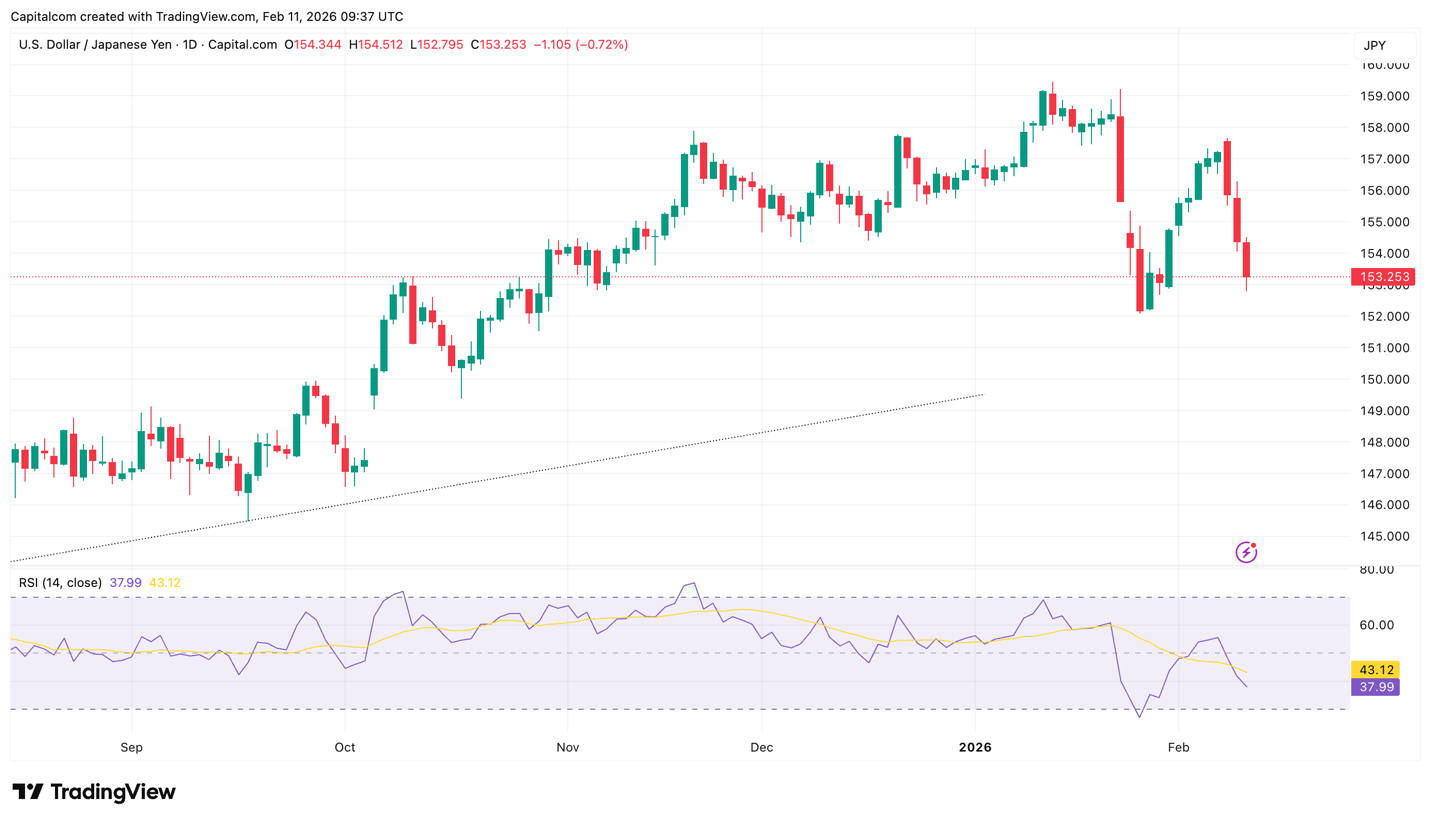
USD/JPY daily chart
Past performance is not a reliable indicator of future results.
USD/JPY has shifted from a steady uptrend into a corrective phase after failing to sustain gains above the 158–159 resistance zone. The chart shows a sharp rejection from recent highs, followed by a sequence of lower highs and stronger bearish candles, suggesting momentum has turned decisively lower in the short term. Price is now trading around the 153.25 area, with the next key support sitting near the recent swing low around 152.10–153.00. A sustained break below that zone would expose the 150.00–151.00 region, which aligns with prior consolidation levels and could act as the next demand area. The RSI has dropped toward the low 40s and briefly dipped into oversold territory earlier in the move, confirming weakening momentum but not yet signalling a clear reversal. Unless price reclaims the 155.50–156.00 region and rebuilds bullish structure, the path of least resistance appears tilted to the downside in the near term, with rallies likely to face selling pressure into prior breakdown levels.
Outlook: a battle between policy and positioning
In the near term, USD/JPY is caught between structural dollar fatigue and tactical yen strength. The “sell America” narrative weakens the dollar through capital outflows and compressed yield differentials, while the yen benefits from intervention risk and gradual policy normalisation.
However, it is important to distinguish between tactical and structural moves. The yen’s strength may prove episodic if not backed by sustained policy tightening, while the dollar could regain support if US data surprise to the upside or global risk sentiment deteriorates.
For now, the balance of risks favours continued volatility rather than a clean directional trend, with USD/JPY trading as a barometer of both US capital flows and Japanese policy credibility.