

EUR/USD forecast: US dollar strength and Hormuz tensions
EUR/USD traded near 1.1400 in mid-July 2026, as a firmer US dollar, Strait of Hormuz tensions and French political risk influenced the pair. Explore third-party EUR/USD forecasts and technical analysis. Past performance is not a reliable indicator of future results.
Euro–US dollar (EUR/USD) last traded at $1.14172 as of 12:08pm UTC on 15 July 2026, holding within the day’s $1.13793–$1.14530 intraday range and staying close to the 1.1400 level it has held above through the week. Past performance is not a reliable indicator of future results.
Price action has been supported by a firmer US dollar, as investors scale back expectations for prolonged dollar weakness (Currency News UK, 13 July 2026). Safe-haven demand has also risen amid escalating US-Iran military tensions around the Strait of Hormuz, which pushed oil prices higher after President Trump said the US would reinstate a blockade of Iranian shipping and impose a 20% fee on cargo passing through the waterway (Yahoo Finance, 13 July 2026). Political risk in France, following the upheld conviction of National Rally leader Marine Le Pen, has added uncertainty for the euro, though her appeal reduced her public office ban and left her eligible to seek the presidency (Carnegie Endowment, 9 July 2026), with Credit Agricole noting that EUR/USD continues to take its cue from the OAT-Bund yield spread and interest rate differentials between the Federal Reserve and the European Central Bank (InvestingLive, 15 October 2025).
Third-party EUR/USD outlook: Hormuz tensions, rate paths
As of 15 July 2026, third-party euro US dollar predictions point to a range of possible price paths shaped by Federal Reserve and European Central Bank policy divergence, US rate expectations and technical positioning. The following mini-briefs summarise leading third-party forecasts for the pair, ordered from lower to higher target.
Danske Bank (six-month bearish forecast)
Danske Bank projects EUR/USD to fall to $1.13 within six months and to $1.12 on a longer-dated horizon, extending its bearish stance on the pair. The bank cites persistent US dollar resilience as its key rationale for the continued downside path (ExchangeRates.org.uk, 22 June 2026).
DailyForex (technical short-term outlook)
DailyForex projects EUR/USD to test support near $1.14000, with downside risk extending toward $1.12, after falling from higher levels earlier in the week. The outlook cites rising US Treasury yields, broad dollar strength and elevated geopolitical risk as the main drivers behind the projected move lower (DailyForex, 9 July 2026).
LiteFinance (target zone projection)
LiteFinance projects EUR/USD to decline toward its next downside Target Zone 3 at $1.12490 to $1.12290, with a primary near-term target near $1.13240 as the medium-term downtrend extends. The projection follows the pair's break below Target Zone 2 at $1.14410 to $1.14210 at the end of June, with resistance now expected near $1.18200 (LiteFinance, 13 July 2026).
Third-party roundup: BNP Paribas (three- and 12-month targets)
BNP Paribas projects a three-month EUR/USD target of $1.16 and a 12-month target of $1.24 in its Currencies Focus note, expressed as the value of one euro against the US dollar. The bank's projection assumes gradual dollar depreciation as US rate cuts progress relative to a steadier European Central Bank path (Investing.com, 1 January 2026).
Predictions and third-party forecasts are inherently uncertain, as they cannot fully account for unexpected market developments. Past performance is not a reliable indicator of future results.
EUR/USD macro backdrop and upcoming data
The euro to dollar exchange rate has stabilised above the 1.1400 level heading into 15 July 2026, with the US dollar retaining underlying support as investors scale back expectations of prolonged dollar weakness. The pair entered the week of 13 to 17 July 2026 near 1.14410, with easing geopolitical tensions between the US and Iran and falling oil prices giving the euro additional support by reducing inflation concerns (Currency News UK, 13 July 2026).
The key upcoming data point remains the June US Consumer Price Index release, which markets expect to play an important role in shaping expectations for the Federal Reserve's future policy path. Federal Reserve officials have also drawn attention this month, with New York Fed President John Williams citing artificial intelligence-driven demand growth as a key inflation factor, while Fed Chairman Kevin Warsh announced five task forces to review the central bank's key areas of activity (Currency News UK, 13 July 2026).
On the eurozone side, the European Central Bank's euro reference exchange rate showed EUR at 1.14050 against the dollar on 14 July 2026 (European Central Bank, 14 July 2026), down 0.2% from the prior year (Trading Economics, 15 July 2026). Broader sector commentary has noted that the US dollar drew only limited support from an oil-price spike tied to the conflict around the Strait of Hormuz, as markets stayed focused on US economic resilience and whether the Federal Reserve may need to keep rates higher for longer (Yahoo Finance, 13 July 2026).
Euro–US dollar: Technical overview
EUR/USD trades near $1.14172, holding just below its 20/50/100/200-day simple moving averages at approximately $1.14127, $1.15406, $1.15909 and $1.16405. This cluster sits above the current price and points to a broader downward tilt on the daily chart. The 50-day and 100-day exponential moving averages, at $1.15104 and $1.15718 respectively, run close to their simple moving average counterparts, reinforcing this overhead shelf. The pair also remains beneath its Ichimoku base line near $1.14730, while the Hull moving average sits lower at $1.14026, according to data compiled via TradingView.
Momentum readings remain mixed. The 14-day relative strength index reads around 43.9, placing it in lower-neutral territory rather than at a stretched level, while the average directional index at roughly 28.9 points to an established trend, per TradingView data.
On the topside, the nearest classic pivot resistance (R1) sits near $1.16151. A daily close above that level would put the R2 pivot near $1.18101 back in view, based on TradingView’s classic pivot calculation. On pullbacks, the classic pivot point (P) near $1.14697 offers an initial reference, while the 50-day simple moving average near $1.15406 forms the closer moving-average shelf. A move below the S1 pivot near $1.12747 would risk a move toward the S2 pivot near $1.11293, per TradingView’s pivot data (TradingView, 15 July 2026).
This is technical analysis for informational purposes only and does not constitute financial advice or a recommendation to buy or sell any instrument.
EUR/USD history (2024–2026)
The euro to US dollar rate started July 2024 near $1.09, spending much of that summer in a range before drifting higher into autumn as US rate cut bets built.
The pair climbed through 2025, breaking above $1.10 in August and pushing past $1.15 by June. A sharp jump to $1.15145 on 21 April 2025 coincided with fresh US tariff uncertainty that weighed on the dollar. EUR/USD went on to hit a multi-year high near $1.20834 on 27 January 2026, before pulling back through February and March as US data proved resilient and Federal Reserve rate cut expectations were pared back.
The pair fell as low as $1.13249 on 24 June 2026 amid a hawkish Fed hold, before stabilising above $1.1400 through early July.
EUR/USD closed at $1.14183 on 15 July 2026, approximately 2.8% down year to date and roughly 1.6% down year on year.

Past performance is not a reliable indicator of future results. Prices are indicative and may differ from live market prices.
Capital.com analyst view
EUR/USD’s price action through the first half of 2026 has been shaped by shifting expectations around the pace of Federal Reserve policy easing relative to the European Central Bank’s own rate path. The pair retreated from a multi-year high near $1.20834 in late January toward the $1.13–$1.15 range by mid-year. Resilient US economic data and reduced expectations for aggressive Fed rate cuts have supported the dollar in recent months, though some analysts note that a slower US labour market or softer inflation prints could revive dollar-weakness narratives and lift the pair back toward earlier highs.
Geopolitical developments, including tariff policy and tensions in the Middle East, have periodically driven haven flows into both the euro and the dollar. This shows how such events can pull the pair in either direction, depending on which currency markets perceive as the safer asset at the time. Political developments within the eurozone, such as uncertainty in France, add a further layer of complexity that could weigh on the euro or, alternatively, prompt flows toward the currency bloc’s core economies. Past performance is not a reliable indicator of future results.
Capital.com’s client sentiment for EUR/USD CFDs
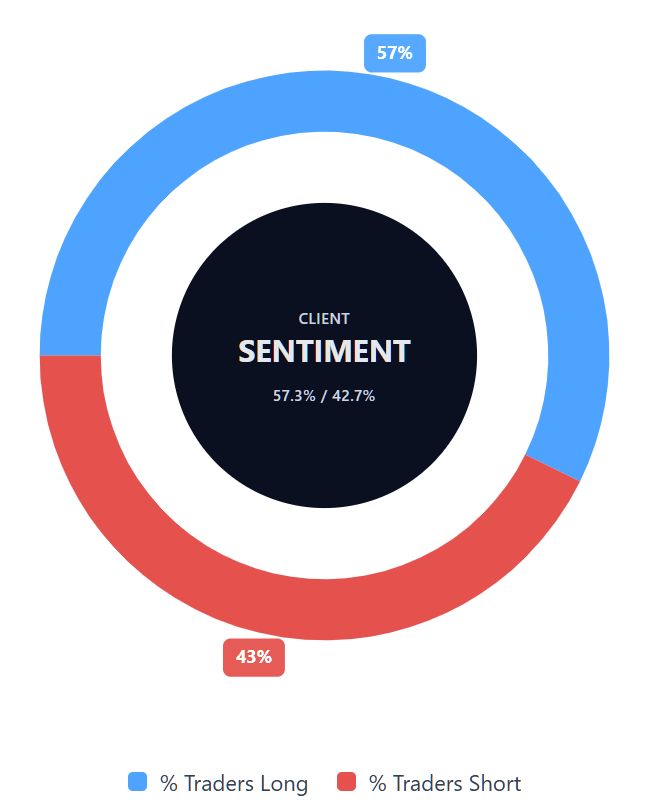
As of 15 July 2026, Capital.com client positioning in EUR/USD CFDs is split 57.3% buyers versus 42.7% sellers, indicating a slight long bias, with buyers ahead by 14.6 percentage points. This snapshot reflects open positions on Capital.com and can change.
Summary – EUR/USD 2026
- As of 12:08pm UTC on 15 July 2026, EUR/USD traded near $1.14172, down from January’s multi-year high near $1.20834 but above April 2025 lows near $1.08.
- Technical indicators on TradingView show prices below the 20/50/100/200-day moving averages, with RSI near 43.9 in lower-neutral territory and ADX near 28.9 pointing to an established trend.
- Key drivers include Federal Reserve versus European Central Bank policy divergence, US economic resilience, geopolitical tensions in the Middle East, and French political uncertainty.
- Recent attention centres on the upcoming US Consumer Price Index release, Fed leadership commentary on inflation, and easing Strait of Hormuz tensions.
Past performance is not a reliable indicator of future results.
FAQ
What is the euro US dollar forecast?
Third-party EUR/USD forecasts published between late June and mid-July 2026 show a wide range of possible outcomes. Near-term technical projections cluster around $1.12–$1.16, while broader bank consensus forecasts for the rest of 2026 sit closer to $1.18–$1.25. These views depend on changing assumptions around Federal Reserve and European Central Bank policy, US data, geopolitical risk and technical positioning. Forecasts can change and shouldn’t be treated as financial advice.
What influences EUR/USD movements?
EUR/USD movements are shaped by the relative strength of the euro and the US dollar. Key drivers include Federal Reserve and European Central Bank interest rate expectations, inflation data, economic growth, labour market signals, bond yield spreads and geopolitical developments. Political uncertainty in the eurozone, US tariff policy and safe-haven flows can also affect the pair. Because both currencies can attract demand during periods of stress, the impact of external events isn’t always straightforward.
Could EUR/USD go up or down?
EUR/USD could move in either direction, depending on how upcoming data and policy expectations develop. Softer US inflation or labour market data could revive expectations for Federal Reserve rate cuts and weigh on the dollar, potentially supporting EUR/USD. However, resilient US data, renewed geopolitical risk or eurozone political uncertainty could support the dollar or pressure the euro. Technical levels may also influence short-term moves, but past performance isn’t a reliable indicator of future results.
Can I trade EUR/USD CFDs on Capital.com?
Yes, you can trade EUR/USD CFDs on Capital.com. Trading forex CFDs lets you speculate on price movements without owning the underlying currencies, and to take long or short positions. However, contracts for difference (CFDs) are traded on margin, and leverage amplifies both profits and losses. You should ensure you understand how CFD trading works, assess your risk tolerance, and recognise that losses can occur quickly.