

USD/JPY slides after coordinated US-Japan intervention
USD/JPY drops to three-month low as the US and Japan confirm a joint intervention.
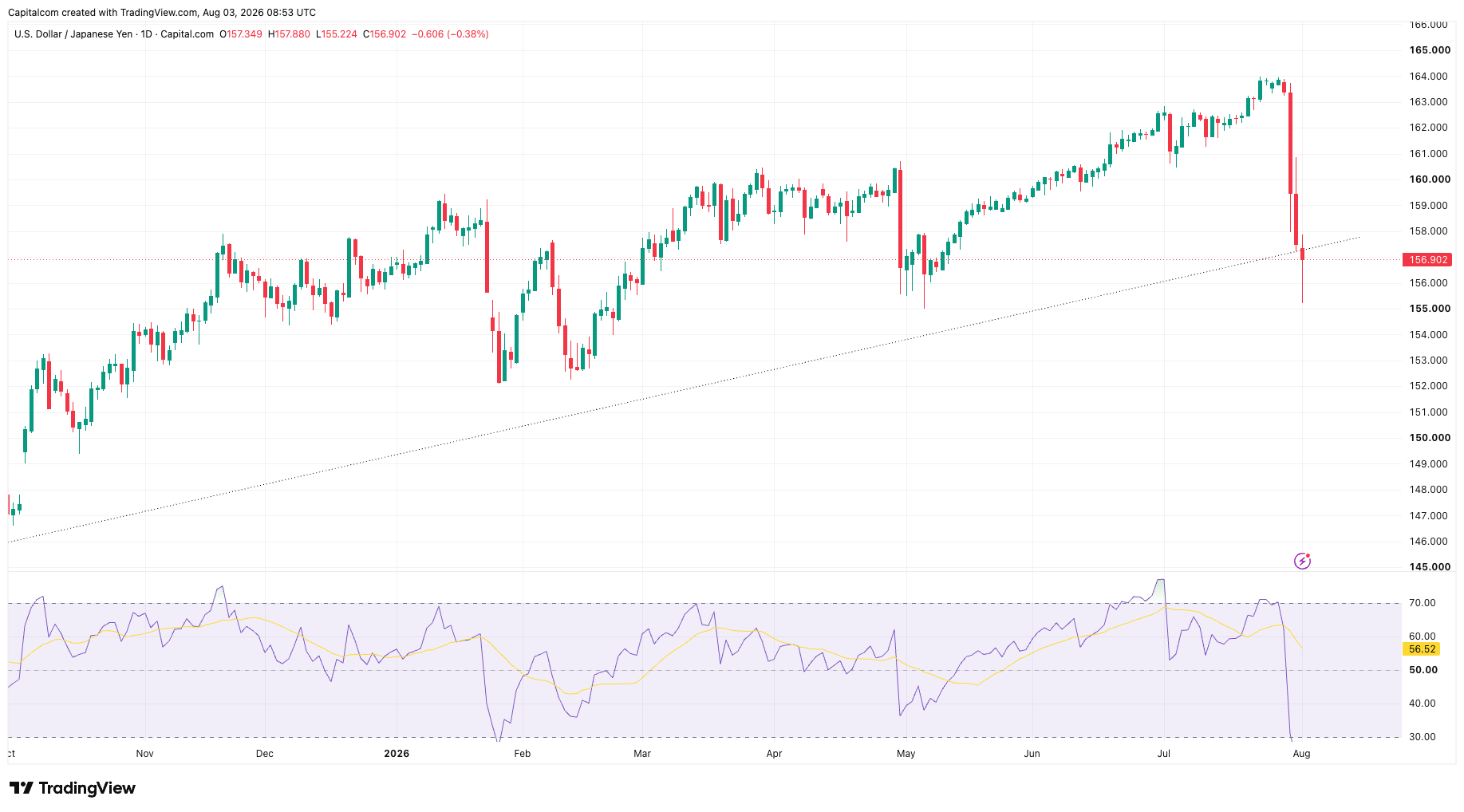
Japan and the U.S. intervened jointly last week to halt the yen's slide to a fresh 40-year low, pushing USD/JPY from above ¥164 to around ¥155-157, delivering one of the largest moves in a major currency pair in years and forcing traders to rapidly unwind long-dollar positions. The intervention was significant, not only because of its scale, but because of direct US participation, signalling a greater willingness by policymakers to counter excessive currency volatility.
USD/JPY daily chart
Past performance is not a reliable indicator of future results.
The more important question, however, is whether it changes the broader outlook for the yen. For now, probably not. The fundamental forces that have driven yen weakness remain firmly in place. US interest rates remain well above those in Japan, encouraging investors to move capital into higher-yielding assets, while the Bank of Japan continues to normalise policy only gradually. Intervention can alter the price, but it does not alter those underlying fundamentals. Unless the interest-rate differential narrows through either additional Bank of Japan tightening or a more dovish Federal Reserve, history suggests the broader trend is unlikely to reverse permanently.
Volatility and rates
Implied volatility in USD/JPY options should be expected to stay elevated for as long as the market treats further intervention as a live possibility — both Tokyo and Washington have explicitly said they're prepared to repeat the operation. That standing threat itself changes trading behaviour: it raises the cost of carrying short-yen positions even between intervention events, because the tail risk of a sudden, sharp move against the position is now visibly priced by two governments rather than one. This is where the intervention could have a more lasting impact on market behaviour rather than the exchange rate itself.
The more structurally important variable sits in the bond market. The BOJ left its policy rate at 1% last week despite the currency pressure, with one board member dissenting in favour of a hike, and gave little forward guidance on the pace of further tightening. Japan's government bond yields have been rising in the background of the yen story, and a bond market that lets yields move more freely would take pressure off the currency — but Japan's debt load limits how far the BOJ can allow that without raising the government's own financing costs.
That linkage is why some analysts read the yen's weakness as a symptom of bond-market constraints rather than a standalone FX phenomenon, and why volatility in JGBs is worth monitoring alongside spot USD/JPY: a disorderly move in Japanese yields would matter more to global portfolios than the currency pair itself, given how deeply Japanese institutional flows are embedded in U.S. Treasuries and other developed-market debt.