

Dividend stocks compared by yield and payout ratio

As of May 2026, Dow has cut its dividend, while several major US stocks have updated yields and payout ratios. Here’s how they compare.
Learn what dividend stocks are, how dividend yield is calculated, which factors may affect dividend sustainability, and how prominent US dividend stocks compare by key metrics.
What are dividend stocks?
Dividend stocks are shares of publicly traded companies that regularly distribute part of their earnings or cash flow to shareholders. These payments can supplement any potential capital gains from rising share prices, although dividends and share price gains are never guaranteed.
Dividends are usually paid quarterly, monthly, semi-annually or annually, depending on the company and region. They’re often used by established companies to return capital to shareholders and can form part of a wider assessment of a stock’s income profile.
You may have heard the term ‘dividend aristocrats’. These are companies in the US 500 that have increased their dividend payouts annually for at least 25 consecutive years and meet specific inclusion criteria. Examples include Coca-Cola (KO), McDonald’s (MCD), Johnson & Johnson (JNJ), Procter & Gamble (PG), ExxonMobil (XOM), and Chevron (CVX).
How to find the ‘best’ dividends in the stock market
The ‘best’ dividend stocks aren’t always those with the highest yields. A high yield can reflect a rising dividend, but it can also result from a falling share price. Traders often compare several measures to understand whether a dividend appears consistent with a company’s earnings, cash flow and wider financial position.

- Dividend yield is the annualised dividend payout divided by the stock price, expressed as a percentage. It can help compare dividend shares, but it should be viewed alongside the share price trend, earnings and any recent dividend changes.
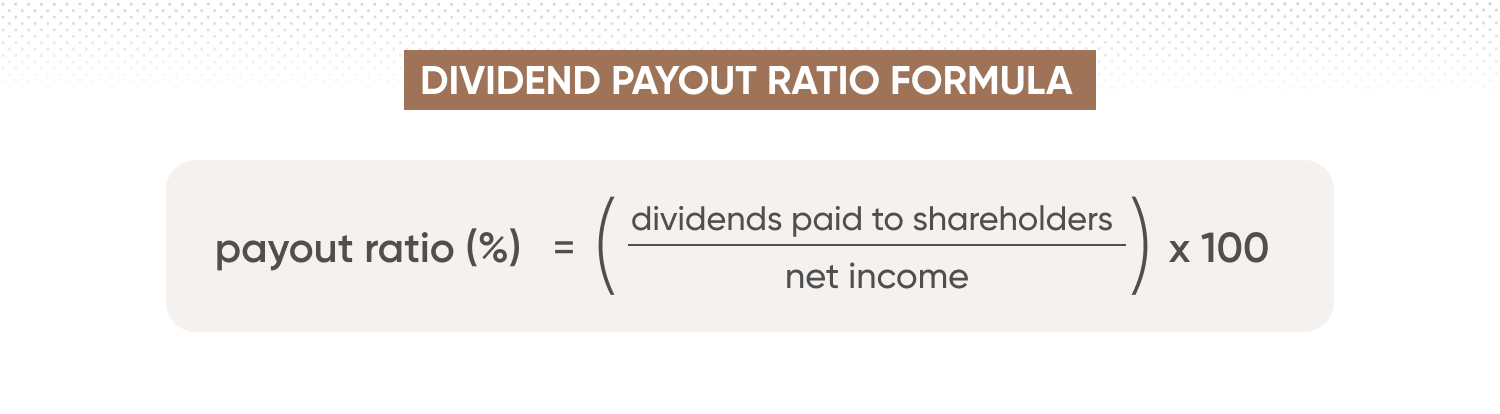
- Payout ratio shows the proportion of earnings paid out as dividends. A ratio of 30.00%-60.00% is often viewed as moderate, but the appropriate level varies by sector. Some companies can sustain higher ratios because of their business model, while others may face pressure if earnings fall.

- Dividend growth indicates whether a company has increased its dividend over time. A long record of increases may point to consistent shareholder distributions, but it doesn’t guarantee future payments.
- Industry and stability can also be relevant. Consumer staples, healthcare, telecoms and utilities often include established companies with recurring revenue streams. However, each stock should still be assessed on its own fundamentals, including earnings, debt, cash flow and dividend history.
- Ex-dividend date determines eligibility for the next dividend payment. Shareholders must own the underlying shares before this date to receive the upcoming dividend. For CFD traders, this matters because a dividend adjustment may apply when a qualifying position is held over the ex-dividend date, but this isn’t the same as receiving a traditional shareholder dividend.
The value and financial stability of dividend stocks can change over time. Traders should use recent, reliable and qualified sources, including company results, regulatory filings and independent technical analysis.
Learn more about dividends and how they work in our trader’s guide to dividends.
Top 10 overall dividend stocks
Here are 10 prominent US dividend stocks, as of 27 May 2026, assessed using yield, payout ratio, dividend history, sector, ex-dividend dates and stability. These examples are for information only and don’t constitute investment advice.
| Rank | Stock | Industry | Trailing dividend yield* | Payout ratio |
|---|---|---|---|---|
| 1 | ExxonMobil (XOM) | Energy | 2.70% | 68.07% |
| 2 | Johnson & Johnson (JNJ) | Healthcare | 2.32% | 60.68% |
| 3 | Verizon Communications (VZ) | Telecommunications | 5.82% | 67.32% |
| 4 | Procter & Gamble (PG) | Consumer staples | 2.98% | 61.24% |
| 5 | Medtronic (MDT) | Healthcare | 3.61% | 78.65% |
| 6 | Comcast (CMCSA) | Telecommunications | 5.28% | 25.76% |
| 7 | PepsiCo (PEP) | Non-alcoholic beverages | 3.62% | 72% |
| 8 | Altria (MO) | Tobacco | 5.86% | 88.61% |
| 9 | Kimberly-Clark (KMB) | Consumer staples | 5.26% | 78.95% |
| 10 | Chevron (CVX) | Energy | 3.78% | 120.75% |
*Trailing dividend yield represents the total dividend paid per share over the past 12 months, expressed as a percentage of the share price. Current data should be checked before publication against company filings and financial data providers. Recent dividend data shows ExxonMobil’s annual dividend at $4.12 per share, Verizon’s at $2.83, Altria’s yield above 5%, and Chevron’s annual dividend at $7.12, though yields move with share prices.
FAQ
What is a dividend aristocrat?
A dividend aristocrat is a company in the US 500 that has increased its dividend payout every year for at least 25 consecutive years and meets the index’s other inclusion criteria. These companies are often large, established businesses, but dividend aristocrat status doesn’t guarantee future dividend payments or share price performance.
How can traders compare dividend stocks?
How do I start trading dividend stocks via CFDs?
To trade dividend stocks via contracts for difference (CFDs), you’ll need to open an account with a CFD trading provider. CFDs allow you to speculate on share price movements without owning the underlying shares. If you hold a long share CFD position over the ex-dividend date, a dividend adjustment may be credited to your account. If you hold a short position, a dividend adjustment may be debited. This isn’t the same as receiving a traditional dividend as a shareholder. CFDs are traded on margin. Leverage amplifies both profits and losses.

