

Oracle stock forecast: Q1 FY2027 results ahead
Oracle is a US cloud and software company. Its Q1 FY2027 results put $638bn in contracted backlog and $95bn of planned capital expenditure in focus. Explore third-party ORCL price targets and technical analysis. Past performance is not a reliable indicator of future results.
Oracle Corporation (ORCL) traded at $159.12 as of 1:14pm UTC on 10 September 2026, within an intraday range of $158.78–$164.23. Past performance is not a reliable indicator of future results.
The earnings update puts Oracle's cloud infrastructure expansion in focus. Areas to watch include how quickly its $638bn in remaining performance obligations converts into revenue (Reuters, 10 June 2026) and its planned $95bn of fiscal 2027 capital expenditure, compared with roughly $67.7bn previously anticipated by analysts (Investing.com UK, 10 June 2026). Oracle's previously outlined plan to raise around $40bn through debt and equity also adds a financing consideration as the company expands its AI infrastructure capacity (Yahoo Finance, 9 September 2026).
Third-party Oracle outlook: Q1 earnings and AI spending
As of 10 September 2026, third-party Oracle stock predictions span a wide range ahead of earnings, reflecting different assumptions around cloud growth, AI demand, capital requirements, financing and execution.
Guggenheim
Guggenheim maintains a buy rating and $400 target. Its outlook partly reflects progress with Oracle's equity-raising plans as the company funds further infrastructure expansion (Investing.com, 8 September 2026).
Mizuho
Mizuho reiterates an outperform rating and $320 target. The firm argues that Oracle's valuation doesn't fully reflect its expectations for growth in the company's cloud infrastructure business (Investing.com, 8 September 2026).
Citi
Citi maintains a buy rating and $330 target, placing Oracle on a 90-day upside catalyst watch. The bank attributes part of the preceding share-price weakness to positioning and technical factors rather than weaker underlying demand (StocksToTrade, 8 September 2026).
Jefferies
Jefferies cut its Oracle target to $290 from $320 while retaining a buy rating. Analyst Brent Thill's revision reflects a reassessment of near-term valuation ahead of the earnings release (StockAnalysis.com, 8 September 2026).
RBC Capital Markets
RBC maintains a sector perform rating and $190 target. While recognising AI-related cloud demand, the firm highlights execution and financing risks associated with Oracle's data-centre expansion (StocksToTrade, 8 September 2026).
Predictions and third-party forecasts are inherently uncertain, as they cannot fully account for unexpected market developments. Past performance is not a reliable indicator of future results.
Oracle's upcoming earnings report
Oracle confirmed it will release its fiscal first-quarter 2027 results on 10 September 2026 after the US market closes, with a conference call and live webcast scheduled for 4:00pm Central Time (Oracle IR, 2 September 2026).
Its previous quarterly update showed $638bn in remaining performance obligations, making the pace at which contracted business converts into revenue an important point to watch. Cloud infrastructure growth, margins and the investment required to expand data-centre capacity are also in focus, alongside Oracle's plans to raise capital through debt and equity issuance (InvestingLive, 10 September 2026).
Investing.com reported that options pricing implied a potential post-earnings move of around 5%–15% in either direction, based on data as of 10 September 2026 (Investing.com, 10 September 2026). Options-implied moves reflect market pricing rather than a prediction of the eventual outcome.
The results also come amid wider attention on AI infrastructure spending. Stronger cloud growth or margins could support expectations around Oracle's expansion, while slower backlog conversion or higher-than-expected costs could put greater focus on the scale and financing of its investment plans.
ORCL stock price: technical overview
As of 1:14pm UTC on 10 September 2026, the ORCL stock price trades near $159.12, above its 20- and 50-day simple moving averages around $150 and $140, but below its 100- and 200-day averages near $164 and $168 respectively. This places the price between shorter- and longer-term moving-average references. The 200-day exponential moving average sits higher at around $170, according to TradingView.
The 14-day relative strength index (RSI) stands at 62.39, within neutral territory but towards its upper end, while the average directional index (ADX) at 17.09 indicates limited trend strength.
Above the latest price, R1 near $162.18 provides the closest classic pivot reference, followed by R2 around $175.25. Below the market, the classic pivot near $146.20 provides a lower reference, followed by the 50-day SMA around $140 and S1 near $133.13.
A rise could bring $162.18 and $175.25 into focus, while a move lower could shift attention towards $146.20, $140 and $133.13 (TradingView, 10 September 2026).
This is technical analysis for informational purposes only and does not constitute investment advice or a recommendation to buy or sell any instrument.
Oracle share price history (2024–2026)
ORCL’s stock price traded around $157 in September 2024 and rose over the following year as cloud infrastructure demand increased, reaching an all-time high of $335.89 on 11 September 2025 after its fiscal first-quarter 2026 update showed higher contracted revenue.
The stock subsequently moved lower through late 2025 and into 2026, trading around $195 by early January amid questions over AI infrastructure spending. Shares fell to around $115 on 24 July before recovering through August and early September as attention shifted back towards earnings and cloud infrastructure demand.
Oracle traded at $159.12 as of 1:14pm UTC on 10 September 2026, around 19% lower year to date and roughly 52% below its level a year earlier.

Past performance is not a reliable indicator of future results. Share prices are indicative and may differ from live market prices.
Oracle (ORCL): Capital.com analyst view
Oracle shares fell from above $335 in September 2025 to around $159 a year later as rapid growth in contracted cloud business came up against the cost and financing requirements of its infrastructure expansion. Its $638bn in remaining performance obligations represents a substantial volume of contracted business, but how quickly and profitably Oracle converts it into revenue remains central to the outlook.
Faster cloud growth, stronger margins or quicker backlog conversion could support earnings expectations and the shares. Conversely, higher capital expenditure, financing costs, slower conversion or execution difficulties could weigh on them.
Oracle's planned $95bn of fiscal 2027 capital expenditure and potential $40bn debt and equity raise illustrate that trade-off. Greater investment could expand capacity and support revenue if customer demand develops as expected. Higher borrowing needs, dilution from equity issuance or weaker returns on that spending could instead put pressure on valuation.
These factors may influence Oracle's share price in either direction and do not indicate a likely future outcome.
Capital.com’s client sentiment for Oracle CFDs
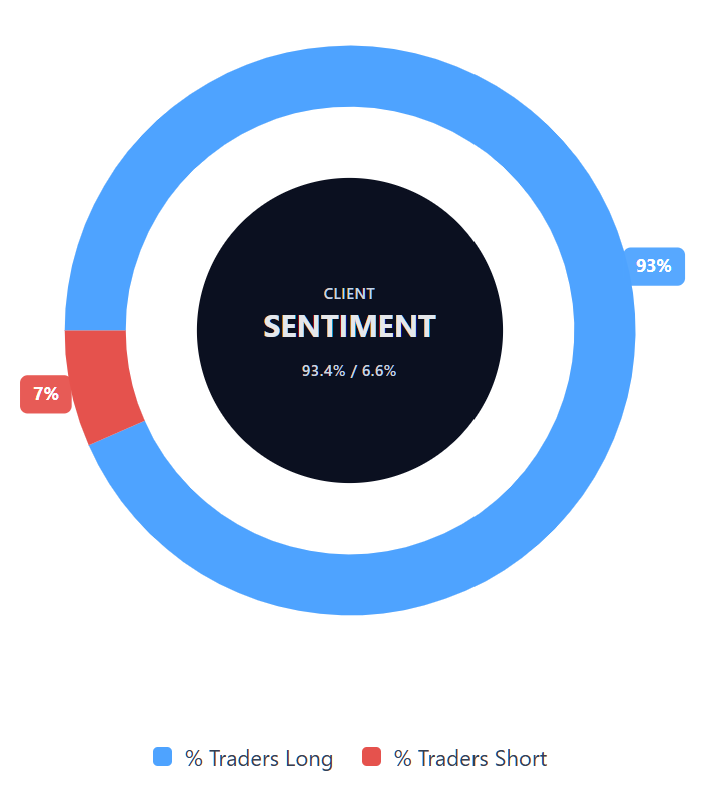
As of 10 September 2026, Capital.com client positioning in Oracle CFDs were positioned predominantly long: 93.4% of open positions were long and 6.6% short. The 86.8-percentage-point gap shows a clear preference among positioned clients going into the results, but it doesn't indicate whether Oracle's shares will rise or fall after the announcement. Client positioning can change.
Summary – Oracle 2026
- As of 1:14pm UTC on 10 September 2026, Oracle traded near $159.12, within an intraday range of $158.78–$164.23.
- According to TradingView, the price was above its 20- and 50-day moving averages but below its 100- and 200-day averages, while RSI stood at 62.39 and ADX at 17.09.
- Key factors include cloud infrastructure growth, conversion of Oracle's $638bn contracted backlog into revenue, and the cost and financing of data-centre expansion.
- Faster cloud growth, stronger margins or backlog conversion could support sentiment, while higher spending, financing requirements or execution risks could weigh on the shares.
Past performance is not a reliable indicator of future results.
FAQ
Who owns the most Oracle stock?
This article doesn't identify Oracle's largest shareholder or provide a full ownership breakdown. It focuses instead on earnings, cloud infrastructure growth, remaining performance obligations, capital expenditure, financing plans and third-party analyst forecasts. Shareholdings can change as institutional and other investors adjust their positions, so current company filings or shareholder disclosures would need to be checked separately to determine who holds the largest stake in Oracle.
What is the five-year Oracle share price forecast?
The article doesn't provide a five-year ORCL stock forecast. The third-party estimates covered here focus on 12-month targets, ranging from $190–$400. Longer-term projections carry greater uncertainty because cloud growth, backlog conversion, margins, capital expenditure, financing costs and AI infrastructure demand can change materially over several years. These targets should therefore be viewed as analyst estimates rather than reliable long-term predictions of Oracle's future share price.
Is Oracle a good stock to buy?
This article doesn't classify Oracle as a good or bad stock to buy. Faster cloud growth, stronger margins or quicker conversion of its $638bn contracted backlog could support earnings expectations and sentiment. Conversely, higher capital expenditure, financing costs, dilution from equity issuance or execution difficulties could weigh on the shares. Analyst targets also vary widely, reflecting different assumptions around growth and funding. These factors provide context but do not amount to an investment recommendation.
Could Oracle stock go up or down?
Yes. Oracle shares can move in either direction as earnings, cloud demand and financing conditions develop. Faster backlog conversion, stronger cloud growth or better margins could support the price, while higher spending, slower revenue conversion, execution issues or weaker returns on infrastructure investment could weigh on it. Oracle's planned $95bn of fiscal 2027 capital expenditure and potential $40bn debt and equity raise make both growth and funding particularly relevant to the outlook.
Should I invest in Oracle stock?
Whether Oracle shares are suitable for you depends on your circumstances, objectives and tolerance for risk, and this article doesn't provide investment advice or a personal recommendation. Factors to consider include cloud infrastructure growth, the pace of backlog conversion, margins, capital expenditure, financing requirements and potential equity dilution. Each could influence the share price positively or negatively, while unexpected company, sector or wider market developments may change the outlook.
Can I trade Oracle CFDs on Capital.com?
Yes, you can trade Oracle CFDs on Capital.com. Trading share CFDs lets you speculate on price movements without owning the underlying asset and to take long or short positions. However, contracts for difference (CFDs) are traded on margin, and leverage amplifies both profits and losses. You should ensure you understand how CFD trading works, assess your risk tolerance, and recognise that losses can occur quickly.