

Mercedes-Benz stock forecast: Third-party price targets
Mercedes-Benz Group is a global automotive manufacturer whose shares are traded in Europe, with price movements influenced by company results, industry conditions and broader economic factors. Explore MBG’s recent price action, third-party price targets and technical analysis.
Mercedes-Benz Group (MBG) is trading around €59.41 in intraday European dealings on 15 January 2026, within a session range of approximately €58.88–€60.95, as quoted by Capital.com’s EUR-denominated share CFD. Past performance is not a reliable indicator of future results.
The move comes after the company reported sales of around 2.16 million cars and vans in 2025, alongside growth in high-performance Mercedes-AMG models and a continued emphasis on electric vehicles as part of a broader product and technology rollout into 2026 (Mercedes-Benz Group, 12 January 2026). The sector backdrop remains shaped by the European automotive industry’s mixed earnings environment and sensitivity to macroeconomic data and interest-rate expectations, which continue to influence auto valuations across the region (Reuters, 12 January 2026).
Mercedes-Benz stock forecast 2026–2030: Third-party price targets
As of 15 January 2026, third-party Mercedes-Benz stock predictions fall within a relatively tight band above the current Capital.com quote of €59.41 as of 15 January 2026, with most 12-month views framed in euro terms for the Xetra listing. The following third-party snapshots summarise how key data providers and broker excerpts characterise the stock’s valuation range and underlying assumptions, as disclosed in late 2025 and early 2026.
Fintel (consensus screen)
Fintel reports an average one-year MBG stock forecast of €63.07, with individual analyst forecasts ranging from €40.40 to €82.95. The service notes that these one-year targets typically reflect views on fair value relative to projected and historical earnings, alongside ongoing tracking of analyst and fund sentiment.
In addition to headline targets, Fintel highlights an 'Analyst Sentiment' score in the mid-50s out of 100 and characterises the stock’s valuation using metrics such as a price-to-earnings ratio of around 9.3 and a price-to-book ratio near 0.6. These indicators are presented alongside the price-target range to illustrate how analyst views on risk, profitability and balance-sheet strength feed into their fair-value assessments (Fintel, 13 January 2026).
MarketWatch (MBGAF ADR coverage)
MarketWatch’s analyst estimates page for Mercedes-Benz Group’s US OTC line (MBGAF) shows a set of 12-month stock price targets converted into dollars, with a high of about $91.84, a median around $73.44 and a low near $52.49, giving an average of roughly $72.98. The site notes that these figures are compiled from brokers covering the ADR and indicate the levels at which analysts assess the shares as fairly valued, based on their earnings and cash-flow models (MarketWatch, 9 January 2026).
Investing.com (Xetra MBG overview)
Investing.com’s profile for Mercedes-Benz Group on the Xetra venue references a consolidated price target near €63.17, implying mid-single-digit upside relative to its displayed spot level at the time of the January 2026 analyst-rating update. The portal attributes this to a blend of recent investment-bank reports, with targets conditioned on auto-cycle dynamics, margin development and capital-return policies (Investing.com, 15 January 2026).
Predictions and third-party forecasts are inherently uncertain, as they cannot fully account for unexpected market developments. Past performance is not a reliable indicator of future results.
MBG stock price: Technical overview
The MBG stock price is trading around €59.41 as of 3:59pm UTC on 15 January 2026, sitting just under the classic pivot at €59.77 and below the short-term moving-average band clustered near the 10-, 20- and 30-day SMAs around €60–€60.5. The broader structure continues to lean on longer-term support, with the 50-, 100- and 200-day SMAs near €59, €56 and €54 respectively, leaving price positioned between short-term resistance and a rising medium-term base.
On momentum, the 14-day RSI at around 46.6 sits in neutral territory, while an ADX near 11.6 points to a weakly defined trend rather than a strong directional phase. A daily close above the €62.65 classic R1 area would begin to reopen the topside towards the €65.21 R2 zone, while the classic pivot near €59.77 marks initial support, ahead of the 100-day SMA around €56 as the main moving-average shelf. A clear break below that level could expose the €57.19 S1 area (TradingView, 15 January 2026).
This technical analysis is for informational purposes only and does not constitute financial advice or a recommendation to buy or sell any instrument.
Mercedes-Benz share price history (2024–2026)
Mercedes-Benz Group’s share price spent much of 2024 trading in the €60–€75 area, with a stronger phase into mid-May 2024 when it closed as high as around €69–€72 and briefly pushed above €70 later that month. Through the summer of 2024, the stock largely held in the mid-€60s before drifting lower into the high-€50s by late September, then stabilising within a mid-€50s to low-€60s band into year-end.
In 2025, MBG mostly traded between €50 and €62, dipping towards the low-€50s in April before gradually edging higher through the summer and autumn, with closes in the mid-€50s to low-€60s by December. By 15 January 2026, MBG had moved back towards €59.60, leaving it modestly above early-2025 levels and broadly centred within its two-year closing range.

Past performance is not a reliable indicator of future results. Share prices are indicative and may differ from live market prices.
Mercedes-Benz (MBG): Capital.com analyst view
The MBG stock price has spent the past two years oscillating between roughly the low-€50s and low-€70s, with 2024 marked by a firmer phase in the mid- to high-€60s before easing back into the €50–€60 band through late 2025. This pattern reflects periods where expectations around earnings, cost measures and premium demand supported higher prices, interspersed with phases of consolidation as investors reassessed growth prospects, competition in electric vehicles and the broader macroeconomic backdrop.
Into mid-January 2026, the price near €59.60 sits around the middle of its recent range, reflecting a market balancing supportive factors such as brand positioning, efficiency initiatives and exposure to higher-margin segments against risks linked to cyclical auto demand, input costs, regulatory pressures and the capital intensity of the EV transition. These same drivers could support renewed interest if conditions evolve favourably, but they could also weigh on valuations if growth underperforms or margins come under pressure, leaving sentiment responsive to company updates and wider economic data.
Capital.com’s client sentiment for Mercedes-Benz CFDs
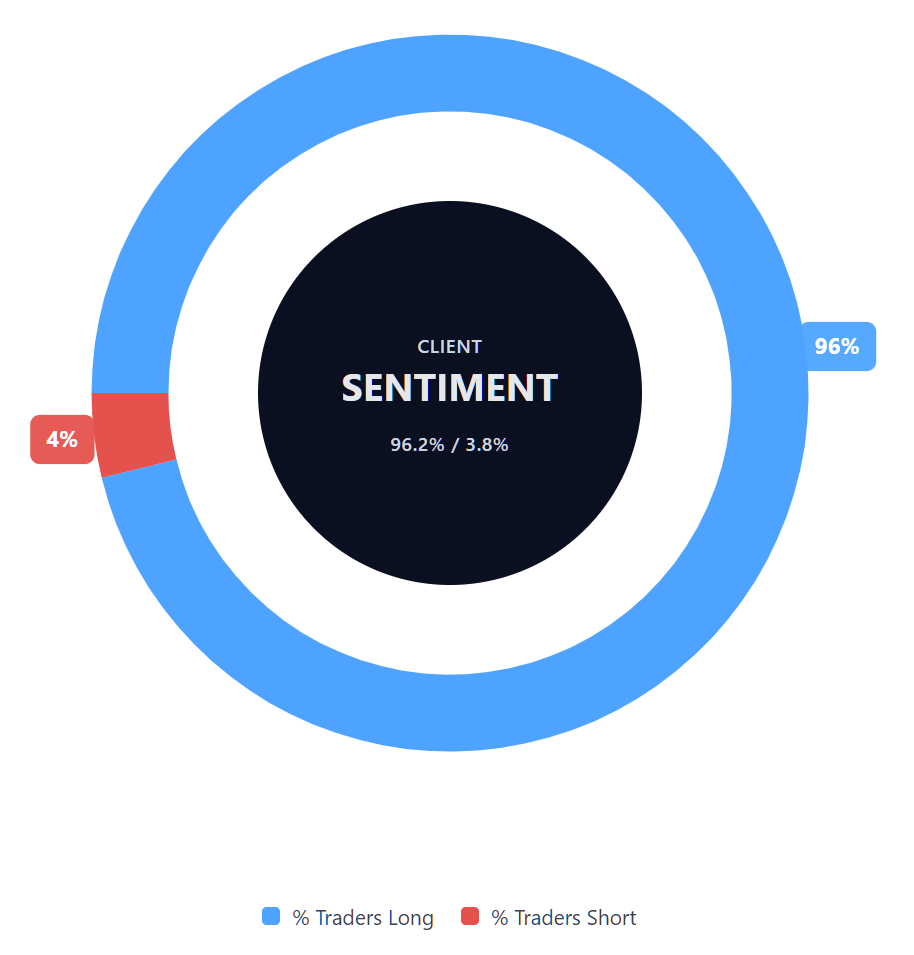
As of 15 January 2026, Capital.com client positioning in Mercedes-Benz Group CFDs shows 96.2% buyers versus 3.9% sellers, indicating a heavily skewed long stance and placing buyers ahead by around 92 percentage points. This imbalance suggests that most open positions are currently aligned with the upside, while a relatively small proportion is positioned on the short side. This snapshot reflects open positions on Capital.com at the time of writing and can change over time.
Summary – Mercedes-Benz stock price
- Mercedes-Benz Group traded mostly between about €50 and €62 during 2025, with dips towards the low-€50s in April and firmer closes around €60–€62 into year-end.
- The share price opened 2025 near €53.10 on 2 January and closed the year at €60.39 on 30 December, reflecting a gradual upward drift over the period.
- In the second half of 2025, MBG generally held within the mid-€50s to low-€60s range, consolidating earlier moves while tracking shifts in auto-sector sentiment and broader macroeconomic conditions.
- Technical readings into January 2026 show price sitting just below a cluster of short-term moving averages around €60–€60.5, while longer-term SMAs near €56–€59 continue to provide underlying reference points.
Past performance is not a reliable indicator of future results.
FAQ
Who owns the most Mercedes-Benz stock?
Mercedes-Benz Group has a diversified shareholder base, with significant holdings split between institutional investors, strategic shareholders and the public free float. Key long-term shareholders have historically included investment funds and state-linked entities, alongside retail investors accessing the stock via European and international listings. Ownership levels can change over time due to portfolio rebalancing, corporate actions and market activity, so published shareholder data should be viewed as a snapshot rather than a fixed structure.
What is the five-year Mercedes-Benz share price forecast?
There is no single, definitive five-year MBG stock forecast. Most publicly available projections focus on shorter horizons, typically around 12 months, and are based on analyst models that reflect assumptions about earnings, margins, auto demand and broader economic conditions. Longer-term outcomes are inherently more uncertain and may be influenced by factors such as technological shifts, regulatory developments, competition and global macroeconomic trends.
Is Mercedes-Benz a good stock to buy?
Whether Mercedes-Benz is considered a 'good' stock depends on an individual’s objectives, risk tolerance and market outlook. Analysts often reference factors such as brand strength, premium positioning and cost-efficiency initiatives, while also highlighting risks linked to cyclical auto demand, electric vehicle investment and regulatory pressures. This information does not constitute investment advice, and market participants typically weigh both potential opportunities and downside risks before making decisions.
Could Mercedes-Benz stock go up or down?
Like any listed share, Mercedes-Benz stock can move both up and down. Price changes may reflect company-specific developments such as earnings results, sales trends or strategic updates, as well as broader influences including economic data, interest-rate expectations and sector sentiment. Short-term movements can also be driven by market positioning and technical factors, meaning outcomes may differ from expectations across different time horizons.
Should I invest in Mercedes-Benz stock?
Deciding whether to invest in Mercedes-Benz stock is a personal decision that depends on individual financial circumstances, objectives and risk appetite. Information on analyst targets, technical levels and historical performance can help provide context, but it does not remove the risk of loss. Market participants typically consider how a company fits within a broader portfolio and risk-management approach before taking exposure.
Can I trade Mercedes-Benz CFDs on Capital.com?
Yes, you can trade Mercedes-Benz CFDs on Capital.com. Trading share CFDs lets you speculate on price movements without owning the underlying asset and to take long or short positions. However, contracts for difference (CFDs) are traded on margin, and leverage amplifies both profits and losses. You should ensure you understand how CFD trading works, assess your risk tolerance, and recognise that losses can occur quickly.