

Daimler Truck Holding stock forecast: Third-party price targets
Daimler Truck Holding’s share price reflects a mix of company-specific developments, conditions in the global commercial vehicle market and broader macroeconomic factors. Explore DTG’s latest price action, third-party price targets and technical analysis.
Daimler Truck Holding (DTG) is trading around €41.16 as of 14 January 2026, 2:11pm UTC, after moving between an intraday low of €39.29 and a high of €41.05 on Capital.com’s platform. This places the price above the earlier session range during relatively active European trading hours. Past performance is not a reliable indicator of future results.
The backdrop includes signs of improving German industrial activity, with official data showing a third consecutive monthly rise in industrial production driven by car manufacturing in November (The Wall Street Journal, 9 January 2026). Germany’s main equity benchmarks have also remained near record levels in early 2026, which may provide a broadly supportive context for large industrial exporters (Reuters, 6 January 2026).
Daimler Truck Holding stock forecast 2026–2030: Third-party price targets
As of 14 January 2026, third-party Daimler Truck Holding stock predictions indicate a range of views on the stock’s potential over the coming 12–18 months. These forecasts reflect differing assumptions around global truck demand, margins and capital returns. As third-party estimates, these targets are indicative, subject to change, and do not represent guidance from Daimler Truck itself.
Morgan Stanley (broker research)
Morgan Stanley lifted its DTG stock prediction to €47 from €46 and reiterated its ‘overweight’ stance, framing DTG as its preferred exposure among global truck manufacturers. The bank cites expectations of weak global truck sales in 2026, particularly in North America, but highlights potential for gradual improvement in Europe. It also references what it describes as a shareholder-return strategy yielding around 8% as part of its broader investment thesis (Investing.com, 13 January 2026).
RBC (broker research)
RBC raised its Daimler Truck price target to €48 from €42, while maintaining a positive fundamental rating on the shares. The move, reported via broker commentary, reflects RBC’s assessment of the company’s positioning within the European commercial vehicle sector, alongside a reassessment of valuation against a changing macroeconomic and interest-rate backdrop (MarketScreener, 12 January 2026).
StocksGuide (consensus snapshot)
A StocksGuide consensus compilation shows an average 12-month DTG stock prediction of around €41, based on 21 analyst estimates. Individual targets range from €30.30 to €55.65, with the spread reflecting differing assumptions around the pace of cyclical normalisation, regulatory impacts and regional demand patterns into 2026 (StocksGuide, 14 January 2026).
Predictions and third-party forecasts are inherently uncertain, as they cannot fully account for unexpected market developments. Past performance is not a reliable indicator of future results.
DTG stock price: Technical overview
The DTG stock price is around €41.16 as of 2:11pm UTC on 14 January 2026, holding above a rising daily moving-average cluster. The 20-, 50-, 100- and 200-day simple moving averages are grouped around €38, €37, €37 and €38 respectively. The 14-day RSI near 73.8 sits in stretched territory, while the ADX around 19 points to a trend that is active but not yet strongly established.
On the topside, the nearest classic pivot resistance is located around €39.21, with €41.10 acting as a higher reference level if the price manages a sustained daily close above the initial barrier. On pullbacks, the classic pivot near €37.08 marks initial support, while the 100- to 200-day SMA band around €37 forms a key shelf. A clean break below this area would risk exposing the S1 region near €35.19 on the Classic framework (TradingView, 14 January 2026).
This technical analysis is provided for informational purposes only and does not constitute financial advice or a recommendation to buy or sell any instrument.
Daimler Truck Holding share price history (2024–2026)
DTG’s stock price has seen a generally upward but uneven path over the past two years. The stock moved from around €31–€32 in early 2024 to approximately €36–€38 by late 2024, as trading stabilised after a softer period in the low-€30s. Through 2025, shares largely traded in the mid- to high-€30s, before a strong move into late July lifted prices above €43 and briefly into the mid-€40s. This was followed by a pullback toward the high-€30s into the year-end.
By 14 January 2026, DTG was trading near €41.16, leaving it modestly above late-2025 levels but still below the highs seen in mid-2025.

Past performance is not a reliable indicator of future results. Share prices are indicative and may differ from live market prices.
Daimler Truck Holding (DTG): Capital.com analyst view
Daimler Truck Holding’s share price over the past two years has been characterised by orderly but sometimes choppy trading, with the stock progressing from the low-€30s in early 2024 into the high-€30s and low-€40s more recently. This pattern points to periods of renewed interest around company-specific and sector developments, alongside phases where broader market sentiment or cyclicality within the industrial and truck sector has weighed on performance. While recent levels near €41 leave DTG below the mid-€40s reached in mid-2025, the shares remain comfortably above 2024 lows, highlighting improved sentiment that remains sensitive to shifts in the macroeconomic and earnings environment.
Looking ahead, key influences for DTG are likely to include trends in global freight demand, interest-rate expectations and company updates on profitability, costs and capital returns. Firmer economic data and resilient orders could support the share price by improving earnings visibility, although rising expectations may also increase the risk of sharper pullbacks if results disappoint. Conversely, slower growth, higher financing costs or sector-specific headwinds could weigh on margins and valuations, while potentially creating periods where some longer-term participants view lower prices as more attractive.
Capital.com’s client sentiment for Daimler Truck Holding CFDs
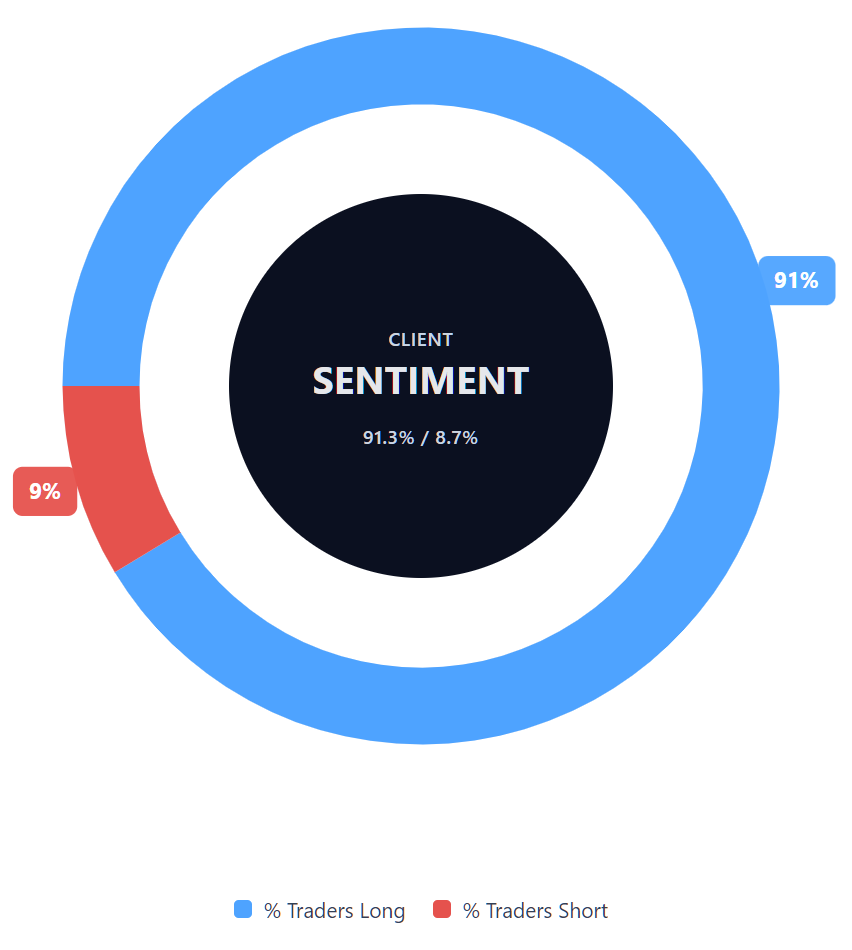
As of 14 January 2026, Capital.com client positioning in Daimler Truck Holding CFDs shows buyers at 91.3% versus sellers at 39.3%, indicating a heavily skewed long bias and a gap of around 52 percentage points. This snapshot reflects open CFD positions on the platform at a specific point in time and may change as traders adjust exposure.
Summary – Daimler Truck Holding stock price
- Daimler Truck Holding traded mainly in the mid- to high-€30s during 2025, with swings into the low-€40s and a brief move above €45 in late July before easing back toward year-end.
- As of 30 December 2025, the share price was around the mid-€37 area, leaving it above early-2025 levels but below the highs reached during the summer rally.
- Technical readings into early 2026 show price holding above key daily moving averages clustered around €37–€38, with a stretched 14-day RSI near 73.8 and an ADX near 19 pointing to active but not firmly established trend conditions.
- Third-party analyst targets compiled in late 2025 and early 2026 generally cluster in the low- to high-€40s, with a wide range reflecting uncertainty around global truck demand, margins and capital-return plans.
Past performance is not a reliable indicator of future results.
FAQ
Who owns the most Daimler Truck Holding stock?
Daimler Truck Holding has a diversified shareholder base, with significant ownership spread across institutional investors, asset managers and index-tracking funds. Large European and global investment firms typically account for the biggest disclosed stakes, reflecting the company’s inclusion in major equity indices. No single shareholder is generally understood to hold a dominant controlling position, meaning the share price tends to reflect broader market sentiment, earnings expectations and sector-wide developments rather than the actions of one investor.
What is the five-year Daimler Truck Holding share price forecast?
There is no single agreed five-year forecast for Daimler Truck Holding’s share price. Longer-term projections vary widely and depend on assumptions about global freight demand, economic growth, regulation, technology investment and capital returns. While some analysts publish shorter-term targets, extending these estimates over five years introduces additional uncertainty. As with all equities, outcomes may differ materially from forecasts, and long-term projections should be treated as indicative rather than predictive.
Is Daimler Truck Holding a good stock to buy?
Whether Daimler Truck Holding is considered attractive depends on individual objectives, risk tolerance and market outlook. Analysts often point to factors such as market positioning, margins and shareholder returns, while also highlighting exposure to cyclical demand, regional trends and cost pressures. Share prices can reflect both positive developments and setbacks over time. This information is not investment advice, and any assessment should be based on independent research and personal circumstances.
Could Daimler Truck Holding stock go up or down?
Daimler Truck Holding’s share price can move higher or lower in response to company updates, earnings results, macroeconomic data and changes in the commercial vehicle cycle. External factors such as interest rates, freight activity and regulatory developments may also influence performance. Short-term price movements can be volatile, while longer-term trends often reflect evolving expectations about demand, profitability and capital allocation. Past price behaviour does not reliably indicate future outcomes.
Should I invest in Daimler Truck Holding stock?
Deciding whether to invest in Daimler Truck Holding involves weighing potential opportunities against risks, including economic sensitivity and sector-specific challenges. This article provides market context and third-party views but does not offer a recommendation. Investing decisions should reflect your financial situation, time horizon and understanding of equity market risks. If you are unsure, you may wish to seek independent financial advice before committing capital to any single stock.
Can I trade Daimler Truck Holding CFDs on Capital.com?
Yes, you can trade Daimler Truck Holding CFDs on Capital.com. Trading share CFDs lets you speculate on price movements without owning the underlying asset and to take long or short positions. However, contracts for difference (CFDs) are traded on margin, and leverage amplifies both profits and losses. You should ensure you understand how CFD trading works, assess your risk tolerance, and recognise that losses can occur quickly.