

Credit Agricole stock forecast: Third-party price targets
Credit Agricole’s share price is shaped by a mix of company-specific decisions and wider forces affecting the European banking sector.
Daily price movements, longer-term trends and positioning by market participants all provide different perspectives on how the stock is behaving at a given point in time.
Credit Agricole (ACA) is trading around €17.45 as of 9:53am UTC on 9 January 2026, moving within an intraday range between €17.40 and €17.57 on Capital.com’s platform. Past performance is not a reliable indicator of future results.
The move comes amid a firmer backdrop for French equities, with France’s main stock market benchmark (FR40) trading above 8,300 points on 9 January 2026 and showing gains over both the past month and year (Trading Economics). At the same time, European bank shares have remained supported by higher interest rates and generally solid sector earnings (Euronews, 13 December 2025). Recent corporate developments at Credit Agricole have centred on capital allocation and governance, including board changes and liquidity-contract adjustments disclosed on Euronext in December 2025 (Euronext, 19 December 2025), alongside ongoing media coverage of the group’s Italian strategy and its stake in Banco BPM (Reuters, 11 December 2025).
Credit Agricole stock forecast 2026–2030: Third-party targets
As of 9 January 2026, third-party Credit Agricole stock predictions point to a relatively clustered range of 12-month price targets for Credit Agricole (ACA), with most published benchmarks for late 2025 and early 2026 sitting moderately above the current market price. These figures typically aggregate views from European and global banks covering the stock and are updated periodically as new financial results and strategic guidance are incorporated.
MarketScreener (consensus snapshot)
MarketScreener provides an early-January 2026 analyst consensus for Credit Agricole, with an average 12-month target price of around €18.77, based on 16 analysts. Individual targets span roughly €14.50 to €22.49. The service reports an ‘Outperform’ mean recommendation, framing the gap to the last close as a mid-single-digit percentage, against a backdrop of broadly constructive views on earnings and capital return following the group’s medium-term strategy update (MarketScreener, 9 January 2026).
Investing.com (broker poll)
Investing.com’s consolidated broker poll shows an average 12-month target for Credit Agricole around the €18.77 range, with a €22.49 maximum and €14.50 minimum estimate, based on input from around 16 analysts. The platform attributes this dispersion to differing assumptions around net interest income, fee income resilience and Italian exposures, as banks adjust forecasts to reflect shifting rate expectations and group-level profitability targets (Investing.com, 9 January 2026).
TipRanks (Wall Street coverage)
TipRanks summarises coverage of ACA stock forecasts with an average €18.13 12-month target, based on a sample of four US-aligned analysts and a stated range between €16.50 and €19. These estimates are presented alongside assumptions of stable asset quality and capital ratios, while also noting that macroeconomic or regulatory changes could alter earnings trajectories and valuation multiples (TipRanks, 9 January 2026).
UBS (broker review)
UBS reiterates a 12-month ACA stock forecast of €18, maintaining its stance after the bank’s presentation of the ACT 2028 strategic plan and associated financial objectives. The broker cites projected net income of €8.5 billion and a return on tangible equity above 14% by 2028 as supportive factors amid planned investment and restructuring across business lines (MarketScreener, 19 November 2025).
Past performance is not a reliable indicator of future results. Third-party targets and forecasts are inherently uncertain and may not materialise, as they rely on assumptions that can change without notice.
ACA stock price: Technical overview
The ACA stock price is trading near €17.45 as of 9:53am UTC on 9 January 2026, holding just above the daily pivot at €17.23 and remaining within the intraday range between €17.40 and €17.57 on Capital.com’s feed. On the daily chart, the cluster of simple moving averages is gradually rising, with the 20-, 50-, 100- and 200-day SMAs located around €17.46, €16.71, €16.55 and €16.45 respectively. This places the price slightly above short-term trend measures and comfortably above longer-term support. The 14-day RSI sits near 57, within an upper-neutral zone, while an ADX reading around 38 points to an established trend rather than a range-bound market.
On the upside, the nearest classical resistance lies around R1 at €17.99, with R2 near €18.42 coming into focus only if the price achieves a sustained daily close above the first pivot level. On pullbacks, initial support aligns with the €17.23 pivot, followed by the 200-day SMA near €16.45 as a key longer-term reference. Below that, S1 around €16.80 becomes the next downside level if the broader moving-average band were to give way on a closing basis (TradingView, 9 January 2026).
This technical analysis is provided for informational purposes only and does not constitute financial advice or a recommendation to buy or sell any instrument.
Credit Agricole share price history (2024–2026)
The ACA stock price has risen steadily over the past two years, The stock traded around €13.07 in mid-January 2024 and ended that year near €13.40, before advancing through 2025 via a series of measured rallies and periodic pullbacks that lifted prices. By 8 January 2026, Credit Agricole closed at approximately €17.57, leaving it well above its levels one and two years earlier on Capital.com’s data.

Past performance is not a reliable indicator of future results. Share prices are indicative and may differ from live market prices.
Credit Agricole (ACA): Capital.com analyst view
Credit Agricole’s share price movements in 2024–2026 have coincided with solid reported profitability and capital buffers at group level, as reflected in Credit Agricole’s 2025 quarterly updates. At the same time, periods of earnings disappointment and cost pressures have triggered short-term pullbacks, underlining that bank stocks can react sharply to even modest changes in expectations.
From a broader sector perspective, eurozone banks have benefited from relatively high policy rates, solid returns on equity and elevated payout plans, with European bank indices posting one of their stronger annual performances in 2025. However, official stability reports and ECB surveys have also highlighted risks linked to weaker loan demand, pressure on net interest margins as rate cycles evolve, and potential asset-quality challenges if economic growth slows. These cross-currents mean that factors supporting Credit Agricole’s valuation today could also weigh on the shares if conditions reverse, prompting traders to consider both bank-specific developments and the wider policy environment when assessing price action. Past performance is not a reliable indicator of future results.
Capital.com’s client sentiment for Credit Agricole CFDs
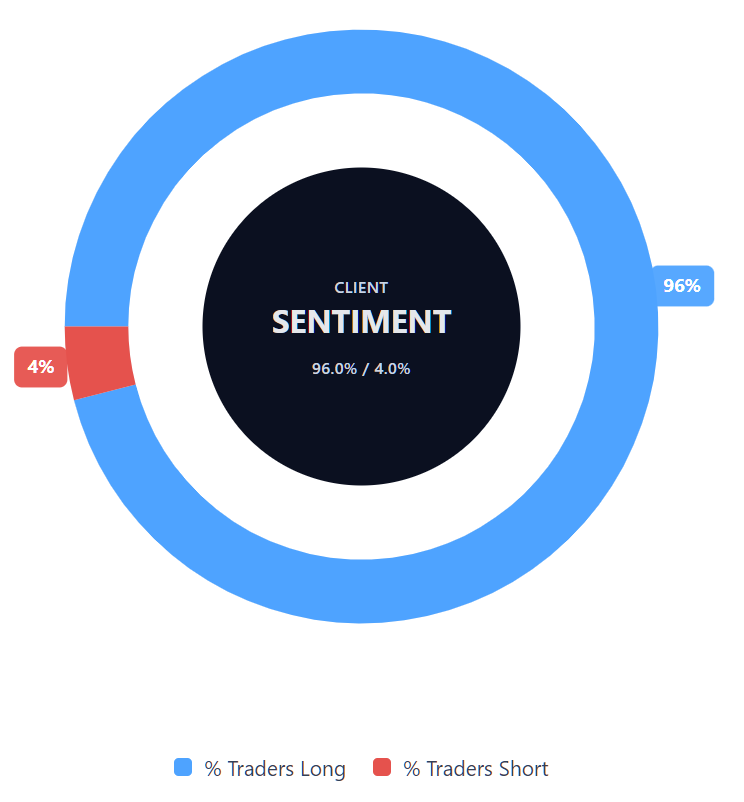
As of 9 January 2026,Capital.com client positioning in Credit Agricole CFDs remains strongly one-sided, with buyers accounting for around 96% of open positions compared with 4% sellers, leaving a 92-percentage-point gap in favour of long positions in the latest snapshot. This reflects a pronounced long bias among current CFD positions, while not providing any indication of how the price may move in future. This snapshot reflects open positions on Capital.com and can change over time.
Summary – Credit Agricole price 2026
- Technical indicators into late 2025 showed the price trading above rising 50-, 100- and 200-day moving averages, with RSI in an upper-neutral range and ADX signalling an established trend rather than a sideways market.
- From a sector standpoint, eurozone banks, including Credit Agricole, benefited from higher interest rates and solid profitability in 2025, although official commentary also highlighted risks related to credit quality, funding costs and slower loan growth.
Past performance is not a reliable indicator of future results.
FAQ
Who owns most of Credit Agricole stock?
Credit Agricole has a broad and diversified shareholder base, which is typical of large European banks. A significant portion of the group is owned indirectly through its regional cooperative banks, which form the foundation of its ownership structure. Beyond this, shares are held by institutional investors such as asset managers and pension funds, alongside retail shareholders. No single external investor is known to hold a controlling stake, which helps spread governance influence across multiple parties.
What is the five-year Credit Agricole share price forecast?
There is no single, definitive five-year forecast for Credit Agricole’s share price. Longer-term projections vary widely between analysts and institutions, reflecting different assumptions around interest rates, economic growth, regulation and credit quality. Forecasts beyond 12 months are inherently uncertain and are revised as conditions evolve. As a result, longer-term outlooks are best viewed as scenario-based assessments rather than specific price expectations.
Is Credit Agricole a good stock to buy?
Whether Credit Agricole is considered 'good' depends on an individual’s objectives, risk tolerance and time horizon. The bank operates in a sector influenced by interest rates, regulation and economic cycles, which can support or weigh on performance at different times. While analysts publish price targets and recommendations, these are third-party opinions rather than guarantees. Assessing the stock typically involves weighing potential returns against sector-specific and macroeconomic risks.
Could Credit Agricole stock go up or down?
Yes. Like all publicly traded shares, Credit Agricole’s stock price can move both higher and lower. Price movements may be influenced by company earnings, capital decisions, interest-rate expectations, broader banking-sector trends and macroeconomic developments. Market sentiment and global events can also affect short-term fluctuations. These factors mean outcomes are uncertain, and past price performance does not indicate future behaviour.
Should I invest in Credit Agricole stock?
Deciding whether to invest in Credit Agricole is a personal decision that depends on individual financial circumstances, objectives and risk appetite. Bank shares can be sensitive to economic, regulatory and policy changes, and prices may fluctuate significantly. Information such as analyst targets, financial results and sector trends can provide context, but do not constitute investment advice. Individuals often consider seeking independent professional advice before making investment decisions.
How can I trade Credit Agricole CFDs on Capital.com?
You can trade Credit Agricole CFDs (contracts for difference) on Capital.com, which allows speculation on price movements without owning the underlying shares. CFDs let you on rising and falling prices, depending on your outlook. However, CFDs also involve margin, and leverage amplifies both profits and losses.