
Siemens Energy stock forecast: Third-party price targets
Siemens Energy AG is a Germany-based energy technology company listed in Frankfurt, supplying equipment and services across power generation, grids and energy-transition projects. Explore third-party ENR price targets and technical analysis.
Siemens Energy AG (ENR) is trading around €143.51 in early European dealings on 2 February 2026, within an intraday range of approximately €139.56–€145.90 on Capital.com’s platform as of 10:42am UTC. Past performance is not a reliable indicator of future results.
Price action comes amid follow-through from Siemens Energy’s fiscal-year 2025 results, where the company reported revenue of about €39.1bn, a markedly improved profit margin before special items of roughly 6.0%, and record quarterly revenue of around €10.4bn in the fourth quarter, alongside a substantial order backlog near €138bn (Siemens Energy, 14 November 2025). The stock is also trading ahead of the company’s scheduled first-quarter fiscal 2026 results release on 11 February 2026 and in advance of its in-person Annual Shareholders’ Meeting set for 26 February 2026 in Berlin, events that may influence liquidity and news flow around the name (Siemens Energy, 2 February 2026).
Siemens Energy stock forecast 2026–2030: Third-party price targets
As of 2 February 2026, third-party Siemens Energy stock predictions outline indicative levels and valuation assumptions for the stock. The following third-party views focus on January–February 2026 publications where available.
Deutsche Bank Research (broker research)
Deutsche Bank Research raised its ENR stock forecast to €170 per share from €135 and maintained a positive rating, pointing to what it describes as improved fundamentals and a stronger earnings outlook. The bank cites a more favourable view of the company’s order pipeline and profitability, set against continued demand for grid and energy-transition infrastructure, as key factors behind the higher valuation marker (MarketScreener, 29 January 2026).
Stockscan.io (consensus-style forecast)
Stockscan.io reports that analysts covering Siemens Energy’s US-traded line SMEGF have an average 12-month price target around $30.06, with individual estimates ranging from about $24.29 to $35.83. The service notes that these figures imply downside from the then-prevailing share price and frames the targets as reflecting divergent expectations around future performance amid uncertainty, while emphasising that such forecasts are not guarantees (Stockscan.io, 2 February 2026).
Simply Wall St (consensus snapshot)
Simply Wall St highlights a consensus analyst price target of about €83.76 for Siemens Energy as of, based on its collation of broker models focused on expected earnings growth and profitability. The platform notes that this target reflects analysts’ attempts to balance an improved operational trajectory with valuation considerations and ongoing execution risks across parts of the business (SImply Wall St, 13 January 2026).
Jefferies (broker research)
Jefferies raised its Siemens Energy target price to €164 from €134 while reiterating a buy rating. The analyst points to improved earnings visibility, alongside supportive sector dynamics linked to grid investment and energy-transition spending, as justification for the higher target range (MarketScreener, 2 February 2026).
UBS (broker research)
UBS reverses a previous bearish stance and upgrades Siemens Energy, raising its price target to €175 per share from €38. The bank says the move reflects a reassessment of the company’s solvency and cash-flow profile, following recent operational improvements, amid what it characterises as structural demand for grid and energy-transition equipment (Bloomberg, 23 January 2026).
Predictions and third-party forecasts are inherently uncertain, as they cannot fully account for unexpected market developments. Past performance is not a reliable indicator of future results.
ENR stock price: Technical overview
On the daily chart, ENR’s stock price is trading around €143.51 as of 10:42am UTC on 2 February 2026, holding well above its short- and medium-term moving-average band, with the 20-, 50-, 100- and 200-day simple moving averages clustered near €135, €124, €113 and €100 respectively, maintaining a 20-over-50 alignment. The 14-day RSI, at around 71.9, sits in a stretched zone, while the ADX near 33 points to an established trend, suggesting sustained momentum while price remains above the broader moving-average structure.
On the topside, the nearest classic resistance sits around the R1 pivot at roughly €155.9, with a sustained daily close above that level bringing the R2 zone near €167.2 into focus as the next reference. On pullbacks, initial support lies around the classic pivot near €138.1, with the 100-day SMA around €113 marking a more substantial moving-average shelf and S1 near €126.8 acting as a deeper level if the pivot area gives way on a daily closing basis (TradingView, 2 February 2026).
This technical analysis is provided for informational purposes only and does not constitute financial advice or a recommendation to buy or sell any instrument.
Siemens Energy share price history (2024–2026)
The ENR stock price has undergone a pronounced turnaround over the past two years, rising from around €13.85 at the start of February 2024 to about €143.90 by 2 February 2026 on the Xetra exchange. The stock spent much of 2024 trading below €30, with prices near €24–€27 in mid-2024 and a year-end level of roughly €50.25 on 30 December 2024. By early 2025, ENR was still below €60, but momentum began to build from the spring, with the price moving into the €80–€110 range between June and November 2025 before advancing above €120 in December.
Momentum extended into 2026, with the share closing at about €123 on 2 January and continuing higher through January, moving from roughly €125–€136 in the first half of the month to above €140 by 23 January. Into late January and early February 2026, the price has been consolidating at higher levels, with daily prices mostly in the low-to-mid €140s and an intraday high near €149.65 on 29 January 2026, leaving ENR significantly higher on a year-on-year basis as of 2 February 2026.

Past performance is not a reliable indicator of future results. Share prices are indicative and may differ from live market prices.
Siemens Energy (ENR): Capital.com analyst view
Siemens Energy’s share price has recovered sharply over the past two years, moving from double-digit levels below €20 in early 2024 to trading around €143.51 as of 10:42am UTC on 2 February 2026 on Capital.com’s platform. This move has coincided with stronger reported financial performance, including double-digit comparable revenue growth, record order intake and an upgraded mid-term outlook through 2028, alongside a proposed dividend for fiscal year 2025. At the same time, the pace and scale of the advance mean current levels reflect elevated expectations around execution and the broader energy-transition theme, leaving scope for sharper pullbacks should delivery falter or risk sentiment shift.
From a fundamental perspective, the stock sits at the intersection of several structural drivers, including demand for grid and energy-transition infrastructure, management’s efforts to improve margins and cash flow, and ongoing work to address challenges in the legacy wind business. Supportive factors such as record orders and upgraded guidance may underpin confidence, yet persistent issues in onshore wind, potential project risks and wider macro uncertainty remain relevant considerations for valuation.
Capital.com’s client sentiment for Siemens Energy CFDs
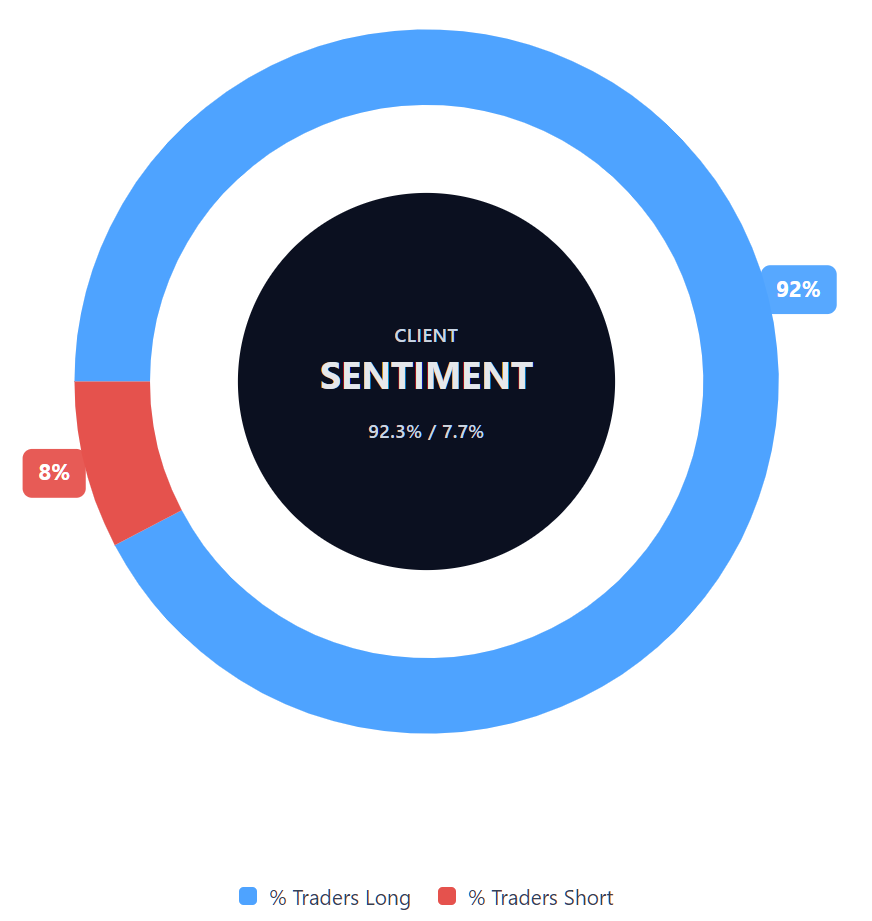
As of 2 February 2026, Capital.com client positioning in Siemens Energy CFDs is currently skewed toward long positions, with buyers accounting for 92.3% of open trades versus sellers at 7.7%, a difference of 84.6 percentage points. This reading indicates a pronounced imbalance in positioning rather than a broadly even distribution. This snapshot reflects open positions on Capital.com only and can change over time as clients open and close trades.
Summary – Siemens Energy 2026
- Siemens Energy’s share price rose from below €20 in early 2024 to trade around €143.51 as of 2 February 2026, marking a sharp multi-year recovery.
- In 2025, the stock trended higher from roughly €50 at the end of 2024 into an €80–€110 range by mid-year, before moving above €120 in December.
- Technical indicators show ENR trading well above its clustered 20-, 50-, 100- and 200-day SMAs, with a stretched 14-day RSI near 71.9 and an ADX around 33 pointing to an established trend.
- Classic pivot analysis places initial support near €138.1, with deeper reference levels around the 100-day SMA close to €113, while resistance levels sit near €155.9 and €167.2.
- Recent fundamental themes include stronger reported revenue growth, record order intake and upgraded medium-term guidance linked to grid and energy-transition demand, balanced against ongoing execution risks and challenges within the wind business.
Past performance is not a reliable indicator of future results.
FAQ
Who owns the most Siemens Energy stock?
Siemens Energy has a widely distributed shareholder base, with ownership spread across institutional investors, asset managers and retail shareholders. Large global investment firms and pension funds feature among the largest holders, while Siemens AG also retains a significant strategic stake. Ownership levels can change over time as institutions rebalance portfolios and as shares trade on the open market. Public filings and regulatory disclosures generally offer the most up-to-date insights into major shareholdings.
What is the five-year Siemens Energy share price forecast?
There is no single, reliable five-year ENR stock forecast, as long-term projections depend on assumptions around earnings, margins, capital investment and broader market conditions. Most publicly available forecasts focus on shorter horizons, such as 12 months, and can vary considerably. Over longer timeframes, outcomes may be influenced by execution on grid and energy-transition projects, developments in the wind business, policy support and macroeconomic factors, many of which are inherently uncertain.
Is Siemens Energy a good stock to buy?
Whether Siemens Energy represents a suitable stock depends on individual circumstances, objectives and risk tolerance. The company operates in sectors linked to long-term infrastructure and energy-transition themes, which some market participants consider supportive over time. At the same time, the share price has already risen sharply, and challenges related to project execution, profitability and sector volatility remain relevant. Any assessment should weigh both potential opportunities and risks rather than relying solely on recent performance.
Could Siemens Energy stock go up or down?
Siemens Energy’s share price can move higher or lower, as it remains sensitive to company-specific developments and broader market conditions. Factors such as earnings updates, order intake, guidance changes, project developments and shifts in investor sentiment can influence price movements. External elements, including interest rates, energy policy and global risk appetite, may also play a role. As with any equity, past price movements do not determine future outcomes.
Should I invest in Siemens Energy stock?
Yes, you can trade Siemens Energy CFDs on Capital.com. Trading share CFDs lets you speculate on price movements without owning the underlying asset and to take long or short positions. However, contracts for difference (CFDs) are traded on margin, and leverage amplifies both profits and losses. You should ensure you understand how CFD trading works, assess your risk tolerance, and recognise that losses can occur quickly.