
Eni stock forecast: Venezuela production deal
Eni is an Italian energy company. In September 2026, it signed a 25-year agreement with Venezuela's PDVSA covering production at the Junín 5 heavy-oil field. Explore third-party ENI price targets and technical analysis. Past performance is not a reliable indicator of future results.
Eni S.p.A. (ENI) last traded around €23.94 in early European trading at 9:33am UTC on 9 September 2026, after moving within a reported intraday range of €23.19–€23.93. Past performance is not a reliable indicator of future results.
The move coincided with Brent crude trading near $97–$98 a barrel as renewed US–Iran military exchanges reduced tanker traffic through the Strait of Hormuz (Reuters, 7 September 2026). Eni's own newsflow included second-quarter results and a 25-year production-sharing agreement with Venezuela's PDVSA covering the Junín 5 heavy-oil field (MarketScreener, 2 September 2026). Analysts said the agreement could improve Eni's prospects of recovering more than $2.3bn owed by Venezuela (Reuters, 4 September 2026). Eni and Malaysia's Petronas also agreed on 7 September to explore a high-performance bio-gasoline for motorsport use (Reuters, 7 September 2026).
Third-party Eni outlook: Venezuela deal and oil prices in focus
As of 9 September 2026, third-party Eni stock predictions show a range of forecasts, reflecting differing views on crude prices, the company's buyback programme and its Venezuela agreement. These are third-party forecasts rather than Capital.com recommendations.
Berenberg (broker price target)
Berenberg raised its Eni price target to €25.50 from €22 while maintaining a neutral rating. The revision cited progress in Eni's satellite-company strategy and its potential role in portfolio optimisation (MarketScreener, 20 August 2026).
RBC Capital Markets broker price target)
RBC Capital maintained its hold rating on Eni and kept its €28 price target as part of a wider period of broker updates on the stock (The Globe and Mail, 4 September 2026).
Barclays (broker price target)
Barclays raised its Eni price target to €29.50 from €28.50 while maintaining an overweight rating. The update cited the company's earnings trajectory and capital-return plans (Ad-Hoc News, 4 September 2026).
Morgan Stanley (broker price target)
Morgan Stanley raised its Eni price target to €23.80 from €22 while maintaining an equal-weight rating. The revision formed part of wider European energy-sector updates following improved near-term earnings visibility (Yahoo Finance, 4 September 2026).
MarketScreener (multi-broker consensus)
MarketScreener's 22-analyst consensus shows an average 12-month target of €25.45 and a mean rating of outperform, with estimates ranging from €19–€30. The range reflects differing assumptions around earnings and valuation (MarketScreener, 8 September 2026).
Predictions and third-party forecasts are inherently uncertain, as they cannot fully account for unexpected market developments. Past performance is not a reliable indicator of future results.
ENI stock price: technical overview
As of 9:33am UTC on 9 September 2026, the ENI stock price trades at €23.94, close to its 20-day simple moving average and above its 50-, 100- and 200-day averages, at roughly €24, €23, €23 and €21 respectively, according to TradingView. With the shorter-term averages close to the latest price, they provide limited directional indication on their own.
The 14-day relative strength index (RSI) stands near 56.6, while the average directional index (ADX) is near 16.6, indicating relatively limited trend strength.
The classic R1 pivot near €24.43 is the nearest higher reference, followed by R2 near €25.55. Below the latest price, the classic pivot stands near €23.53, followed by the 100-day simple moving average near €22.77 and S1 near €22.41 (TradingView, 9 September 2026).
A move through higher levels could shift attention upwards, while a decline through lower references could bring further support levels into focus. These are technical reference points rather than predictions.
This is technical analysis for informational purposes only and does not constitute investment advice or a recommendation to buy or sell any instrument.
Eni share price history (2024–2026)
ENI’s stock price rose from around €13.79 on 10 September 2024 to €23.94 on 9 September 2026, an increase of roughly 74%.
The stock traded mainly around €13–€14 in late 2024 and early 2025 before falling to a two-year low of €11.28 on 9 April 2025, coinciding with a wider market sell-off following US tariff announcements. It then recovered through the second half of 2025, ending the year at €16.18.
In 2026, Eni rose from €16.44 on 2 January to a two-year high of €24.85 on 7 April, during a period of higher earnings and crude prices. Shares fell to €20.79 on 10 July before recovering in September alongside Eni's Venezuela agreement and higher oil prices.
Eni closed at €23.94 on 9 September 2026, approximately 45.6% higher year to date and 59.6% higher year on year.
Past performance is not a reliable indicator of future results. Share prices are indicative and may differ from live market prices.
Eni (ENI): Capital.com analyst view
Higher earnings, an expanded buyback and elevated crude prices may support sentiment towards Eni, while weaker oil prices or execution risks on overseas projects could weigh on it.
Brent's rise towards the high $90s a barrel may support oil producers, while geopolitical de-escalation, weaker demand or increased supply could push prices lower and reduce that support (Reuters, 7 September 2026). Eni's buyback may also support demand for its shares while it remains in place, although the programme can change with cash-flow conditions (Eni, 29 July 2026).
Capital.com’s client sentiment for Eni CFDs
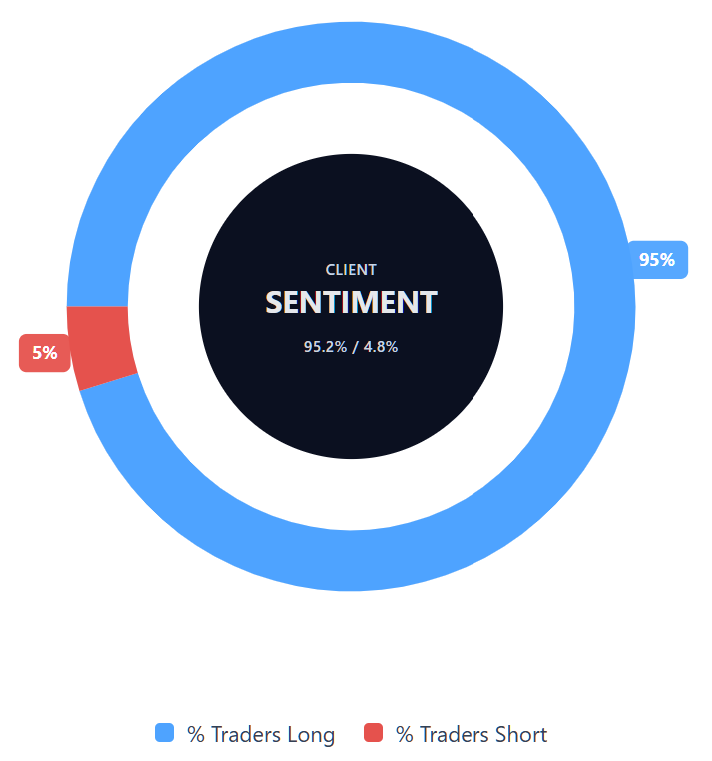
As of 9 September 2026, Capital.com client positioning in Eni CFDs is weighted towards long positions, with 95.2% long and 4.8% short. This shows the balance of open positions at the time of measurement rather than indicating future price direction, and the figures can change
Summary – Eni 2026
- As of 9:33am UTC on 9 September 2026, Eni traded near €23.94, within a reported intraday range of €23.19–€23.93.
- According to TradingView data, the share price was around its 20-day moving average and above its 50-, 100- and 200-day averages, with RSI near 56.6 and ADX near 16.6.
- Key factors include Brent crude near $97–$98 a barrel, alongside Eni's earnings and buyback activity.
- Higher oil prices or stronger company execution may support sentiment, while weaker crude prices or project risks could weigh on it.
- Recent developments include Eni's Venezuela production-sharing agreement, second-quarter results and bio-gasoline agreement with Petronas.
Past performance is not a reliable indicator of future results.